New Twenty Palaces Novella Coming Soon

Standard

I’ve been talking about this here and there, so let’s hit the topic one more time, but with art.

The new Twenty Palaces novella, The Twisted Path, will be released soon. I just got the copyedit back, so sometime in the next few days, I guess? Being a novella, it’ll be ebook only, and I hope you’ll buy yourself a copy for Christmas.

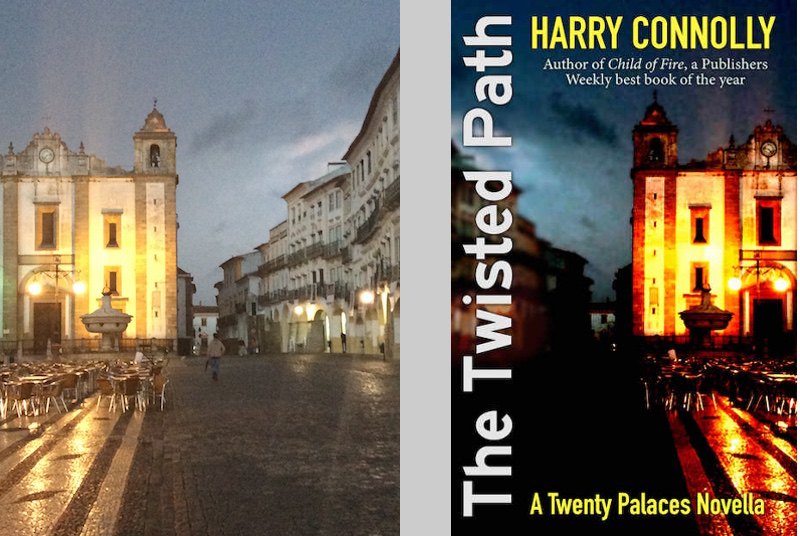
Here’s the photo the cover was created from and the original.

My wife took that picture in the public square in Evora, Portugal. My son adjusted the image (in GIMP) and I did the text. I’m pretty happy with it.

And I’m pretty happy with The Twisted Path too. I’ve come at this story several times over the last few years. It was only this last effort where I feel I “solved” the story.

Of course, you guys will be the final judge of that.

If you want to hear about the novella as soon as it’s released, sign up for my newsletter right there in the sidebar.

Seeing the Forest for the Algorithm: a Review of Past Edit Notes and a Hard Truth

Standard

In which the author makes an embarrassing confession

One of my little secrets is that, in between projects, I’ll sometimes read a book about writing. It’s always useful to reinforce the basics, and seeing how other writers approach the blank page gives me insights into my own work.

Sometimes I get the impression that I’m supposed to be past all that, but I’m not. I’ve never really felt that I’ve mastered this craft. Some aspects of it, maybe, but I still struggle.

And since I’m brainstorming something new, I took another writer’s casual mention of his favorite book about writing, Stephen King’s On Writing, and borrowed it from the library. I had barely started when I heard a discussion of a different book over the radio. You can listen to that here, if you really feel you have to. It’s not an interview with either of the authors, and the interviewee’s Wired article is more interesting and informative with fewer dopey questions.

The book is The Bestseller Code by Jodie Archer and Matthew Jockers. Maybe you remember when it came out last year, or maybe the title is enough to guess what the book’s about. The authors created an algorithm to analyze a variety of modern novels, then ran all sorts of books through them: bestsellers, non-bestseller, midlist books, self-published, the whole deal. The algorithm noted the differences, then sorted out the ones that were strongly predictive of bestsellers. According to the authors, their “bestseller-ometer” was capable of predicting whether a book would be a bestseller with 80% accuracy.

It’s correlation, sure, but the authors found nearly 2800 factors that were present in books that made the NY Times list but not present in the ones that didn’t. Yes, the NYT has issues with the ways it manages it’s list and it’s not a true sales meritocracy, but it is a powerful cultural signifier, and Archer, a former Penguin UK editor, wanted to better understand the differences.

The Bestseller Code is an exercise in finding meaning in those differences.

I don’t know if you remember when the book came out last year, but I do. I scoffed at it. Computer analysis? Of a creative endeavor? Please.

But that interview, flawed as it was, piqued my interest, so I borrowed a copy from the library.
It turned out to be interesting stuff.

What we talk about when we talk about luck

First, I want to say that the technology Archer and Jockers deployed—sentiment analysis, topic modeling, and more—was pretty impressive. The field is more advanced than I would have guessed.

Second, it turned out that the way they applied those tools, and the conclusions they drew from them, were entirely unremarkable. (Bolded because I want folks to take note.)

It’s common for folks to talk about success in the arts as part skill, part talent and part luck. I’ve talked at length on this blog about my opinion of “talent”, and at a little less length about “luck.” The effects of luck have been proven experimentally.

My question is always: what are they calling “luck”? What confluence of choices and incidents brought about this fortunate outcome? Because, to me, “luck” is what you call a series of events you don’t understand well enough to predict or control.

But what if we had the tools to look at things more closely? What if we had a better understanding of the differences between what people want to read and what we’re offering? What if we could narrow that gap?

Data doesn’t frighten me. Nihil veritas erubescit.

Besides, I’m a published writer with starred reviews and even, if you can believe it, fans. I already have the skills I need to break through to a larger readership, don’t I?

This is where my agent comes in

As I was reading The Bestseller Code, I kept thinking My agent could have written this.
Let me take an example. Using topic modeling, the algorithm breaks down what each book is “about.” Maybe a certain percentage might be concerned with crime and police work, and a smaller percentage for domestic matters. The next smallest percentage would concern, say, hospitals and medical concerns.

It seemed weird to me that algorithms are sophisticated enough to manage this task until I remembered Pat Rothfuss talking about programs that could handle the task five years ago.

Anyway, the books that sold well had fewer topics (around four), and those topics offered opportunities for dramatic contrast. Books that didn’t sell as well had more topics (around six, if I remember correctly). The subjects were more wide-ranging, less unified.

What’s more, one of the most important predictors of success was that a book devoted a certain amount of time to human interaction and connectedness. If one of the four topics was characters being with the people they cared about, living their lives and dealing with each other, that was a strong indicator of good sales.

Guys, my agent has been trying to teach me these lessons for years. For my whole career, I’ve been trying to establish relationships between characters the way a movie would: with a single, significant gesture or remark. She has been telling me, book after book, to give them more time on the page. To let them relate to each other. To let them bond. It turns out that human interaction in fiction is incredibly powerful, and I’ve been giving it short shrift.

She has also told me—many times—that I need to simplify. Often times I have too many storylines, plot turns, or characters. Especially characters. Too many “topics.” Maybe my work would reach a larger audience if it was more unified.

Another thing the algorithm does is generate plot curves through sentiment analysis. When the language of the book is full of upbeat words, like succeed, kindness, rest, and peace, the plot trends upwards. When it’s full of words like loss, failed, grief, and pain, it trends downward.

What surprised me is that, when the algorithm studied bestsellers, it produced plot curves very similar to the ones writers see all the time. One is quite similar to Freytag’s Pyramid; others matched different but fairly common models.

I’ll admit that I was startled to see a computer pull the old tried-and-true plot diagrams out of bestselling books, and how non-bestsellers seemed so flat. It made me question how well I manage the rise and fall of a plot curve and whether the language I use is appropriate for it.

There were other findings beyond those, obviously. The data was all descriptive, and it covered books that were popular but critically derided as well as popular but prize-winning. Except for a few surprises, like the need for scenes of human connection and a general distaste for sex (::shakes fist at America::) it’s standard stuff. Create a character who really wants something. Have them go after it. Make the plot turns powerful. Keep things focused. Write in a naturalistic style. Hook them in the first few pages.

Honestly, my agent could have written this advice, and as I was coming to the end of the book, it occurred to me that she sort of already had.

In which I step back from my edit notes to examine my edit notes

Just last week, my agent got back to me about a book I’d sent her. The news was bad, I don’t mind admitting, and of course she had some notes to give me.

As I was thinking about how closely the advice in Archer’s and Jocker’s book matched what my agent told me, I got the idea to go back through all her editorial notes for all of my books and look for patterns.

I’ve been happy to take her input—I signed with her, in part, because I knew she’d help make my work better—but I’ve been looking at them case by case. Book by book. It never occurred to me to look for trends.

To be fair, there was usually a year in between each new book, and sometimes more, and I’m a forgetful, disorganized person. It’s easy for me to carefully study a bunch of trees without once considering the forest.

So I opened all my old emails from my agent to review the notes she’d given me. My first thought was that past-me really needed to be more practical with his subject lines. My second thought was that I’d always thought of myself as a slam-bang thriller writer, a guy who could spin out an exciting story. It occurred to me that I wasn’t being exciting enough, because that self-conception wasn’t matched by outside reality. The work I was doing was earning fans and selling books (by my estimation, The Way into Chaos, which was self-published, has sold a little over 13k copies, which would be a fine, fine number for most NY genre publishers) but I wasn’t breaking through to the larger world.

What if I had placed myself in the “Good But Not Good Enough” category, and was missing out because I wasn’t really addressing persistent flaws in my creative choices?

So what were those persistent flaws? Obviously, each book had its unique problems, but there were several that popped up over and over.

Here they are:

  • Book started too slowly
  • Too many characters/plot complications/names
  • Characters not sympathetic enough/don’t have time for personal bonding

The hook must come sooner. More unity. More time for the characters’ relationships.

Honestly, I thought I’d already learned all the skills The Bestseller Code suggested I would need. I thought I was already working at that level. It’s pretty clear that I’m not.

The nice thing is that I’ll have a chance to be mindful of these persistent issues as I start a new book. Will it help? Shit, I hope so. I have ambitions, you guys, and I’m not meeting them.

My agent will still have notes for me, but maybe she won’t have to tell me the same old things she’s had to tell me every other time.

There’s more to say on the subject of computer analysis and the services various tech companies offer publishers, but that’ll have to be next time.

(If you thought this post was interesting or useful, why not share it?)

Moving Past the Trope: Creativity Through Lists

Standard

At the moment, I’m brainstorming for a new novel, and I thought I might help myself along by writing about the process. (And by “help myself along” I mean make myself stop goofing off on Twitter.)

In the moment that any writer looks at a blank page without a good idea of what to put on it, the possibilities are basically infinite. I could write about anything, really, including a random jumble of geometric shapes and nonsense squiggles.

But I don’t, because I’m a fiction writer. And I like magic and crime. And I’m a white dude living in America 2017.

And each of those things narrow that range of infinite possibility, because there are some things I’m more likely to write than others. Sounds obvious, right? Sometimes it helps me to think through obvious things.

Other times, I narrow that range with an easy answer. So the question: “Who will be the main antagonist in this book?” could be answered quite easily with a trope: A vampire. A werewolf. A Voldemort. A Lucifer.

And that’s fine. Some people love those tropes and want to play with them. Nothing wrong with that, if that’s the intent. For me, it’s not the intent. I’m hoping to find something on the far side of that trope. Something weird or unusual that readers maybe haven’t seen before.

Some readers don’t like that. That’s fine. But for me, the question is always How do I get there?, and the answer is almost always With a list.

I came across the idea of using lists for creative purposes in a book about writing comedy, especially a standup comedy routine, and it’s served me well in my fantasy/horror books ever since. The first step is always to identify the question. The second is to list the easy answers I won’t use in my book

So, “Who will the the main antagonist in this book?”

Possible answers:

1. Werewolf
2. Vampire
3. Voldemort
4. Lucifer
5. Ghost
6. Genius Serial Killer
7. Shadowy Gov’t Agency

And on and on.

I put them on the list because I want them out of the way. I don’t have to think about them anymore because they’re already on the list.

And let me say once more that I’m not bashing these tropes. I’ve written two novels with werewolves in them, so I recognize that they exist to be used and they persist because of the readers who love them. But sometimes that’s not what I want.

Next, I force myself to keep going. I write down terrible answers, like “ghost horse” or “newborn god of public transit who’s sick of waiting for his human sacrifices”.

Eventually, I get to weird stuff, like maybe “super-intelligent hive-mind of wharf rats”. What do the rats want? How intelligent are they? Will they join the longshoreman’s union?

It’s weird. Twenty years ago, if you told me my most creative work would come from a nearly rote exercise of making lists, I would have been horrified. And yet, here I am, writing a book about a rat colony that share a single mind.

(Obviously, I’m just kidding. No way am I writing a rat book. The research alone would give me the heebie-jeebies.)

The State of the Novelist Address: I just sent a book to my agent

Standard

I thought I’d pop in and update things for folks, writing-wise.

First, earlier this week I sent a new novel to my agent. It’s a crime/mystery novel, a genre I’ve been reading for years. This isn’t my first attempt at this style, but it is the first one that I feel comfortable with. Some aspects of it fall right down the middle of the genre, while some are probably all wrong and will make me tear my hair out in revisions. We’ll see! But it feels good to start a book and send it to her in under six months. I’m not usually that prolific.

Which means I’ve returned to revision on my Twenty Palaces novella. I know I’ve been talking about this for a while, but this mini-book has resisted several attempts to write it. At this point, I feel I’ve solved most of the problems and hope to have it on sale before the end of the year.

Once I finish that, I’ll be working on something new. No idea what it will be, but I’m just going to pick an idea that sounds cool and run with it.

Thank you for reading this, and being here.

Are you a writer hoping to improve their synopsis, pitch, and query skills?

Standard

Joshua Palmatier has put together a collection of essays on each subject. Remember link farms? Well, we have them again.

Here’s the one on writing a synopsis.

Here’s the one on putting together a short pitch.

Here’s the one on writing a successful query letter.

If you find those links helpful, please feel free to share.

For God’s Sake, Don’t Talk in the Elevator: The Social Media Pitch

Standard

[Added later: This post has been included on Joshua Palmatier’s blog round up of posts about creating pitches. If you want to read more (after you finish mine, ‘natch) check it out.]

The elevator is a terrible place for an elevator pitch.

The idea behind an elevator pitch was that maybe someday Earnest Hopeful, young production assistant at Big Wig studios, might unexpectedly find himself alone in an elevator with Mr. Big Wig himself! How could he best describe his movie idea so that Mr. Big Wig falls in love with it, gives it the green light, and casts William Powell and Veronica Lake to star. Earnest has to be prepared! His pitch has to be shorter than the elevator ride but compelling enough that Mr. Big Wig invites young Earnest to get off at his floor.

But that’s not why we need an elevator pitch. In my entire life, I’ve never had reason to talk to a stranger on an elevator unless I couldn’t reach the button for the floor I wanted.

No, elevator pitches are supposed to be for the writer, and for social media.

For a long time, elevator pitches were mixed up with the idea of the “log line”. Log lines were the short descriptions of TV shows or movies that appeared beneath the listings in the TV Guide. But, if you went online during the late nineties hoping to find advice that would make you a pro, creating a log line for your story was commonplace advice. In that context, the log line was:

[Protagonist] struggles to [goal] in order to [what’s at stake] to prevent [terrible price of failure].

Or something like that. It was always a little different each time, but the basic Mad Libs of the thing are in that line above.

The point of a log line was to show beginning writers where their story could be found. It was about [Protagonist], not a million side characters. [Protagonist] was in pursuit of [goal] because [what’s at stake] was so important. They didn’t laze around mom’s basement, feeling sorry for themselves. And so on. It’s a fine way to highlight the important parts of a certain kind of story (essentially: stories that are like movies or tv shows, which is where these ideas come from) but it didn’t apply to every sort of fiction.

Eventually, this Mad Libs-ed log line idea merged with the elevator pitch to become the most basic way a writer could describe a story. It told you where to go with the story. It told you what mattered. It was extremely limited and limiting.

But it’s a tool, and all tools are limited. When we teach writing, it’s much easier to gas on about basic story construction than what most new writers really need: the skills and judgement needed to organize sentences and paragraphs in an enjoyable way. That’s what I really needed to study but that shit is hard to teach in a 300-word blog post or message board thread, so instead the internet filled up with “How to make your protagonist compelling” and Freytag’s Pyramid.

So, has an elevator pitch/log line ever been useful to me before I wrote a first draft? Yeah, actually, in short fiction. The format has helped me keep the story from spinning out into an unpublishable length.

For novels, which are a complex, sometimes digressive form, no. Not ever.

After the book is started, I’ve found some use for these pitches/log lines. Has the plot started to wander? Have the characters motivations become jumbled? Does this one particular scene seem to be going nowhere? That’s a good time to remind myself what, specifically, each character wants and what’s in their way. When I’m blocked in something as small as a few lines of dialog, filling in those blanks can help point the way forward.

But really, the elevator pitch is the social media pitch. It’s the short description that fits inside a tweet (oh for the luxury of a five-story elevator ride) that piques readers’ interest. It may not sell the book, but it might get readers to download the sample. I didn’t have one for the Twenty Palaces books, but I did for The Great Way: “An epic fantasy trilogy about a sentient curse that destroys an empire.”

At one point a reader asked me if I hadn’t gotten that wrong: shouldn’t elevator pitches focus on the character? Who’s the story about? What are they trying to do? This reader was focussing on all the log line essentials: Shouldn’t I fill out that Mad Lib? I responded by saying that a pitch should highlight what’s most unique and compelling about a book. If that’s the lead character and their goal, awesome. Going that route is easy enough, and it can be effective. If, instead, what’s unique and compelling is an apocalyptic tone and a weird antagonist, then some other format has to be created. The Mad Lib of a log line is a fine tool to start with when organizing a pitch, but it’s a poor fit for a lot of books. Sometimes the work has to be done without that tool.

For example, the pitch for A Key, an Egg, an Unfortunate Remark was: “It’s a pacifist urban fantasy with a hero who’s a cross between Auntie Mame and Gandalf.” Nowhere does that define her goal (which is to solve a murder) or what awful thing will happen if she fails (because she doesn’t know at first and it’s supposed to be a fun surprise) but it does highlight what I think is unique and compelling about that book.

Currently, my agent is shopping One Man, a fantasy/crime thriller, and I’ll have to create a social media pitch for it. That means I take a sheet of scrap paper and list elements that I think are fun/unusual/exciting. Not all of them will make the cut, but lists gives me something concrete to work with. Should I focus on the protagonist, a former golden boy responsible for the deaths of those nearest to him, who now bears unknown magic? The setting, a city built within the skeletons of two “dead” gods (both killed while fucking)? The plot’s macguffin, a piece of forbidden healing magic that might lead to civil war?

Nah. For me, the most unusual and interesting aspect is the stakes. The protagonist isn’t trying to destroy a magic ring, or defeat an evil army, or slay a sorcerer-king. He wants to rescue an orphaned little girl that no one else in the whole world cares about. They’re small, personal stakes for a book filled with fighting, magic, and impending war, but that’s what makes it interesting to me. Will readers feel that same way? It’s impossible to know. Fantasy readers like their stakes to be big. Epic, even. Will pitching the stakes in One Man push people away from a book they might love if they read it?

I haven’t worked that out. But then, if it were easy, everyone would do it.

That’s my take on so-called elevator pitches. Once in a long while, they’re useful during the writing process, but they’ve become necessary after the books comes out to help attract readers. Start with a log line, if you want, and make a list of unique and compelling elements that you believe will intrigue readers. And good luck. None of this is easy.

But please don’t talk on elevators.

Detective Twitter and the Case of the Unexpected Bestseller

Standard

I spent a fair portion of yesterday watching online amateur investigators look into an unexpected appearance on the NYTimes bestseller lists. Short version: a nerd-oriented site published it’s first YA fantasy, then identified bookstores that report sales to the New York Times and bulk ordered their own book.

It’s a time-honored tradition to try to scam your way onto the Times’s list, and for all the cultural cachet (not to mention the sales boost) that comes from putting “NY Times Bestselling Author” on the covers of your books, the process has plenty of flaws.

The Times itself curates it’s lists, leaving off the romance genre, for instance, because they would dominate any list that was truly fair. It’s a prestige thing, I guess. When the movie Julie and Julia hit the theaters, it bumped Julia Child’s Mastering the Art of French Cooking back onto the lists several decades after it came out. When the Lord of the Rings movies came out, the Times decided they weren’t going to list the books, no matter how well they sold.

The list is fudged in other ways, too: it’s compiled from the sales figures of a number of bookstores around the country, a list that’s supposed to be secret. It can’t accurately chart actual sales, because only the publishers have those figures, and they aren’t sharing.

Plus, book-buying is stronger at some times of the year than at others. You can make the list with lower sales in February than you’d need in July or December.

But still, it’s not a big deal to say that bestseller lists are imperfect. Everything created by human hands is imperfect, and imperfect systems can be exploited.

See also this article by an author who hired a company to buy enough copies of his business book to put it on the NYTimes list. The news articles about it have been vanished or are behind paywalls, but the author spoke candidly about what he did and why he did it.

One thing you notice is that the author wasn’t simply trying to sell more business books. For him, writing books was a stepping stone that would lead him to 5-digit speaking fees. Buying three thousand copies of his own book would be cheap compared to what he stood to make.

And reading through the detective work from yesterday, it concludes by saying that the author was expecting to turn the book into a film, and that she would be cast in the leading role. Once again, it’s not success in the book world these people are seeking. For them, books are a stepping stone.

So, sure, the lists are imperfect, but they still matter quite a bit. Not only are they worth a lot of publicity, they give negotiating power to authors when they negotiate with their publishers. But if you’re going to scam your way onto the list, be more careful than these people.

[Added later:] the author speaks to Huffpo, insisting that she didn’t game the system and that she worked to build buzz at Wizard World Comic Con events. She also claims there’s a bias against “new voices” even though her book bumped a debut novel by a black author that has been getting widespread buzz for months. So, yeah.

A Sudden Attack of Common Sense

Standard

Sometimes, common sense sneaks up on me and shakes me out of a stupor. When it does, I tell people.

I’ve just changed the price of The Way into Fate from a set dollar amount to a Pay What You Want system.

What is The Way into Fate? It’s a 50K word-long game supplement that adapts both The Great Way trilogy and A Key, an Egg, an Unfortunate Remark into campaign settings for the Fate Core rpg. It includes world building documents, custom rules for adapting non-human species (to make them intelligent and inhuman at the same time) plus scenario ideas and “Invasion at Shadow Hall”, a full-length fantasy adventure set in Kal-Maddum.

If you’re a Fate Core player or GM, the supplement has never been more affordable. If you enjoyed the books and are curious about the nuts and bolts behind them: see previous sentence.

And if you’re gamers who haven’t read the books, maybe the supplements will make them look intriguing.

So, The Way into Fate is Pay What You Want for a not-limited time. Check it out.

Going Big, Going Home, and Missing the Point: The Casual Hatred of Fun

Standard

Yesterday I tweeted this:

It’s not the first time I’ve tweeted that particular book cover, but it had been a while and it crossed my social media again, so I thought I’d make this point again: Don’t hold back. Have fun with your premise. People like fun.

A number of people have expressed doubt that this is a real book, but it is: The Angel Wore Fangs. If it sounds like a fun read, grab yourself a copy. Book seven of a series!

Now, you can glance at the stats on that tweet to see that it sort of blew up, 3700 RTs at the time I write this, and it’s only now slowing down. And my mentions have been flooded with quote tweets from people adding “Wow” or laughing smileys or whatever.

But some people have responded like fools.

First of all, if your first response to that back cover blurb is something along the lines of “And NY publishers won’t publish my books!” as though all mainstream publishing cares about is cheap trash when heartfelt human stories languish in rejection piles, I would suggest you’re learning the wrong lesson.

Simple fact: publishing is large and complex, putting out books for a variety of tastes. If an aspiring author is not writing light-hearted gonzo paranormal romance, the success of such a book has nothing to do with the lack of success Aspiring’s book has achieved. They’re in different markets, aiming for readers in a specific mood.

Instead of moaning, these Aspirings ought to be trying to learn something from it, like “Be fun.” And if “fun” is not your thing, then how about “people like fun.”

Even worse are the people who seem to think the author isn’t in on the joke. They call the description things like “train wreck” and talk as though the author is just piling random obsessions into a story without realizing it will make it funny. Guys, the author is in on the joke. Click the Amazon link above and read her bio. Assuming that she’s not making conscious choices about this is sexist bullshit. Unfortunately, it’s all too common, especially when the woman is writing paranormal romance.

My official stand on that blurb is that I think it’s amazing and hilarious and I’m a little envious. It makes me wish I were a romance fan because then I could write in the genre; the romance readership is HUGE. Instead, I’ve written nine novels, and not one of them has a decent romance in it. I’m stuck with the muse I’ve got.

What did make me happy, though, were the folks who took that blurb as inspiration. Reading that wild description seemed to give them permission to go a little wild with their own stories. At one point, someone tweeted that she wished she could have written that story herself, although it would have been “browner and queer-er.” I had to jump in to encourage her to do just that.

I spent much of last night and this morning skimming through my mentions, looking for people who seemed to need an encouraging word. I hope they go on to write their own.

And I’m sure that I helped Ms. Hill sell a few books. Hopefully, she’ll get a bunch of new readers out of it. (If you’re wondering, all those retweets have done nothing to sell my own books, but I wouldn’t expect them to.)

Anyway, I guess I should sum things up this way: “Fun! People like it.”

Three Things Make a Post

Standard

If you subscribe to my Patreon, you’ve already seen this, but here’s one for everyone else:

1. Long time readers of my blog and/or social media will know what this picture means. I’ve reached another major goal in my current work-in-progress. The book is ONE MAN, which is the fantasy/crime novel I’ve been working on for OVER TWO YEARS. The goal is that I’ve incorporated my agent’s notes and I think the book is much stronger and therefore ready to send to publishers.

There will be new drafts later on, whether publishers bite or not, but for now it’s off the table.

That means I can spend the week leading up to Giftmas doing family stuff, cleaning, cooking, and otherwise refilling the well.

2. I took the wife and son to see ROGUE ONE (no spoilers) on Friday afternoon. I liked it more than they did, but I’m more inclined to forgive the clunky, awkward moments so I can have space ships and shoot-outs. We all watch Star Wars as generic but enjoyable mass media entertainment, not as a fannish fetish object. But it’s more my kind of thing than theirs.

And the clunkiness was there–hoo boy–along with the plot problems that come with the way the films have used The Force. They also struggled with the constraints of being a prequel to “A New Hope:” Darth Vader is there, but he’s not the main villain. They need their own antagonist who can lose at the end (see above re: generic but enjoyable mass media entertainment) and not outshine the villains in ANH, but still seem powerful and effective. They might have had a better film if they’d managed it.
Still, it’s an enjoyable diversion from holiday stress.

3. Speaking of Giftmas, I’ve dropped the Amazon ebook price of the first novel in my Great Way trilogy to $2.99. If you know someone who likes ebook adventure fantasy, you might want to grab it for them. Also, once you own the ebook, the audio book becomes super cheap. That, too, might make a nice gift.

And that’s it. I hope everyone has a wonderful holiday, however you celebrate. And if you don’t celebrate at all, I hope your days are wonderful anyway.