Deleting Games

Standard

I don’t play a lot of video games for one reason: it’s bad for me when I find a good one.

Frankly, that’s rare. With most games, it’s pretty at first, with some fun puzzles and an interesting setup. Maybe there will be a couple of easy fights (I don’t have a lot of patience with frantic, complicated fights) and the suggestion of a fun story.

Then shit starts to turn into a grind and I lose interest.

An exception was FREEDOM FORCE, and old squad-level superhero game, which had a sense of humor about it and let you pause the action to give the characters instructions. You fought giant ants, dinosaurs, alien invaders, minotaurs, the whole deal. I really enjoyed that game, and my poor wife saw nothing but the back of my head for two weeks. Not much writing got done, either. I finally had to delete the thing and put it away for good.

But I still own games and occasionally buy new ones. I keep hoping I’ll find a big name game that will really hook me, even though they all seem to grind.

Anyway, as a reward for finishing The Great Way, I bought myself the video game version of Sentinels of the Multiverse. We own the card game but never play it because a) it’s hard to read the text on those cards and b) the game has a simple structure but can become really complex. The video game version solved all that, because the cards were huge on the screen and the program kept track of all the little bullshit: how many plusses to damage, now many negatives, how many cards to play, etc.

When I say the structure is simple, I mean it. It’s a cooperative superhero-themed game, and each hero, villain, and environment has its own deck. The villain goes first, then each hero in turn, then the environment, then back to the villain again.

When playing a hero, you play a card from your hand, then use that hero’s power, then draw a new card. The villain and environment, in their turn, just play a card. That’s it. That’s how complicated it is.

However, some cards have an effect and go away, some stay around. Some take damage. Some let you play more cards, or draw more, or use extra powers.

In that sense, like M:TG, the cards are about breaking the games rules.

And I really, really liked playing it. It was absorbing as hell, with a lot of interesting complexity. The video game version turned a cooperative game into a solo one, but whatever, my wife and son didn’t like the game anyway.

When I played, I wasn’t hungry. I wasn’t in pain. I just had flow. It was so great that I bought a year-long season pass to get all the new heroes, villains, and environments.

On Tuesday, I played one more game against Lex Luthor Baron Blade, and took him out with The Flash Tachyon, then deleted the game from my wife’s iPad. I lose all the characters and all the variants I’d unlocked, but the truth is I was becoming obsessive about it. I was falling behind on things (not writing this time, but other stuff) and even though each game was not very long–mainly because I know the cards so well I don’t have to think about strategy too much–I kept returning to them again and again. Yeah, it made me forget my numerous discomforts for a short while, but it was also drawing me in in a way I could no longer allow.

So, it’s gone. For now. When the next update is released, I’ll probably download it again to try out the new characters and face the villains, but until then it’ll feel good to recapture some of that time. The older I get, the more precious it is.

It’s a great game, though. If Steam would toss it into the Summer Sale, I’d recommend it to everyone.

Kindle Unlimited Switches to Pay Per Page

Standard

Cue surprised reaction.

I’ve been arguing for a while that Kindle Unlimited is a bad idea for writers. Instead of taking a commission on book sales (don’t bother calling it a “royalty”, because it isn’t), they set up a fund and divvy it up among the authors.

That fund has been getting smaller. And that makes sense, since Amazon has long been in the business of squeezing other people’s margins. For authors who have been paying 30% or 65% commissions, it’s difficult to work out why they would agree to bigger cuts. Amazon’s idea of creating a subscription library that paid a share only if the reader read 10% of the book.

Naturally, authors began to game that system right away. Why dump a 400-page novel into the KU marketplace when you could drop in, say, 50 eight-page novels? If a reader merely opened to page one, that was enough to reach the 10% threshold and trigger payment.

That was clearly not a situation that was going to last (although it lasted much longer than I expected). Now Amazon has switched to a “pay per page” system. Instead of dividing their (arbitrarily-designed) kitty among partially-read books, they’re going to distribute it according to the number of pages people have read.

That improves a terrible program somewhat, but I still wouldn’t put my work in it.

Randomness for 6/16

Standard

1) One-bedroom home for sale in Minneapolis: $150K. Every picture is weirder than the one before it.

2) Eight of the best D&D modules of all time. Warning: gallery.

3) I have 227 browser tabs open, and my computer runs fine. Here’s my secret.

4) Things to never order at a fast food restaurant.

5) Beautiful hand-carved skateboards from Mumbai.

6) Like movies and reading screenplays? Simon Barrett’s shooting scripts for the films THE GUEST and YOU’RE NEXT are online.

7) The worst fucking shoes on the planet: Cowboy sandal boots.

Rest in peace, Bruce Durocher

Standard

I learned from Making Light that Bruce Durocher has died.

I didn’t know him well; we mostly spoke over LiveJournal. He was local to me, and he had a love of books that didn’t find a large audience but were good nonetheless. It was on his recommendation that I read Bucket Nut this year. He was also kind about my books.

I knew he was sick and had been for a long time. I’m sorry that he didn’t get more of this world, and that this world won’t get any more from him.

My condolences to everyone who knew and loved him.

How to make sure your dice are balanced

Standard

This requires a fair amount of salt.

I can’t help but be curious to see how well this works for six-siders.

Elder Scrolls fan builds $50K Elder Scrolls basement

Standard

And the dude is a comic book artist.

The video makes the basement look cool enough, if you’re into that sort of thing (and I’m not) but I can’t help but wonder how much this dude earns for his comic book art. Also, what’s the cost of living in SLC? Apparently, he can afford a big house with a beautiful back yard.

The ka-CHING noises in the video are annoying: $8K for wooden furniture? That seems pretty cheap for all those pieces. I also wonder how much he saved by having his contractor father do the work with him. Maybe it ought to be a $125K fantasy basement.

Tor’s Dumb Letter

Standard

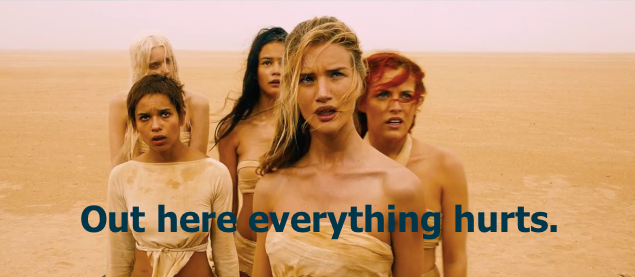
Out here everything hurts, from Mad Max: Fury Road

A brief history: For years, Tor editor Jim Frenkel was widely known as a serial sexual harasser at conventions. What was done about it? Not much, for a very long time. Eventually, he was encouraged to resign after the public outcry became too much, which was announced with typical corporate blandness.

Last year, Tor contracts manager Sean Fodera publicly attacked one of Tor’s authors, Mary Robinette Kowal, in a typically gross and sexist way. He later apologized, in a half-assed way, and she graciously accepted.

In May of this year, on her personal Facebook page, Irene Gallo (Creative Director at Tor Books) described a group of extreme right wings fans who call themselves “Sad Puppies” as extreme right wing fans. She also described a group of fan who follow a neo-Nazi (he denies the label even though he fits it) who call themselves “Rabid Puppies” as neo-Nazis. That neo-Nazi screencapped her remark and filed it away so he could release it as the Nebula Awards were given out, to distract people from the award winning books.

Did Tor CEO Tom Doherty release a letter apologizing publicly for Frenkel’s or Fodera’s behavior, while insisting that they should have been smarter about separating the personal from the professional? Of course not. For one thing, Frenkel’s shitty behavior happened while he was representing Tor Books at public events. For another, they were dudes and their victims were women. Continue reading

Things Fall Apart by Chinua Achebe, Book 11 in #15in2015

Standard

Things Fall Apart (The African Trilogy, #1)Things Fall Apart by Chinua Achebe
My rating: 5 of 5 stars

Book 11 of #15in2015

It’s not often I set aside genre works to read something regarded as a literary classic, but I’ve wanted to read this since the author died a few years ago.

The main character, Okonkwo, is a tragic figure determined to make a prominent place for himself within his (fictional, but based on the Igbo of southern Nigeria) people. His father was a lazy, good-for-nothing layabout, who played music and drank other people’s palm wine, and borrowed sums he never intended to pay back. In a culture that valued community he was a likable taker.

Deeply ashamed of his father, Okonkwo was determined to be everything he was not. He worked hard, fought fiercely in war, and won renown as a great wrestler. But while he could fight and work and create wealth, he couldn’t manage the things his father was good at: he couldn’t create strong social bonds within the community. He was prone to rages, and did terrible things because he was afraid to seem weak/feminine.

Naturally, he ends up dying an outcast’s death, just like his father, because he was ready to go to war with the British colonials but no one was willing to follow him.

Okonkwo is one of those literary protagonists that literary readers lose so much: he’s an asshole you wouldn’t want to spend five minutes with in real life, but as a reader you go deep into his history and his tragic flaws, watching from a superior position as his misguided instincts push him closer and closer to tragedy. The text portrays his errors but doesn’t allow much commentary on them, except in the context of the way he clashes with cultural traditions.

However, those cultural traditions are not spared overt criticism in the text at all. For a people who explicitly value community and the bonds of tribal identity, they have terrible blind spots. The vicious misogyny, the cruelty toward babies born twins, and more, create weak points in their society that the English missionaries, who show up late in the book, exploits. Okonkwo’s own son, whom he has treated with nothing but anger and criticism (in the hope that he would grow up hard and strong) is one of the first to flee his traditional tribal community for the Christian church. And just as with the man, so it is with the community as a whole: the lowest and most despised break away first, and once on the outside, attack the culture they were once a part of.

Not that the British are made into good guys, with their sham talk about justice while they destroy the Ibo traditions and kill their people.

It’s a sad book. I like sad. It’s also complex–much more so than this review makes it seem. I enjoyed it, but I don’t think I’ll be seeking out the subsequent books.

Buy this book

Author attracts a dozen one-star reviews by blowing his stack over one

Standard

No author likes to see a one-star review, but the truth is that they’re a good sign for some books.

However, as mentioned previously, some authors really don’t deal well with rejection.

I’m an indie author. I work over 100 hours a week to get my books to succeed so that I don’t have to be a slave anymore. This review is not good for my business, so unless your desire is to ruin my dreams, it would mean a great deal if you could remove this review from my work and forget about it. But if it’s your desire to hurt me financially and ruin my business, then it’s understandable why you would post such a harmful review.

and

For someone to leave such a toxic review on a book that contains so much gnosis, that people had to die in order to learn in the past, is an utter disgrace to the human condition.

and

Someone that leaves 1 star reviews on someone’s work who didn’t wrong them, who they’ve never met, that’s IS THE MEASURE OF A BAD PERSON.

and one more

NONE of you have any more or less rights than anyone at the NYT. To me, you’re more important than the people that are bought off at the NYT. Or did you think Hilary Clinton could just write a bestseller on her own? Nevertheless, wait till the NYT tries me. I’ll start NAMING NAMES. See what you don’t understand is my experience with the dark occultists of this world that are destroying you from within. You think ToO is some pathetic little fantasy from an author with a God complex. It’s not. It’s an allegorical metaphor for what’s going on because I can’t come out and speak without being in serious danger…

And on and on. It’s quite the train wreck, and he does it in response to other comments as well.

But what he doesn’t understand is that a few one-star reviews mixed in with a bunch of five-stars (and I don’t even want to think about how he got those) legitimizes those positive reviews. Without a few slams, the praise seems like it came from friends, family, and co-workers (or worse, was bought and paid for). He should WANT some dings.

Instead, he’s going on about “dark occultists” and being attacked, which says everything that needs saying about him, I guess.

18 minute video about the staggering number of deaths in WW2

Standard

Truly astonishing video. You won’t regret watching it.