Yesterday’s birthday celebration

Standard

How many places around the U.S. (around the world, even) would be amused that yesterday’s high temps set a new record for July 1st: 94F, over a previous record high of 89F? In many places those numbers capture temps in the early morning, not the high for the day, but those places also have central air or even just air conditioners. My apartment in Seattle has no insulation and it doesn’t circulate air well, unless it’s a very windy day.

Anyway, we broke out the fan for the first time, but I still had an outbreak of heat-induced urticaria. (I keep meaning to blog about my health issues but never seem to find the time.)

My main birthday gift was a day when I didn’t have to do any work at all. The trash had been taken out, the floor cleaned, the toilet scrubbed, the carpet vacuumed (all by me the day before) so I had literally nothing to do around the apartment. I took a day off from my writing responsibilities, too. All I wanted to do was sack out on the couch and watch the extended LOTR movies.

You guys, I was really surprised by how much I was looking forward to this. Yeah, I do things that are fun or that count as goofing off, but they always come with a portion of guilt.

Yesterday was a day off from guilt.

Also, when I watch most movies I’m tempted to look at Twitter or have a comic book open next to me, but LOTR had my attention from the start. I managed to sit down close to my start time (which was 7am) and aside from looking at Twitter messages during DVD changes or checking the World Cup score for the Belgium match, I was offline most of the day. The movies themselves were engaging enough, even after multiple viewings, that I had no urge to turn away or fill dull time. What’s more, my wife–who generally has zero interest in Tolkien or other kinds of fantasy–was nearly late for work because the movie was so absorbing. I started the movies just after 7am and finished 8:30pm, and now I want to reread the books and replay the Lego game.

Weird thing: my kid is going through one of his bouts of late night wakefulness, where he sleeps all day and stays up all hours of the night. In fact, when I woke this morning, I found a plate of bacon, eggs, and toast waiting for me. My wife explained that she woke at 4am and found the boy wide awake in the kitchen cooking. He wanted to make a prepare breakfast for me, despite not being a kitchen person.

So, he dug up some YouTube videos for making scrambled eggs with bacon (and the video suggested boiling the bacon until the water steamed off and it could be browned in the skillet). Yes, by 6:45am, everything was stone cold, but while the bacon was a little bland, it was pretty good. Well, it was better than you could expect from twelve-year-old who never cooks and could barely sleep.

Dinner was delivery from a favorite pizza place. Lunch was a meatball sandwich on a fancy baguette, followed by the birthday cake cantalope-free fruit salad. See:

Inside the bag was a bottle of fancy rye whiskey. It was a good day, you guys, even if I did squeeze in a little writing work at the very end of the day.

I am 49.

I’m looking forward to Tuesday

Standard

I’m looking forward to Tuesday, but not for any of the reasons you might think. Nothing will be completed or released. I’m not going anywhere. No one is coming over.

In fact, it’s my birthday.

Well, not my real birthday. That’s already passed. July 1st is the day I celebrate my birthday (I moved it because my wife and I were born on the same day, and it sucks to share something like that).

This year, the plan is simple: Up early, to the couch, the full Lord of the Rings extended trilogy, which I got for Giftmas a few years back. That’s it. Nothing else.

Well, except for a big fruit salad (I don’t like cake) and delivery pizza. And my son’s headset mic muted so he can’t bicker with his pals in co-op games. But it’s 13 hours of movie or something, and I’m going to do nothing all day but watch.

It’s been a long time since I could really take a day to myself. Usually I have work to do (or work I ought to be doing, guilt guilt). If it’s a family day, we’re going somewhere my wife wants to go, to a park or something. And when I do goof off, I’m always kicking myself it.

That’s why I’m really, really looking forward to a full day of doing nothing. I sorta can’t wait.

“Seriously: this is epic fantasy unlike anything I’ve ever read.”

Standard

So, the hunt for blurbs for The Great Way is going pretty well. Author C.E. Murphy has even written a preview review (Hey, I should trademark that) that is really positive and spoiler-free. I could probably grab a couple of nice blurbs out of there. Even nicer is that she wrote this on the day after the last book in her Walker Papers series came out. Seriously, I turn into a narcissistic maniac when my books are released, so I’m incredibly grateful that she took the time.

This also makes me hopeful that these books won’t pass through the market like shit through a goose, and you know what I think about hope.

“So what then is an indie author to do?”

Standard

I’m linking to a blog post from last January, but I think this is worth talking about. Besides, I only saw a link to it from @EvilWylie this morning. It’s supposed to be advice about reviews and what an author should do about them, but it’s the worst advice you could ever find, short of kidnapping reviewers so you can hunt them on your private game reserve.

[Update: that link leads to a 404 page now. Apparently he’s pulled it down.]

Context: apparently the author sometimes receives Amazon reviews giving his books only one or two stars, and that is not allowed.

He starts by saying he never leaves reviews with less than four stars, which is perfectly sensible as policies go. There are a lot of people who prefer to be silent rather than talk a book down. Positivity, amirite?

Then he starts talking about the sort of people who *would* leave a two- or one-star review, and immediately it becomes about “holier than thou Grammar Nazi[s]” who don’t understand how hard indie authors work on their books! And are just like those awful elitist college professors. Or something. Plus, all books have errors in them, so why do these reviewers have to be so fussy?

But what to DO? The first suggestion he makes is, if it’s the first review, to unpublish and republish the book so the review will be lost. Also, maybe–just maybe–the author should consider the possibility that they need to take another editorial pass.

Next, he suggests talking to the reviewer, maybe asking for their help, because it’s possible that a person leaving a negative review is not a bad person.

No, seriously, that’s what he says:

Often a reviewer doesn’t take into consideration of the impact a bad review can have on your sales. They may not even be bad people.

Look at that fuckery. In fact, let’s highlight something: They may not even be bad people.

Let’s get to the point, because this is the point right here: Just because someone does something you don’t like and/or is actually harmful to you, does not mean that person is attacking you personally. How people manage to bumble into adulthood without learning this, I’ll never know, but it’s a simple fact. Okay? “I feel pain” does not necessarily lead to “You tried to hurt me” even if they’re college professors.

So the author suggests talking to the reviewer politely, asking for tips to make things better. In his first example, this works out fine because the reviewer takes the time to respond, offer help, and improve the author’s work. Wasn’t that kind of them? They even changed the review.

But what happens to a reviewer who leaves a negative review but doesn’t respond to the author’s request for help? What if they don’t want to take time out of their day to point out the errors they found or beta-read a project?

So what then is an indie author to do? Well this is where we as indies have to stick together. This is trench warfare people… anything goes.

Clearly, the solution is to find a bunch of other authors to go on the attack:

I called on some friends to discredit the review, promising to do the same for them should the need ever arise. I’ve made a lot of friends in indie author community through kindlemojo. I asked some of fellow authors to write comments in this fellow’s review.

OMG, I had no idea that some of them were going to be as vicious as they were. The looked up this guys history and saw that he mostly liked to review video games and painted him as a mommy’s boy living in her basement with nothing better to do. They got personal with him as well – it was getting quite ugly – but in a good way. One of the comments even accused him of being a mole of the big 6. However most were simple rebuttals to the unfair review. Someone even pointed him to the article I reblogged about how the first mass marketed Harry Potter novel had over 200 typos. After a few days of the onslaught he took the review down.

Let’s highlight something else here: They got personal with him as well – it was getting quite ugly – but in a good way.

Hey, there is no good way to get personal with a reader who left a negative review. The author includes a quoted text of the review in question (not a screencap, because as they said they bullied the reader into dropping it) that states the one-star is because the reader found four typos, but even if we were assume the review really was that extreme, it doesn’t matter. It doesn’t matter who posted the review or why, you leave it alone.

I have a one-star review that I know for a fact was payback for an online scuffle. Whatever. I leave it alone. There’s a one-star review on the Goodreads page for Game of Cages that mocks the book for an error that doesn’t actually exist: the reviewer misread the scene. What’s more, she has a ton of likes for that review and it pops up at the top of the page. Whatever. I leave it alone.

One thing indie authors like the dude I linked above could learn from traditionally-published ones is professionalism regarding reviews: Leave them alone. They’re written for the benefit of other readers, not for the author (or the author’s marketing efforts).

Don’t attack people because they say they don’t like your book. Even if you think they didn’t read it or they’re just taking a dig at you–even if you know both of these things for a fact–it’s completely unprofessional to silence readers’ opinions in readers’ spaces, whether by unpublishing the book or through an “onslaught” when they refuse to help you fix your mistakes for free. If it bothers you so much, do what other authors do: stop reading your reviews.

John Scalzi’s take on Yog’s Law

Standard

So, John Scalzi had a response to my post about Yog’s Law, and we still disagree.

As I mentioned in the comments over there, the beauty and power of Yog’s Law is in its simplicity. Once you start talking about spending money with your publisher hat on rather than your author hat, that’s when things get conditional, and Yog’s Law stops being so useful.

And, by my reading, Scalzi’s Self-Pub Corollary boils down to “Keep your rights and spend wisely,” which is straight up normal business advice, as far as I’m concerned.

Which is not a slam against Yog or his law. Some years ago, it saved me when I was a noob looking for any way in. I just think it is not as useful as it once was.

Five Things Make A Post

Standard

First, my Father’s Day was pretty great. I asked to get no gifts and didn’t receive any but the cards were wonderful. We also went out to brunch. My wife is pretty cool on the idea of going to a restaurant for breakfast–and my son actively hates it–so this is something I sorta love but get to do only once a year. And yeah, I ate more than I should have.

We went some distance to a little place called Mulleady’s, mainly on the rule that we could get things we never make at home, like blood pudding, boxty, scotch eggs, and other things we didn’t order. Sadly, marrow wasn’t on the bfast menu, but maybe another time. One downside of going there is that it really doesn’t many people before it becomes uncomfortably loud.

Second, you may have seen news articles everywhere recently claiming that bike share programs increase head injuries. They’re wrong. Head injuries fell after bike share programs were introduced, but they didn’t fall as fast as other kinds of injuries. Therefore, according to the media, head injuries rose because, among those injured, a greater percentage of them had head injuries.

It’s statistical fuckery. To quote the linked article: “A more critical view would be that the researchers went looking for evidence that bikeshare programs are dangerous, and upon failing to find any, cherry-picked a relatively unimportant sub-trend and trumpeted it as decisive finding.”

My wife rides almost every day and she always wears her helmet. When I rode (back in my office job days) I wore a helmet all the time, too. We also have lights, reflective vests, and all the safety gear that people make fun of. But it’s important to remember that nothing makes the streets safer for cyclists than having a whole lot of cyclists on the streets.

Third, I’ve sent out copies of The Great Way in hopes of getting blurbs for them, and the first two have come back. Both are wonderful and make me feel like dancing around my apartment singing “I Feel Pretty.”

Fourth, I’m currently at work revising my pacifist urban fantasy, and never in my life have I had so much trouble making headway. My revisions are creeping along at a pace barely better than my first draft days. Stuff is difficult, you guys.

Fifth, I bought the first edition of CHILL (by Pacesetter) way back when it first came out. I bought the second edition enthusiastically, and when I made that six-figure deal for Child of Fire, I rewarded myself by buying up all the Chill books I didn’t already own.

Even though the game is pretty much unplayable.

Pacesetter’s first ed. was fun and had simple game mechanics. Mayfair’s second edition improved on things, but still couldn’t deal with Fear checks. You could prep a haunted house, prep the monster that would be there, arrange the clues the players needed to find or the person they needed to save, but what you couldn’t do was predict who would pass a Fear check. If all the players made it, the monster would not be able to stand against them. If only one made it, that player would have to face a villain designed to challenge a party while his compatriots ran screaming into the streets.

It was impossible to create a balanced confrontation, because you could never tell how many players would make that Fear check (the first thing to happen in every encounter), so you didn’t know which would stay in the scene.

And let’s be honest, any time a GM takes control of a player it sort of sucks, especially if you make the run in terror.

So, none of the games I tried to get off the ground ever went anywhere. My friends had no interest in horror games, since they’re pretty much the opposite of jokey power fantasies, and the only truly successful Chill game I ever ran was with my six-year-old son, and it was one session.

Still, it was great fun to read, and now I’m foolishly excited to see that, after a couple of false starts, there’s a third edition on the way. The previous attempt at a third edition got as far as informal play tests, which I took part in until assholes drove me away, but I’m hopeful for this. I don’t even know anything about the game, but I’m foolishly hopeful.

Not everyone celebrates Father’s Day, nor should they.

Link

C.C. Finlay talks about terrible fathers.

Let’s not make everyone celebrate. And let’s not ever talk about “all dads.” That’s a category without meaning. To everyone who doesn’t celebrate Father’s Day, to everyone who avoids it because it brings up too many painful memories, this post is for you.

Ebooks changed publishing because they changed distribution

Standard

Yog's Law and Distribution

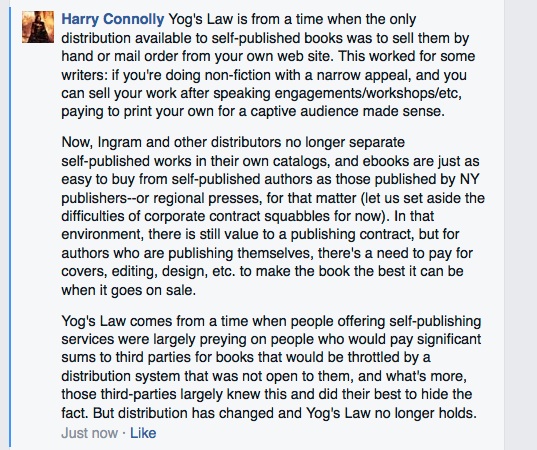
I just posted this comment on a friend’s Facebook status update, and I thought it worth posting here. Once upon a time, it was impossible to get a self-published book into bookstores: shelf-space was at a premium, and stores wouldn’t risk the chance that a buyer might select a truly terrible book and never return.

Amazon changed things because they had, essentially, infinite shelf space. What’s more, the internet has “caveat emptor” written all over it (in invisible pixels) so Amazon didn’t have to worry so much if this book or that one was illiterate.

New distribution options meant a change in the way the business works, and that’s the end of Yog’s Law (“Money flows toward a writer” or: “Don’t pay to have your book published; write a book that others will pay you for the privilege of publishing.”) as a useful guideline.

Get Together for Seattle-Area Folk, 6/14, 3pm

Standard

Hey, if you’re in Seattle, why not join me at the UW Bookstore on Saturday, 6/14, for a 3pm reading by Greg Van Eekhout. Greg’s new book is called California Bones. Here’s the description:

When Daniel Blackland was six, he ingested his first bone fragment, a bit of kraken spine plucked out of the sand during a visit with his demanding, brilliant, and powerful magician father, Sebastian. When Daniel was twelve, he watched Sebastian die at the hands of the Hierarch of Southern California, devoured for the heightened magic layered deep within his bones.

Now, years later, Daniel is a petty thief with a forged identity. Hiding amid the crowds in Los Angeles—the capital of the Kingdom of Southern California—Daniel is trying to go straight. But his crime-boss uncle has a heist he wants Daniel to perform: break into the Hierarch’s storehouse of magical artifacts and retrieve Sebastian’s sword, an object of untold power.

For this dangerous mission, Daniel will need a team he can rely on, so he brings in his closest friends from his years in the criminal world. There’s Moth, who can take a bullet and heal in mere minutes. Jo Alverado, illusionist. The multitalented Cassandra, Daniel’s ex. And, new to them all, the enigmatic, knowledgeable Emma, with her British accent and her own grudge against the powers-that-be. The stakes are high, and the stage is set for a showdown that might just break the magic that protects a long-corrupt regime.

You can read an excerpt, too.

Anyway, it sounds great. I’m going to be there. I plan to be at the Big Time Brewery at 1pm, resolutely not getting drunk. Depending on how well Greg’s travel arrangements go, he might be there, too. Maybe I’ll bring some galley copies of the paper edition of Twenty Palaces to give away. Or something.

With luck, traffic arriving for the UW Commencement ceremony will end before 1pm and Greg’s event will end before the outflow traffic resumes.

“Do you ever feel ground-down by this business”

Link

Authors who are way more successful than me talk about how difficult publishing can be.

The original tweet is directed to male-identified authors because the discussion sprang from another one about the difficulties female-identified authors have getting reviews, tours, etc.

What this tells me is that I should be working on my book, not going online to have my blissful ignorance shattered.

[Also, this is my first post with my new blog theme. I’m still getting used to it.]