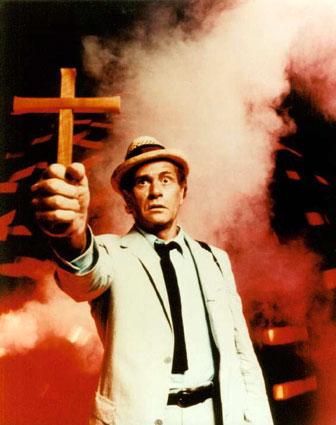
This is the telemovie that started it all. When it aired in 1972, THE NIGHT STALKER received the highest ratings of any TV movie up to that point, surprising everyone involved. They knew they’d made a solid movie, but they’d underestimated the appeal of the vampire. The sequel (set in Seattle!) and the single-season TV show all built on that success. Sadly, behind-the-scenes conflict tore the show apart.
But! The first movie is tight, sharp, suspenseful and a helluva lot of fun, mainly because it’s about more than just the booga-booga. It’s also a mere hour and fourteen minutes.
Do I need to make a spoiler warning? Skip down to the part that says “Commentary” if you haven’t seen the movie before and want to watch it unspoiled. If you don’t care about spoilers, keep right on.
.
What happens: We open in an anonymous motel room with the fanciest technology of the day, a cassette tape being slid into a portable tape recorder! The hand presses play and we get the start of the voice-over narration we’ll hear for the rest of the movie. It’s a little purple, promises us we’ll never believe the story we’re about to hear, and nicely establishes the noirish tone. Enter Carl Kolchak, peeling a pull tab off a can of beer with his teeth and kicking back with his open-neck shirt and white shoes. He kindly mouths the word on the tape as we hear them so we know it’s his voice.
Cut to the first victim, a young woman on the Las Vegas strip. Her shift at the casino has ended and her ride hasn’t turned up, so she starts walking home, cleverly taking a short cut through an alley. A hand suddenly grabs her by the throat and drags her between buildings. After a brief struggle where her fashionable red shoes don’t touch the ground, she’s thrown into a pile of TV trash and her attacker leaps onto her. Cut to a trash collector discovering her body in a trash can.
The next scene shows three medical examiners bending over the camera as though it was a body. Larry Linville, soon to straight-jacket his career as Frank “Ferret Face” Burns on M*A*S*H, starts cutting into us with a scalpel as the title flashes on the screen. The murder victim has been drained of blood. The coroner tells the others to keep it a secret.
Next we see Carl Kolchak himself, driving his beater into Vegas as the narration informs us that he’s been called back from vacation. In the newspaper office he and his editor, Vincenzo, have the first of the many shouting matches they would have over the next three years. Carl is ordered to cover the murders. Go, Journalism! First stop, a friendly doctor willing who apparently can’t keep the coroner’s secret. Second stop, The Girlfriend, who happened to work with the victim. He comforts her, and she expresses her very 70’s-TV disbelief that the victim’s brown belt in karate didn’t do her any good in the attack. (“Ze goggles! Zay do nothing!”)
The next body turns up, and this time it’s another woman working a casino night shift, but she’s found in the middle of a sandy culvert, over twenty feet away from her purse and the “signs of a struggle” in the hard-scrabble desert. There are also no footprints in the sand nearby. What was she, thrown? (Yes, actually.) Carl, the sheriff, and the sheriff’s men in their funny plastic helmets go out to examine the body, ignoring the huge shadow the camera man and camera cast into the frame. She’s lost all of her blood, but there isn’t a trace of it at the scene.
Then there’s another murder: a young woman lies on the floor of a closet in her apartment while police examine the scene. The narration intones that she answered a knock on the door and was murdered, all without waking her roommate sleeping in the next room. Narration: “That was when everyone stopped talking.”
All within the first ten minutes.
Kolchak buys a beer for his good buddy in the FBI, Bernie, and presses him for information. He also pressures Bernie to start looking for similar crimes around the country. Basic stuff, but Kolchak is the only one ready to pursue that angle this early in the case (especially since he’s delegating all the work). The talkative doctor calls him to tell him about a robbery at a blood bank; the thief stole every and any blood type–and it’s time for one of the series’s signature scenes: the press conference.
I’ll talk more about press conferences later, but this one is a fine, prime example. On the left you have the sheriff, the D.A., the police chief, and Coroner Ferret Face. On the right you have a horde of journalistic extras and Kolchak. The coroner explains that the victims were all drained of blood, the wounds are consistent with a dog bite, and they found human saliva mixed with the victim’s blood.
Being bold (and abrasive) Kolchak asks the obvious blood-drinking question, prompting the coroner to use the “v” word, and that doesn’t make anyone happy. The coroner tries to explain that there’s a historical precedent for people who think they’re–the D.A. suddenly snaps back on his leash. We can’t have that kind of talk! “The public” would go into a panic!
Next, the natural sequel scene to the press conference. Setting the precedent for many public officials to come, the D.A. pulls Kolchak aside, tells him he’ll call Vincenzo to have another reporter assigned to this story and warns Kolchak that he’ll be run out of town if he doesn’t toe the line. Even better, he does it with his arm linked with Kolchak’s and a big friendly smile on his face.
At the newspaper, Vincenzo tears Kolchak a new one. He tells Kolchak to stop bothering the people in power and to wait for the police to tell them what they ought to know. It wasn’t until later in the series that he became a decent editor (as these things are measured on TV). He also accuses Kolchak (correctly, this time) as a down-on-his-luck former-big-city reporter looking for the big story that’ll carry him back to a major paper. Ambition? How unseemly.
Back to The Girlfriend so Kolchak can talk to someone about his personal arc.
Next we get victim number four. This time, a witness–an elderly woman–saw them “kissing.” In the future, I’ll assume all public displays of affection are vampire attacks, just in case. The witness gives the cops the description of the car. Kolchak visits one of his contacts, bribing her to contact him when they discover the owner of the vehicle. Then Bernie, his FBI buddy, asks if he wants to see a picture of the killer.
Cut to: a newspaper in a dispenser, with a police sketch of the killer under the headline “Fourth Slaying.” A hand reaches into the machine and takes a paper, and suddenly we realize we’re with the killer himself. Twenty-three minutes.
The viewer gets shots of the killer’s arm and his back as he walks through a crowded casino, but not his face. Tension builds as everyone seems to be checking him out, including one very beautiful young woman. Cut to a darkened parking lot. The vampire sits in his car watching a woman cross to her car. That’s when we get a look at his face: red eyes, crazy expression, wild hunger… yep. That’s an old school vampire right there. Except for the car.
He creeps up on her, all crazy-faced, and she yanks open her car’s back door. Out charges a Doberman. It races at the vampire and he kills it by grabbing it in some way. Oops. The dog defense has failed. Check and mate. She’s can’t run away because of the power of the vampire (or the script) and the scene goes dark.
In Vincenzo’s office, Kolchak tries to convince his boss that the woman who went missing the night before (Shelly Forbes) must be the vampire’s fifth victim, mainly because of the dog. Having all the courage of a three-term senator facing a primary challenge, Vincenzo is unwilling to commit.
Kolchak does a little investigating and he gets together again with The Girlfriend. At this point, everyone believes the killer is a crazy guy who thinks he’s a vampire, but only TGf is willing to entertain the idea that he’s a vampire for real. She drops a couple of folklore books in his lap and insists he study up, just in case. Smart woman. Love (and lust) prompt Kolchak to read enough to figure out how to get through act three.
Next, we have another blood robbery, but this time we see the vampire being picky about which bottles he takes. A nurse stumbles on him and we are treated to yet another Kolchak staple: The Big Fight. After bouncing a few orderlies off the shaky set walls, the vampire throws a guy straight through an upper floor window.
As Kolchak arrives with his camera, the vampire charges out the front door into the street, OMAC-style. Kolchak snaps pictures while the vampire throws orderlies and then cops around. He flees in the chaos as the cops shoot at him.
“Things were rolling.”
Another press conference, and this time Bernie the FBI agent has the information Kolchak asked him to dig up in the first reel. They’ve ID’ed the killer as Janos Skorzeny, an eastern European millionaire who was born over 70 years before. The room erupts in disbelief, but Bernie testily shouts that he’s triple-checked everything, so shut up. Skorzeny has a long, ugly history of aliases, freaky experiments, and unexplained murders. Kolchak insists that the strange events of the other day can’t be explained away, and while he doesn’t explicitly Mulder the room by insisting the killer is a monster, he tells them they won’t catch the killer until they conduct the search as though he’s a vampire.
Guess how well that goes over. Kolchak gets into a shouting match with the D.A. and comes up second. No one is going to create public panic–or risk looking stupid–by treating the maniac as if he was a real vamp.
Kolchak delegates more of his investigation to another character actor, then sits down with TGf. He admits that this story is the craziest story ever, but he still can’t bring himself to talk about Skorzeny being the real deal.
Next, the second, definitive Big Fight. Kolchak’s police scanner tells him the cops have spotted the killer and his green station wagon (he’s a millionaire vampire and he can’t even afford a white panel van?) and Kolchak races to the scene.
A massive brawl ensues as the cops try to control the unarmed Skorzeny with their clubs and fists. Skorzeny vigorously kicks their asses and tries to flee. They draw their guns and blast away at him. Skorzeny falls, then looks back, ticked off. Oh, yeah. That’s the look.
Skorzeny gets up again. The cops start shooting again, but he jumps a wall and the cops wisely decide not to chase him. Kolchak? He’s finally ready to believe in vampires. That’s minute 43.
Cut to the next press conference. Everyone is in a fuss and the VIPs order all the press out of the room–all except for Kolchak, who’s sitting in the back of the room with his feet up and his hat over his eyes. He strolls to the front of the room and grandly announces that he knows exactly what to do about this killer. He smugly strikes a deal: His advice will show them how to them stop the killer and in return Kolchak gets an exclusive. The cops and D.A. grit their teeth and put up with him long enough to agree. Kolchak takes a cross, stake and mallet out of his bag. The city leaders, not genre film fans it seems, are not pleased, but what options do they have?
One of Kolchak’s character actors contacts him: he’s found Skorzeny’s house.
After making his buddy promise not to tell the cops about the house until after sunrise, Kolchak races across town and breaks into the house. Minute 50. The house is a decrepit wreck (the rich really do live different from you and me) and Kolchak starts creeping around, searching the place. These scenes are damn quiet, much of it with nothing more than the sounds of Kolchak’s fashionable white shoes on the dirty creaking floorboards, up until it’s replaced with quiet, effective percussive music. Nicely done.
Kolchak finds and snaps photos of the stolen bottles of blood in the fridge and the coffin in the bedroom. When he finally finds Shelly Forbes tied to a bed with a bottle of blood draining into her (now we know why Skorzeny was so picky during the second heist) he starts to rescue her (without snapping a pic, thankfully), but then Skorzeny’s car pulls up.
Kolchak puts things back where they were and ducks into a closet, but Skorzeny and his evil bowl cut are not fooled. Kolchak fends him off with the cross and tries to back out of the building, but the mess is so bad that he falls down the stair, dropping the cross.
Skorzeny is on him immediately, and they struggle. Well, Kolchak struggles. Skorzeny throws him across the room and bares his throat for the bite.
Bernie the FBI agent arrives just in time, but his attack (and the gunshots) have the expected effect, which is “none”. Kolchak and Bernie begin yanking down curtains to let the dawn light in and Skorzeny falls back onto the stairs, where Kolchak stakes him.
Just as the cops arrive.
Later that morning, Kolchak is happy and humming. He’s typing out his story, sure it’s going to be the biggest thing ever and he’s going to be offered a job in NY. He proposes to The Girlfriend in the way every early 70’s casino employee dreams of (“You’re a good cooker and kisser. Why not?”) and rushes off to dreams of glory.
Vincenzo is subdued, as though he’s just been told his dog had died. He takes Kolchak’s pages without enthusiasm, and actually compliments him. Oh, and the D.A. wants to see Kolchak downtown. Kolchak heads to the courthouse…
Where he discovers the Sheriff, D.A. and police chief waiting for him, murder warrant in hand. It seems that the local authorities don’t like citizens pounding stakes through people’s hearts, and this Skorzeny guy hadn’t even been charged with anything yet. Kolchak has to get out of town. His girlfriend has already been run off, and his luggage gets dumped on the floor behind him. Bernie is there, squirming, apologizing, but Kolchak drives out of town, knowing his big story has been killed and covered up.
And we return to the motel room framing scene, where the last of the narration plays out of the tape recorder. Kolchak laughs and throws the typed-up account of his story on the desk and walks away.
.
Commentary: Where to start? First, the rest of these writeups are not going to be this long or detailed. I put 2400 words into the first movie because it was such a solid story.
Let me start by talking about how different Carl Kolchak seems from the character he would become. First of all, he’s a bit of a snappy dresser here. Sure, it’s 70’s fashions, with those awful white loafers and knit ties, but he’s not shabby, like he becomes in the series. Even his porkpie hat still looks new and crisp, without the beating it would take during the series.
He’s also much smoother. Sure, he’s willing to ask questions when everyone else wishes he would shut up, and he’s smug and pushy sometimes, but there’s a lot less shouting. He also doesn’t tweak the noses of power as forcefully as we would later. It’s something I see often in TV shows: the characters start out as basically normal people but become charicatured over time.
The biggest change comes from Vincenzo, though. Kolchak’s editor would follow him from Vegas to Seattle to Chicago, but he would never be this go-along-to-get-along guy again. He would always clash with Kolchak over his methods and his crazy supernatural stories, but I don’t ever expect to see him side with public officials solely because they’re public officials.
The script was written by Richard Matheson from “an unpublished story by Jeff Rice.” Matheson won an Edgar for that, but Rice was supposed to have retained much of the control over the characters. The studio cut him out of the process and he sued. Guess how useful that was? He never had a Hollywood career and I’m sorry for it.
The movie is full of solid creative choices. The way it alternates between murders, investigation, helpless government officials and personal moments keep the pacing brisk and sharp without ever seeming forced. It’s also full of terrific character actors. Bernie is played by Ralph Meeker, and Sheriff Butcher is Claude Akins. The only downside there is that almost everyone is the cast is male except for The Girlfriend and the victims. This got better in the series, but it’s pretty pronounced here.
Barry Atwater played the vampire, Janos Skorzeny. He’s terrific in the role, even though it’s all movement and expression. He doesn’t get any dialog. He’s also not a romantic figure–he doesn’t make women swoon, he doesn’t sparkle, he doesn’t bemoan his fate. He’s a predator and he’s hungry.
Which makes him a monster, yeah, and I’ve written about my feelings about monsters before. But here it works, because Kolchak’s major antagonist isn’t the killer. The killer is the thing he’s chasing. Yeah, Skorzeny is dangerous, but he’s also absent for most of the movie. His main enemies here are part of the power structure of the city. They’re the people who can’t solve the problem, but refuse to consider any solution that might make them look foolish. They can’t tolerate dissent and they betray Kolchak at the end, running him out of town rather than accept that he did their job for them, and his story would embarrass them.
Which makes this a noir in the best sense. There’s no cliche guys in trench coats talking in metaphors, but there is a city under tremendous pressure, a protagonist with compromised motives, and vivid supporting cast of unique characters, and an overall sense that justice, in the end, can’t be had at any price the hero can afford.
Next up: THE NIGHT STRANGLER.