Authorial Self Sabotage: first in an informal series

Standard

The common wisdom is: if you publish in the genre, go to conventions. Here:

Now, to clarify (because this has bitten me in the ass before) I’m quoting Kameron Hurley to talk about her assertion, not to blindly agree with it.

I’m going to relink the article she’s linking above because it’s worth reading, and I’m going to quote it, too.

Check this part out:

Here’s another wrinkle: at least in SFF writerdom, there is really no meaningful distinction between friends and colleagues. Which, sure, is true of a lot of fields. But these relationships are particularly close, and the professional utility of these friendships can be very high. There are costs to missing out, to not being at the right place at the right time to meet the right person. Missed connections are a real thing. Because here’s another wrinkle: it’s not just about being talented. It’s about being noticed.

Which calls back to some other, previous posts of mine about luck. (Don’t roll your eyes, people, I’m going to be brief this time.) If you maximize your interactions with other people and with new experiences, and you remain open to new opportunities, you increase your chances of a “lucky” break. That’s why people who say you can’t control luck are wrong. You can’t control luck in any specific situation, but you can increase the chances that something lucky will happen over the long term.

Therefore: conventions, where you meet colleagues who become friends. The benefits of that are unpredictable but they’re there. The costs are there, too.

See this post by Chuck Wendig listing the upside and downside of attending. As Chuck says, the point is to meet people you like and be liked in return. It’s a professional opportunity to make pals, not to cynically acquire names and resumes who will give your career a lift. Chuck also makes an extensive list of the downsides, one of which is cost. Marko Kloos broke down the cost of attending Confusion, an event he really enjoyed and which is apparently the cool new thing.

Clearly, $1,888 isn’t chump change, and it’s clear that no one is going to make back that money on the weekend itself. The money I just paid to Bookbub was not tiny, but the extra sales more than made up for the cost. But that’s short-term thinking. That almost-nineteen hundred dollar ConFusion expenditure will pay off, if it pays off at all, in the long-term benefits that come from the friendships formed at the event.

For example: we’ve all seen writers pushing their books on social media, and most of us know that, while it works once in a while, it’s not an effective way to sell. You reach your core followers, they buy the book, and the positive effects of future promotion nosedives.

But being promoted by other writers to their followers, with a personal recommendation? That’s gold. Meeting an editor who remembers you as smart, funny, and sensible the next time your agent submits your work? Making a good impression on a handful of fans who decide to try your books, then love them so much that they evangelize for them? Also gold.

And it can’t be predicted or forced. It’s like the old saying: “If you want to find someone to love, be someone worth loving.” Authors just have to go, spend the money, the energy, and the time, and hope good comes of it.

For those who have found benefit that way, great. I’m glad Kameron Hurley’s career is doing well and I hope she becomes a best-seller (or whatever her goal is). But it’s important to be wary of Survivor Bias. My own experience at big meetups is not all that positive. Usually I leave feeling that I should have spent that time writing.

And then there’s this:
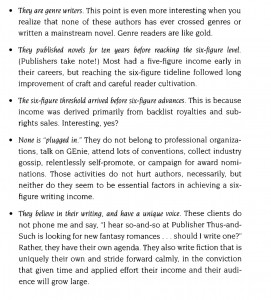
No conventions. Hear that? They don't attend many conventions

Excerpt from ‘The Career Novelist’ by Donald Maass

That advice is more than 20 years old and it’s the exact opposite of what authors are told now. Conventions may have been around for a long time, but could things have changed so much?

I’m open to the possibility that social media magnifies the effects of creating a F2F friendship with your colleagues; it’s possible that folks who witness fun and funny online exchanges between pros would be willing to sample the work of a whole clique. I also suspect that’s where “cool kids” rhetoric comes from (as in “I’ll never be one of the cool kids”). In social media, casual expressions of camaraderie are a public act and it’s easy to feel excluded when it looks like everyone but you gets to take part in the fun (Not to mention getting the reviews, the blurbs, the nominations…)

Then again, what looks widespread and pervasive on social media is usually neither. The ongoing drama in one person’s circles goes completely unnoticed by the world at large. And those people that look like they’re among the “cool kids” are struggling with their books and their insecurities just like any other writer. The only difference is that their circle of friends has a high(ish) profile.

Still, the idea that long-lasting sales comes to those who don’t waste time on the social stuff is very very tempting.

Back and forth. Back and forth. Is it worth the time and money? How many cons does it take to start making friends? Is it even worth it for me, a guy who hates to be jostled, who can’t hear in noisy environments, and is terrible at recognizing faces? (also names?)

Maybe it would be worth it, but feh. I’m terrible at that stuff. We only get 52 weekends a year, and I don’t want to use one of mine on socializing when I could be working on a book.

I could be shooting myself in the foot with that decision, but it wouldn’t be the first time.

Today’s Twitter Confession

Standard

Sometimes I squelch the urge to say things that are true but seem obvious. I probably shouldn’t.

And this is why Wren, an app that lets me send Tweets without being distracted by reading anyone else’s, is a great way to let off steam when I’m writing.

Mysteries with Honest Detectives and Sad Endings: Netflix Codifies Art

Standard

This article pushes all my buttons.

The more I learn about the way Netflix determines their categories, but more convinced I am that they’re doing something really useful that will soon apply to all entertainment media. To summarize the article briefly: not only have they created over 75,000 separate “genres” (called “altgenres” at the company) but they rate and categorize films according to a very complex system of metrics. How gory are they? How romantic? Where are they set? What job does the protagonist hold? How happy is the ending?

Hiding behind those 75+K genres are all sorts of ratings that Netflix pays careful attention to. If you watch a lot of movies in the Action categories but consistently turn off the gory ones before the end, Netflix will stop suggesting action movies with a high gore rating to you. Other kinds, sure, but not that one.

I’d hoped books could get a system like this with Game of Books, but they didn’t deliver. The project was sold or abandoned, and backers’ pledges were returned.

I still interested in a system that could do something similar with books. Bleak mysteries with an honest detective and a sad/tragic ending ought to be easier to find than they are, but the personal recommendations I get through social media haven’t scratched that itch. Those books were one disappointment after another. Would the Game of Books have managed it? Would “Netpages”?

Obviously, a system like this would never be perfect; Netflix’s certainly isn’t. That’s why I miss Netflix’s “Random” category, since my recommendations are now swamped with kung fu movies and British crime shows. (And why not? Love ’em!) Random allowed me to see recs beyond what the algorithm thought I wanted.

For Netflix to survive, it has to connect subscribers with shows they love over the long term, but sometimes its recs are so narrow that we only get to see a thin slice of what they offer. Basically, they hide most of their library. Before she moved in with us, my niece thought she’d seen everything of interest the streaming service offered. Now she’s binging on all sorts of shows. That suggests that Netflix’s algorithms are too restrictive right now. More variety is needed.

As for books, well, variety is not the problem. Covering them all would be the problem. Still, I think it’s inevitable.

I know there are people who will recoil instinctively from the idea of breaking down books into component parts in order to categorize them, but I can’t help but think that, if readers were able to look for “Contemporary Fantasy Crime Fiction with a Sad Ending”, I might still be writing Ray Lilly novels.

Genres are just descriptions for the marketing department, after all. I suspect we’re coming to a time when book classification is going to have to get much more granular.

Our Immortality Lies In The Effect We Have On Others: RIP David Bowie

Standard

I just recently wrote about fearing obscurity, but of course death is out there, too. Death is the end of all our contributions to the world. It’s the end of our opportunities to experience joy and delight, and to make an impact. It’s the end of us.

But we all get to have a kind of immortality, too. When any of us show kindness to someone else, we brighten their day. If we’re lucky, they feel happier than they did, and they get a chance to pass that kindness to someone else. In that way, a good deed can circle the world, just as long as recipients give away what they have received.

That’s our immortality, and it isn’t about us as individuals. The effects of our kindness can touch people who have never heard of us, and it can last long past the life span of those who knew our names or laughed at our jokes. It’s immortality as life force, the soul defined by the effect we have on others, and the way those effects ripple outward.

Maybe one particular good deed was prompted by a kindness someone else showed to us, which would mean that good deed sustains someone else’s immortality, mixing it with our own. Maybe the good deed is something we created ourselves, as an antidote for being mistreated. Either way, every kindness becomes part of the heaven that we ourselves create.

Because heaven isn’t a place we go at the end of things; it’s something we construct with our words and our deeds. It’s found inside generosity, joy, and connection like little pinpricks of light, and it’s something we make for other people, not for ourselves.

The way we raise our children, and the way we treat our neighbors and our friends over the long term… those things have an even larger impact on the world, for good or ill.

And then there’s the art we make.

David Bowie reached a great many people with his art. I’m not going to try to summarize his career; others will do that better than I ever could. But I don’t think it’s out of line to estimate that there are millions of people out there who feel that his music saved them in one way or another. That’s a powerful legacy–any artist would dream of having that kind of effect before their time on this world comes to an end, myself included.

He may not be with us any longer, but his impact remains. If David Bowie ever brought you joy or comfort, please try to pass that on to others. In that way, you help to make him immortal, and you become immortal with him.

Death… I mean, Obscurity stands at your left shoulder and whispers “Soon.”

Standard

I should have put this here instead of on Twitter, but I got into a roll and what the hell.

Here it is, my short essay on obscurity:

I wish I could edit tweets.

Anyway, re: #18, here’s Jaime Lee Moyer talking about her series being cancelled after Tor pulled her first two books just as book 3 was coming out and here’s Patrick Swenson talking about Tor dropping him after one book. Those forgotten bestsellers I mention in tweets #6 & 7? At least they made a little money first. For too many of us, even that’s beyond our grasp.

I have also been thinking about George RR Martin, who recently announced that his next Westeros novel will be delayed. It reminded me of an article I read about JK Rowling, and the pressure she felt while trying to finish the last few Harry Potter books. Those authors have had amazing success, obviously, but they still feel Imposter Syndrome. They still worry that readers will be turned off and turned away. That readers will move on.

Anyway, that’s what I’m thinking about lately, as I watch the Bookbub sales bump fade, and wonder if those readers will move past the 99 cent promo novel to my other work.

Hey new readers, if you want to keep up with my future work, why not sign up for my newsletter? I only send it when I have something new out.

Also, it helps keep the specter of Obscurity a few paces behind.

The Way into Chaos is currently 99 cents

Standard

[UPDATE: The sale’s over, but I’ve permanently lowered the price since. Grab yourself a copy, or read a sample.]

Tomorrow, the second of January, The Way into Chaos is going to be included in a Bookbub promotion, and I’ve already lowered the price to 99 cents in anticipation.

With luck, this will give me a worthwhile sales boost, not only of book one but the whole trilogy. I’ll post about that later. In the meantime, if you’re an ebook reader and you haven’t tried this series–or you know someone who might like an epic fantasy merged with an apocalyptic thriller, you can pick up a discounted copy from one of these vendors:

Amazon
Barnes & Noble
iBooks
Kobo

But only for a limited time.

The paper edition is still available, too, naturally, but without a discount. However, the Amazon “Matchbook” program has changes so that if you buy the paper edition from them, you get a free version for your Kindle.

Holiday time with my family, plus secular symbolism

Standard

I’m not a Christian, but like many Americans I’ll be celebrating the holiday today. We have our niece visiting from out of town, and the tree has lots of gifts under it, four stockings hang over the fireplace, the fridge is stuffed with the traditional foods, and the shelves are full of board games waiting to be played.

Twenty years ago I would spend the holidays alone, making ravioli and writing. Personally, I prefer this. If you find yourself spending the day in a way that makes you feel awful, please reach out. There are folks out there who want to hear from you; you don’t have to be alone.

Whether you celebrate or not, I hope you have a wonderful day. If you like, you can check out my post from two years ago about secular symbolism over the holidays.

Best wishes to you.

Randomness for 12/24

Standard

1) Why you don’t want to wear metal inside an MRI. Video.

2) 15 things I learnt about Islam and British values being a gay boy living opposite a mosque. h/t James Nicoll

3) MRA Dilbert. Combining Scott Adam’s own words with Scott Adam’s art.

4) Poll results: The best video essays of 2015

5) Get rich or die vlogging: The sad economics of internet fame.

6) DIY Netflix socks will automatically pause your show when you fall asleep.

7) The Ten Best Articles Wikipedia Deleted This Week.

Writer Perspective v. Reader Perspective: Is Fantasy a Plot Element?

Standard

Holy crap, you guys, I have so many browser tabs open to read/link to/comment on and no enthusiasm for the job. I’m tempted to just create a giant link salad so I can be rid of them and their spinning beach ball of death.

But first, there’s a post I’ve been meaning to respond to for exactly one year, so I’m going to get it out of the way today, 365 days after it was posted.

My original post: Superheroes Are Not a Genre, in which I said that fantasy was defined by a plot element.

The response: Fantasy is not a plot element, by LJ user barbarienne (who not so incidentally did the interior design work for The Great Way, who helped me find a printer and cover designer, and was generally indispensable during the publication process. She’s the reason those books look as good as they do.)

My original post was about genres and how to combine them. Genres are defined in different ways: how they make the reader feel, what sort of plot question they have, where they’re set. What barbarienne didn’t like was that I defined fantasy by plot and not by setting.

Her post largely focuses on the importance of worldbuilding. For ex: But it is only in genre fantasy where the created setting is why the readers came here. [I removed a footnote from the middle of that sentence.] Note that she wrote “created setting” because there are several genres where the setting is central to reader interest, such as westerns and historicals, but those settings are re-created. Only science fiction blah blah blah, she covered that in her post, which I hope you’ve read.

And I agree with most of what she says. For the most part, fantasy readers love setting above all else, and some are seeking novelty while others are seeking the familiar. It’s why so many fantasy novels seem like travelogues. Even urban fantasy that’s supposedly set in our world contains sections that read like The Smart Tourist Guide To Secret Places.

But the thing is, I wasn’t talking about the reader’s experience of fantasy. I was talking about the issues a creator has to consider when mixing genres. For example, if you’re creating a fantasy/western, you could just add magic to a story set in Dodge City. You could, if you wanted, create a pseudo-Old West map in the way that other writers create pseudo-medieval maps, but you don’t have to. The magic a writer adds to Dodge City changes the type of story you can tell there, and while it might change some of the characters (gun-slinging wizard?) it doesn’t have to. But it will always change the way the plot progresses. Even if they’re stock western characters with nothing fantastical about them, if they’re facing a dragon or cursed dueling pistols or telepathic cattle rustlers, the fantasy elements affect the plot.

Fantasy readers, with their particular reading protocols, may not experience it that way. “It’s the old west with dragons!” they’d say, as though it was an entry in one of Rick Steve’s books. Fantasy can be defined in several ways, but among the fans of the genre, they’re looking for a interesting fantastical setting, but from the outside, readers think of it in terms of a story containing things that “aren’t real” (often with the implication that they are risible, childish, or a waste of time).

Okay. Let me backtrack a bit to my own books: when it was clear that Child of Fire was popular among fantasy readers who also loved mysteries and thrillers, Del Rey tried to push the book by sending it to mystery/crime reviewers, too. It’s a novel that crossed genres! Why not expect it to beyond the overlap of fantasy and crime into readers of crime novels?

But it didn’t. Crime/mystery readers and reviewers were mostly uninterested. (I say “mostly” because I got some very nice feedback from readers who wouldn’t ordinarily touch a fantasy novel; they only read it because they knew my wife and were surprised by how much they enjoyed it.) Why? It wasn’t the setting. It wasn’t even the general plot questions (Two people arrive in town to find and kill a very bad man). It was the fantastical elements that made up the plot: the spells, the spell book, the monsters, etc.

And if you think Spell books that summon monsters are part of the worldbuilding, you’re not wrong. But they are also elements of the plot, and powerful influences on the characters. In fact, they are all those things at once; as a writer, I can’t think of them in any other way. The temptation that Frodo feels to put on the One Ring is not just a question of character (Frodo can resist where others can’t) and it’s not just a plot question (can he resist temptation for the whole journey) and it’s not just evidence at the way magic works in the setting of Middle Earth. It’s all those things at once, and they are inextricable.

So, to sum up:

1. Speaking generally, fantasy readers read fantasy because they are looking for setting.
2. Speaking generally, fantasy readers experience fantastical story elements as worldbuilding first, character and plot elements second, because as much as they love great characters and exciting plots, setting is the commonplace attraction.
3. Speaking generally, non-fantasy readers experience fantastical story elements in a variety of ways, but typically as elements of the plot. In other words, fantasy readers -> “This is a school where kids learn magic!” / other people -> “These kids overcome their problems by casting spells.”
4. Search your feelings. You know number three is true.
5. For a creator who is combining fantasy with other genres, the fantasy elements may be related to the setting but it’s more likely that the fantasy elements will be plot-based.
6. If it’s unclear what I mean by “plot-based” well, consider questions like: “How can the characters achieve their ends?” “What obstacles interfere with the characters’ efforts?” “What goal are they trying to achieve?” Those are plot questions.
7. For example: Among all the space ships and robots, Star Wars has wizards who use telepathy, precognition, telekinesis, and can shoot blue lightning from their fingertips. When a creator is trying to decide what a character should do next, all those (fantastical) elements are on the table.
8. Some people will try to argue that the presence of fantastical elements indicates a fantasy setting. Those people are wrong. A book set in our New York City, but with jewelry thieves who are secretly dragons, is a fantasy plot in a mundane setting.
9. Which means I believe writers can/must sometimes do fantasy worldbuilding in mundane settings.
10. Those fantastical plot elements can be a tough sell to readers outside the genre, but not as tough as it used to be.

Now I remember why I put off responding to this post, because it’s so much easier to cruise Twitter reading jokes like:

A Giftmas Suggestion (Not Book Related)

Standard

You know how jazz of 50+ years ago was vibrant, complex, commercial art? You know how modern jazz is a kind of high art designed to please knowledgeable aficionados but not the average listener?

While I was on vacation in Lisbon, I found out about an album called Once Upon a Time in Portugal, which is just now available on iTunes.

What it is: complex, vibrant, accessible music aimed at a general audience and played by really great musicians. Basically, it’s excellent commercial art.

Play the previews, for real. For me, I think this music perfectly suits a certain mood. Check it out.