This looks intense:
A friend of mine produced this, and it’s going to be fantastic.
This looks intense:
A friend of mine produced this, and it’s going to be fantastic.
In case you wanted to look at something awful for the Easter holiday, I give you Sketchy Bunnies.
Over the weekend I had a bit of a nasty surprise: I couldn’t download the most recent version of Turbo Tax because it requires OS X 10.6 or later. I still run 10.5.
If you’ll forgive me for saying so, this is bullshit. My computer is only five years old. There’s no reason for it to be considered obsolete and I shouldn’t have to order and install a new operating system just to do my taxes. (Note: please don’t suggest alternate programs I could use.) And yet, that’s exactly what’s happening.
Some time ago, my wife told me that she was incredibly proud that my books were going to be in the Library of Congress, because that meant they would last a long long time. In response, I said something to the effect of they’re on the internet, too, I think, and that should last even longer. Unfortunately, I no longer believe that to be true.
How many old filetypes are impossible to read now? How many types of physical media are worthless because no one has the disk drives to read them? Much of my early writing was done on a Brother WP75 and saved on 3.5 inch diskettes. Here’s a pic:
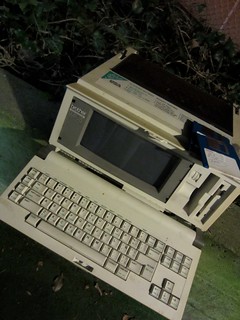
I dug it out because I came this close to donating it to charity. That machine was the bridge between a typewriter and an actual computer (my first real computer came from Gateway in 1994 and I had it so long that there was literally duck tape over parts of the case).
See the diskettes on there? Once the Brother stops working or I give it away, they become unreadable to me. Maybe I could find someone to take the files off and convert them, but that would be an iffy thing, and probably not cheap. (Luckily, it’s just early work and not important.) In all seriousness, the best kind of archive I could have of these would be in paper.
Note also John Scalzi’s recent post about his newest computer acquisition: no DVD drive. He doesn’t miss it because he doesn’t use DVDs, but I still do. I use them all the time, to watch movies, to play games, and to share large files
Speaking of large files, I copied hours and hours of home movies from a box full of mini-DV tapes onto a hard drive, and now that hard drive is being backed up to an online service. There’s so much data to save that I started the backup on January 3rd and, as of today, it’s only about 55% done. This shit is going to be going on until summer time, I kid you not.
And yet, when I’m an old man, will I be able to watch these videos? Will I be able to find a program that recognizes and mp4 or .dv? Worse, will I be able to buy a special adapter that will allow the external hard drive (with its ancient USB connector) to connect to whatever system is in vogue at the moment?
Will my son? I don’t doubt that he’ll have the storage space to keep them–in all likelihood, he’ll have a ring on his finger that he can download all 600+GB of data with room to spare. But will he be able to actually look at them, or show them to his own kids so they can see what we were like? Will he be able to read my old manuscripts?
It pisses me off. There’s such a rush to always have the New! and the Shiny! that things become obsolete even while they continue to function. Yes, I know it’s a way to sell things. Yes, I know companies are hunting for every bit of loose change rattling around in tech-happy early adopters’ back account. But they aren’t the only customers out there.
I’m a customer, too. I don’t want new and shiny. I want practical and long-lasting. I want this shit to make sense. Don’t phase out old media just because there’s a new supposedly-but-maybe-not-better way to do it (don’t even talk to me about “the cloud”). Don’t change operating systems so often that perfectly good computers can’t even run basic software (or watch embedded YouTube videos, or play silly games, or whatever).
Backwards compatibility, people. I want it, and I’m not the only one.
No doubt many of you have heard that a dispute between Simon & Schuster and Barnes & Noble has led to an extraordinary curtailing of book orders from the vendor of S&S books. Orders of new books from big names are very light while orders for debut or midlist authors are at zero.
Stephanie Burgis is one of those midlist authors, and she has a new book coming out tomorrow. See here for her take on the fact that, as far as she can tell, no B&N in the U.S. will be carrying her book.
In a way, that’s nothing new. There have always been books that big chains passed on, books that had to sink or swim in the indie stores or online. Usually, that’s a sign that a series is doomed because sales are low.
That’s not the case here. As with Amazon removing the buy button for all Macmillan titles, this is a dispute involving contract terms: B&N wants things to be more favorable, S&S resists. The dispute will result in a short-term loss for both of them, but the long-term effects will be felt by authors with books coming out this month and next.
Remember back when Borders went bankrupt? They’d always ordered a fair number of my books, but when those orders disappeared, there was no new vendor to take up the slack. They shut down forever in July, CIRCLE OF ENEMIES came out in August. If you’re thinking that was a big hit to my sales, you’re right.
Maybe that seems unfair, but that’s the way it is. When an author’s sales figures come back, there’s no asterisk next to the number. There’s no footnote that reads: “Big chain collapsed”/”Contract dispute reduced orders”/”Global economic collapse” or whatever. There isn’t even allowance made for the errors the publisher makes itself, whether it’s a terrible cover or ebook price screwups or zero promotional work.
The one who takes it in the neck is the writer. No, self-publishing is not the answer, no matter how readily people jump in to suggest it. It’s not for everyone. (While I have issues with Charlie’s timeline there, his overall point still holds.)
We’re facing a great many challenges at the moment. Amazon, while offering a lot of selection and a (somewhat screwedup) distribution method for self-publishers, is still hurting the industry as a whole by operating at a loss. Barnes & Noble would be in a better position right now if they fixed some of their more egregious company practices (they ought to allow local branches to control their own orders, because duh. The local staff are the people interacting with their community), but at the same time the pressure from Amazon’s so-cheap-we’re-losing-money! discounts and the effects of the Great Recession are destroying the company, and who will be able to step in to take up the slack?
Not Amazon. Sure, their sales will certainly tick up, but like telecommuting, we’re learning that online book buying is making it difficult for readers to discover new work. (That link takes you to an Ursula K.Le Guinn essay, so go ahead and give that a click.) When you stand in front of a bookstore or library shelf, you’re presented with an amazing number of titles to look at; there’s no way Amazon or any other online seller could load that many covers in your web browser. It would be too much information.
It used to be that a new book in a series would be published at the same time as an earlier one would hit paperback, or get a small new printing. Now, the book pops up on a Tuesday blog post or status update as yet another new release. Maybe it appears in a stack of books on Scalzi’s blog.
It’s not enough. We need healthy book stores. Indies, yes, but also the big stores with the shelf space to carry midlist authors and a large enough enough staff that there’s someone drawing a paycheck there with knowledge of each of the genres. I like those big stores. I like browsing those huge, long shelves.
Barnes & Noble needs to become less ossified and decentralized. At the same time, Amazon needs to put the brakes on its competition-destroying business practices; if they won’t someone else will have to put the brakes on. Because it’s not the big corporations that are taking it in the neck. It’s the people who create the product those corporations sell.
1) This Lego machine makes and launches paper airplanes. Video.
2) The future of hi-rise demolition comes from Japan.
3) Legobombing and the art of infrastructure.
4) How funny are you? A chart.
5) Pictures we didn’t take before digital cameras.
6) Close up photos of elements from the periodic table.
7) Class project: designing costumes for a film adaptation of The Lies of Locke Lamora
Yeah, I’m watching season 1 of Veronica Mars again. The whole first season is only $12.50 on Amazon at the moment(!)
Damn this show is good.
I see a lot of people calling out coverage of the Steubenville rape trial for being ridiculously concerned about the effects of a rape conviction on rapists, and they’re right to be angry.
However, there’s one thing I don’t see people talking about:
How incredibly common it is.
I know more than a few guys who lost their virginity by bringing a girl who was black-out drunk back to their room. It was a common enough thing in college.
To be clear, I never did this–I have never even found myself in that position–but a lot of guys have. When you see news people online talking about the awful consequences for those teenage boys, understand that they’re thinking That could be me/my husband/my brother/my best friend from college.
It’s hard for people to accept the idea that they or people they care about have done evil.
Ten years ago tomorrow was the start of the Invasion of Iraq. To my shame (not chagrin, not embarrassment. Shame.) I was an early supporter of the war.
I had long believed that war never be taken on as an adventure overseas, but I let myself be turned by the propaganda leading up to the attack. Did I believe the evidence supporting the presence of WMDs? No, actually, but I thought Hussein needed to allow inspections to continue. Did I believe Iraqi oil reserves were part of the reason we went to war? Yes, of course I did, but I thought there was good to be done anyway.
Which is completely ridiculous. Of course it is. How often are the tools of empire and destruction put of a positive use?
What’s more, I was a grown man who knew better. So what happened? I let myself get caught up in all the talk of chemical weapons used against Iraqi citizens and “rape rooms.” I let myself be convinced that the Iraqi people would be grateful.
At the time, there were anti-war marches in the streets. I remember looking out my window at them as they passed the office building where I worked: they were the usual far left hippie types with their giant puppets, long hair, and birkenstocks. They agreed with me that the war was about oil (a stance that was sneered at in the media at the time) but they were sure it was a huge mistake.
Of course they were right. Of course they were. At the time I thought their protests were ridiculous and self-marginalizing. They seemed more interested in confirming their cultural cred as outsiders than in winning people to their side. The civil rights marchers in the sixties wore coats and ties; these people were in tie dye and sandals that showed their dirty feet. These people don’t represent me.
And that’s utterly ridiculous. They weren’t trying to represent me. They were warning us that the nation was about to make a huge mistake, and they were 100% correct.
Shortly before the invasion, when talk of war was ever-present, I remember Hans Blix coming to the media to say that Hussein had knuckled under and agreed to allow inspections again. I spent half a day foolishly thinking that the invasion planning had done it’s job… until Bush administration officials declared that it was too little too late and the invasion was going to happen anyway. That’s when I realized what an immature asshole I’d been, although I still held out thin hope things would turn out all right.
It didn’t.
What I realize now is that I should have been out in the streets with those protesters. I should have held on to my beliefs and my mistrust and marched against the war. It’s not the responsibility of political protesters to make themselves palatable to me; it’s my job to recognize right from wrong and speak out about it.
No really, that’s what he said! Good thing he was joking.
If you’re one of those people who have been going around the internet posting comments, tweets, and status updates like “Who’s this Veronica Mars? Kickstart me some more SERENITY!” you should probably click that link up there. He’s not planning to Kickstart a new Serenity movie because he’s tied up for the next several years with commitments, not to mention the commitments the actors have. Plus yada yada budget etc. Give it a quick read.
After that, you should read this post by LEVERAGE co-creator John Rogers, cleverly titled Veronica Mars Kickstarter Thoughts. If you want analysis from someone who is inside the TV business, Rogers is the guy to turn to right now. Until it was cancelled, Leverage was the only independently-owned TV show in the U.S. market, and he has a lot of insight about the nature of non-studio funding, whether Warner is taking a risk by giving the go-ahead, and much more. That’s worth reading.
Remember yesterday when I talked about ALL THE SHIRTS (limited-edition!) the VM people would have to deal with? Kickstarter fulfillment companies.
And, naturally, everyone is jumping up to say what shows should be next on the Kickstarter auction block: Chuck. Pushing Up Daisies. Sarah Connor Chronicles. Terriers. Deadwood.
Personally, none of those shows appealed to me in a serious way, so I’ll be waiting for that THUNDARR reboot.
Okay. Unless something very interesting happens, I’m going to lay off the TV Kickstarter posts for a while. I’ve got to steal time for my books at some point, right?
Currently I’m over 100K words on THE WAY INTO MAGIC, which is the sequel to THE WAY INTO CHAOS. I’m writing it as one long story, which is probably dumb, but there you go.
My life is incredibly dull! Good thing the internet is full of fun stuff.
I wanted to do a little followup on the Veronica Mars Kickstarter. Yeah, they made goal. You can see the current numbers below.
Hey, you could even click on it to toss in a few bucks. I did.
But that isn’t to say that I think the setup is problem-free. I mean, there are issues and it does no one any good to gloss over them.
For example, at the time I’m writing this, Rob Thomas et al are going to have to make and ship over 40,000 “limited edition” T-shirts. That has to happen even if not one more person makes a pledge. They’re also looking at 4500 signed (by the cast) movie posters so far. You want to talk about signing your name seven thousand times (which is the limit for that reward)? I sure wouldn’t want to do it.
So… yeah. That sort of order fulfillment could be a huge drain on time and resources, even if you bring in a couple of out-of-work people (or actors, even) to handle it for you. He’s going to need his own clothing unit. And assuming they max out the poster reward (which looks pretty likely) and that it takes five seconds to sign one poster and move to the next, each actor is looking at over nine and a half hours to sign them all.
No writing hand was made to handle all of that. Just one hour would bring on cramps.
But that’s minor stuff. A great many people have been complaining that this project is just a way for a major corporation (in this case, Warner Brothers) to crowdsource production costs for their new movie. Is this the wave of the future? Will studios “hold their properties hostage” until the fans pony up?
It’s doubtful. The Veronica Mars Kickstarter is doing very well because it has a solid fan base. Also, it’s first. There’s a power in novelty when you’re asking people to give you money, and if it keeps happening again and again, there just won’t be much buzz around it.
Unless it’s THUNDARR THE BARBARIAN. Thundarr will always get buzz.
I can certainly see studios and production companies turning to crowdsourcing to decide if they want to re-up for another season, or bring the old gang back for a movie. Loved VR-5 and want to bring it back? Throw money at the Kickstater! and if it doesn’t happen the studio doesn’t have to be bad guy any more. They can just say: “The fan base wasn’t there. We only made 48% of goal.”
As for turning to fans for money that studios could put up themselves, the studios already do this in spades. They make foreign rights deals, they bring in outside investors, etc. It’s always been a part of doing business.
The big difference is that those investors get actual cash money once the film makes a profit. Fans, not so much.
Would I like to see that changed? Yeah, absolutely, but it’s not as simple as it sounds.
About ten years ago, my buddy and I were planning to make a movie. It was going to be a solid horror film–scary but not stupid–and we hoped it would open some doors for us. (Spoiler! It didn’t). As we were planning it, I did some research on how producers raise funds.
It turned out that there were all these restrictions on where the money could come from and who could donate. As I recall (a decade later) the budget would have to be split into X number of even pieces and each donor would be limited to that amount. There were more rules, too, and they were complicated and annoying. That’s when I realized I was a novelist.
(Digression: How it came out: The director sort of pushed me, the writer, out. He got the money from somewhere. The movie was seriously flawed and went nowhere. The script wasn’t my best but it is online: pdf or shitty html. It’s not my best work)
The point being, there are very strict rules around asking people to invest in your project for a cut of the profits.
However! The Jumpstart Our Business Startups Act (aka the JOBS Act) which was signed into law last year, contains provisions for crowdsourcing an investment in a company, not just in a particular project/product. You can read a description of the law here but just to touch on a few issues, investors are limited to 5% or 10% of their annual income, companies must use an established third party to run things, a great many disclosures are required, and the goal is $1million or less, so it’s not going to work for television anyway. While the law was passed last year, the crowdfunding part is not yet active because the SEC hasn’t finished drawing up a set of rules yet.
So, yes, a corporation is offloading a sizable part of their costs on this project to the fans, but they offload costs as a part of their every day business, and there’s no legal framework in place to allow the fans to invest directly. They only have the option to pledge for rewards, which is essentially preordering the end product, plus swag.
Will this become the model of the future? I doubt it, but even if it did it would be a terrific hedge against piracy and a fine reason to ditch DRM (not that there aren’t already many, many reasons to ditch DRM). Companies wouldn’t have to worry so much about their product being torrented if the true fans had already chipped in.