A Drop of the Hard Stuff by Lawrence Block

Standard

A Drop of the Hard Stuff (Matthew Scudder, #17)A Drop of the Hard Stuff by Lawrence Block
My rating: 4 of 5 stars

After seeing A WALK AMONG TOMBSTONES at the theater, I was looking for a novel that would make me feel as sad and as bleak as the movie did, without the unfortunate elements that I had to forgive in the theater. This was the closest option and I grabbed it.

It doesn’t have the same punch as the film, but it is very nicely done, as private investigator books go. As in most of these books, it’s primarily dialog but it’s very good dialog.

The plot is pretty straightforward: Matt Scudder, former corrupt NYPD detective and struggling alcoholic, tells a story from decades before when he was an unlicensed private investigator. He does favors for friends, and they give him gifts in return, all very under the table.

In this case, a guy that Matt knew as a kid grows up to be a career criminal. After a stint in prison, he and Matt both end up in AA, trying to stay sober and put their lives back together. Part of the AA recovery process involves contacting people you’ve hurt in the past and making amends and while in the midst of this step, the poor guy gets murdered. Matt gets “hired” to look into the list of people the victim wronged to see if any of them might be the killer.

It’s a sad book, but it’s not as bleak as the film, and that’s what I was looking for. That’s not fair, I know, but I’m still laying out 4 stars for a solid crime story where the most pressing question is whether the protagonist will make it to his one-year sobriety anniversary.

Anyway, if you like private eye mysteries set in NYC of the recent past, this is the book for you.

A Drop of the Hard Stuff by Lawrence Block

New creepiness for the Halloween season

Standard

Maybe you guys have heard about The Dionaea House? It’s a story (or is it real?) told through emails, texts and blog posts, a modern epistolary novel.

And it’s spooky as hell.

Not gross, not horrible, or filled with monsters tearing people apart, or demon children, or whatever bullshit modern horror is about. It’s a smart, subtle (except where it shouldn’t be) scary story, and I highly recommend it.

It’s by Eric Heisserer, and it was popular enough that it launched his screenwriting career. The film that was supposed to be made from it hasn’t happened, for the usual reasons, but it’s supposedly going to be name-checked (or featured, not sure) in the upcoming series The Librarians. Anyway, you should read it.

The reason I mention it? Heisserer is back at it: “Information I’m Dumping Here for Safekeeping”

Read through. Open the images. Follow the updates. It’s fun.

h/t to John Rogers (@jonrog1) for the link.

Randomness for 9/26

Standard

1) The 50 Dorkiest Songs You Love. NB: you don’t have to tell me you personally don’t love some or all of them. I know.

2) Edgar Wright – How to do visual comedy. Video. This is excellent and shows why I find modern comedy so incredibly boring.

3) Joaquin Phoenix’s Forehead (Rotated). Video. So weird and funny.

4) Anonymous Gods. The computers at Google automatically blur the faces of famous religious statuary.

5) Netflix’s new spoiler website. #spoilers

6) Malkovitch Malkovitch Malkovitch Malkovitch.

7) Robert Heinlein, L. Ron Hubbard, Charles Manson & the Birth of Cults

The Health Benefits of Reading

Standard

The WSJ has an interesting article on “reading parties,” (skip the comments). People are getting together to read in silence, which is fine, I guess?

The really interesting thing is the list of health benefits to reading, which is included in this handy graphic.

Hot-linked Pseudo-Venn Diagram of the Benefits of Reading

“Reduces stress” is vital, and “Improves listening” makes me think I should have my son read three or four times a day.

But I’m still stymied by the idea of reading parties. I get that it can be pleasant to meet new people doing the thing you love (especially if you’re the type to bring “impressive” books so everyone could see how smart you are) but it still seems like putting yourself in a position where the people around you will, with your permission, police your own behavior. “I’d never stay off Twitter for 30 minutes if I were alone, but if I have all these people watching me…”

I’m not saying there’s something wrong with it, but it’s not a choice I would make. If I realize the book I’m reading can’t keep me so absorbed that I stay off Twitter, I put the book away. Then again, I’ve never been the sort who tried to impress people with my reading choices.

ADDED LATER: I took the speed reading test. While my comprehension was perfect (partly because I knew I’d be tested) my wpm was 261, slightly above average. That surprises me, because I’ve always believed I was slower than average. I guess I’m just slower than everyone I know.

The Cuckoo’s Calling by Robert Galbraith

Standard

The Cuckoo's Calling (Cormoran Strike, #1)The Cuckoo’s Calling by Robert Galbraith
My rating: 4 of 5 stars

3.5 stars for a book that started poorly but became compulsive reading as the story went on.

This book flies straight down the center of the genre, in that everything anyone talks about is somehow related to the main plot, it’s a long series of conversations (interrogations, really) one after another, with clues hidden in the details that don’t line up, and a crime as improbable as any.

Not that I care about a whodunit. I never try to follow the clue by clue, guessing the real killer or whatever. I just enjoy the characters and their secrets.

How *have* private eye novels been doing? I have been under the impression that they’re out of favor, and that maybe “Galbraith” is keen on resurrecting another moribund genre. It doesn’t really matter, because this book, despite a few rough patches, was great fun (once you read beyond the unpromising first few chapters). I’ll be grabbing the sequel.

Buy a copy.

Gaudy Night, by Dorothy L. Sayers

Standard

Gaudy NightGaudy Night by Dorothy L. Sayers
My rating: 5 of 5 stars

I’m reading these books all out of order.

Harriet Vane is my favorite Mary Sue in all of literature, largely because she’s so complicated and difficult, for herself and for everyone around her. Lord Peter Whimsey (and I don’t care what anyone says, but that’s the best/worst character name ever) is brilliant, super-rich, heroic, funny, well-educated, and completely in love with her. She loves him back but won’t marry him because he saved her from the gallows the first time they met, and she hates the imbalance between them. She can’t bear to marry someone she’s supposed to feel grateful toward.

I kept expecting this to turn into a murder mystery, but really it’s about doxing a particularly vicious pre-internet troll. That makes it the most interesting murderless mystery I’ve ever heard of.

Anyway, I suppose I should have fallen in love with Oxford–the text certainly wanted me to–but it didn’t happen. I did have to employ Fantasy Reading Protocols for the allusions the extremely well-educated characters employed, but that was part of what makes it fun. Also fun was seeing Harriet grapple with a new level of psychological depth in her novel-in-progress while Sayers herself populates the book with a whole platoon of wonderful characters.

I don’t think of this as the sort of book I enjoy. It’s not dark, it’s not violent, it’s not full of grief… Still, I stayed up all hours to finish, and whatever I read next will suffer by comparison.

Good book.

Buy your own copy.

Novelist given psych exam, locked away by police for work of fiction he published at 20

Standard

[UPDATE: According to the L.A.Times, McLaw was not removed from his job and taken for treatment because of the novels. Apparently, he wrote a four-page letter that alarmed authorities, and they’ve known about the novels for a couple of years.

It’s frustrating, because I heard about this story a week ago when it first broke, and I was waiting to see what would shake out before writing a post. If I’d waited until this afternoon instead of this morning, I wouldn’t have relied on the ridiculous early news report, which was disseminated widely and which explicitly linked his books to administrative action.

I’ll leave the original post below, for the obvious reasons.]


You may have heard about Patrick McLaw, a twenty-three year old teacher in Maryland who has been kicked out of his job, is being investigated by the county sheriff, has had his home searched, had the school where he taught searched, has been forbidden to go onto county property at all, is being given a psychological exam in a location that the police will not name, and is not free to leave, according to the cops. Has he been arrested? Authorities will not say. Try not to be surprised when I say he’s black.

His crime? Three years ago he self-published a science fiction novel, set 900 years in the future, about the race to stop a school shooter.

You can read about his story at The Atlantic. I encourage everyone to read it; it’s short and it matters. If you’re curious about the book, not only is it still on Amazon, but the publicity has bumped it quite high in the sales rankings.

I guess it’s possible that there’s something else going on here beyond administrative freak out, but I would be surprised. This sort of over reaction from a school administration is all about the fear and power of petty bureaucrats who are terrified of being seen to have done too little. Any possibility, however slim, that they might be dissected in the media, post-catastrophy, about what they knew and why they didn’t act, drives them like fanatics.

It doesn’t help that so many school officials seem ready to accommodate the most paranoid parents in their district. It all feeds the little voice inside them that says thinking up the plot of a book is the same thing as fantasizing about it.

Based on the news reports we’ve had so far, Patrick McLaw has broken no law. It’s possible he’s being told that he has to do everything he’s told to keep his job, but I can’t understand how a sensible member of the judiciary thought publishing a novel three years earlier was probably cause for a search of the guy’s house.

It’s disgusting.

Dark Fantasy StoryBundle is now live

Standard

Hey, you guys. You know what a StoryBundle is, don’t you? There are several novels all bundled together into one package, and you can pay whatever you like for them (with a $3 minimum). If you’re willing to pay above a certain dollar figure ($12), you get extra books.

Well, currently there’s a Dark Fantasy StoryBundle running for a limited time. You can spend three measly bucks and get five novels. For $12 (or more) you get nine.

Plus, if you so choose, 10% of your purchase price can go to charity. In fact, you can support the ALS Association, the charity that has been benefiting from the ice bucket challenge, but without the social shaming issues that come from “challenging” people. If you think ALS has already received its fair share of support lately, the other options are Girls Write Now and Mighty Writers. There’s a “Learn More” link on the page to tell you more about those charities, but I just want to say that I grew up in Philadelphia and anyone who wants to throw a little love to Mighty Writers would earn my gratitude (not that the other programs are not worthy, too).

You also get to choose what percentage of the purchase price goes to the authors and what goes to the folks at StoryBundle, which is a great way to do things.

All the books are DRM-free. The other authors include a Hugo-winner and a couple of best-selling authors (as well as, somehow, me). The fiction here is *dark* urban fantasy without romance plots, so if you like my work, you might also like these other books. PLUS, it’s super easy to buy the bundle as a gift for someone else.

Anyway, if you guys wouldn’t mind helping to spread the word about this, I’d appreciate it. And check out those books. I’m downloading my bundle right now.

The Bundle will be available until Sept 17. If you’re interested, don’t put off the purchase. It’s going to go away soon.

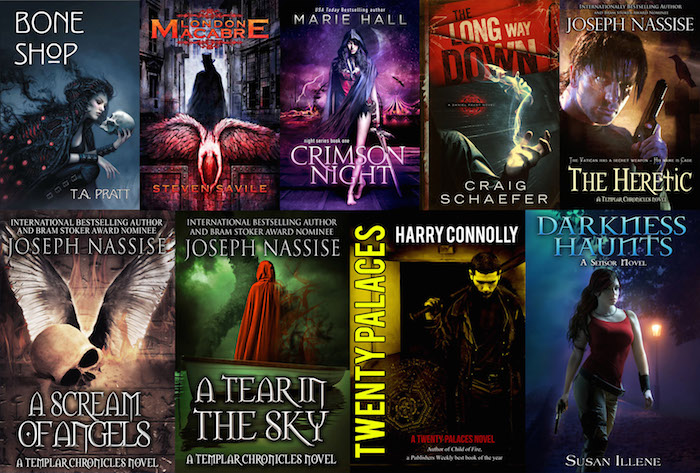
Here are the covers:

All 9 StoryBundle Covers

My short fiction collection reviewed on Boing Boing!

Standard

And it’s a great one!

Don’t take my word for it. Read that guys’s take, and then read it yourself.

City of Stairs, by Robert Jackson Bennett

Standard

City of StairsCity of Stairs by Robert Jackson Bennett
My rating: 5 of 5 stars

Like any detective novel, City of Stairs starts off with a doubled narrative. The first is the story of the investigation itself; the second is the story that is uncovered–a story of secret jealousies, agendas, and betrayals that led to the murder in question. The first narrative is the uncovering of the second.

But while City of Stairs starts off like any detective novel, the second narrative quickly transitions away from the murder toward the history of the ruined city that comprises the setting of the story.

This city was once the capital of a world-spanning empire, backed by the might of mysterious and powerful Divinities. Then, one of their conquered slave states developed a weapon against the gods and, upon their deaths, the empire was not just overthrown but also physically ruined.

Who murdered the beloved old professor looking into the forbidden history of those Divinities? What are the former conquerors plotting to overthrow their new masters? Why did the gods help one people but not the others?

Into this mess comes a bookish, brilliant, bespectacled woman, Shara, who is the preeminent spy in her young empire, along with her secretary, a huge, ass-kicking nihilist named Sigurd.

Sigurd will be a fan favorite, I predict; he nicely fulfills Jim-Butcher-like levels of Exaggeration (reference: http://jimbutcher.livejournal.com/1698.html ) but it’s Shara who carries things. Her voice–analytical, disillusioned, detached emotionally except when she’s not–makes the book work.

However, this is a book about stories, and they’re stories that the characters tell each other. While there are some action scenes, much of the text is taken up with puzzling over old myths and secret history, so it’s talky. In a good way, but still.

Anyway, this is the first of Robert Jackson Bennett’s books I’ve read, and it’s terrific. You should read it, too.

View all my reviews