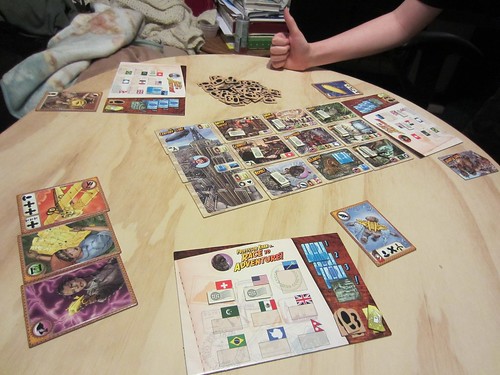
Finally got to play Race to Adventure last night

Standard

Now that season one of Veronica Mars is over, the family finally had a chance to play RACE TO ADVENTURE, which I backed as a Kickstarter.

Here’s the layout near the start of the game. Of course I played Prof. Khan.

IMG_1880

You can see I’ve collected the passports for the USA and Switzerland, while to the right my son has collected USA and GB. However! I am about to collect Nepal in that very turn, while my son was hoarding clues at the Library of Congress.

Yeah, that’s my kid giving the thumbs up.

My wife… I’m not sure what she was doing. Let’s just say she had a busy day and wasn’t concentrating too well.

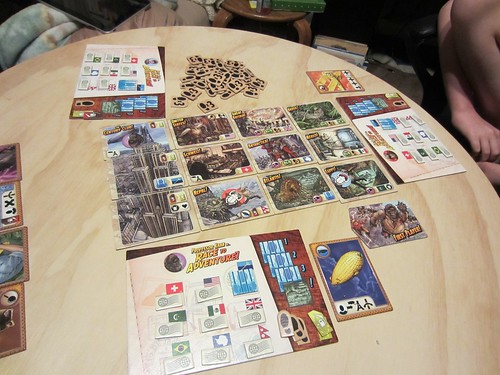
Here we are at the end of the game, when I had returned to the Century Club, said (house rule: no shouting) “I have returned!” and won the game.

IMG_1882

The others also collected all of their passports (and rescued the prisoner from Atlantis) but, having saved Egypt for last, they were still cursed. They were also way behind. Mwah-ah-ah-ah!

As for the game, it was terrific. I think I’d like to play it once or twice more on the tan side of the tiles before flipping them to the more advanced “shadow” game. We stumbled a little bit with the rules at first, like we do with every game, but by the end the turns were flying by. This might be the first game ever that says it takes 30 minutes to play and really means it.

The nice thing is that there’s no luck involved (no blowing your plans because of a lousy roll of the die) and the strategy elements were light but still effective. It’ll be a good fast game when we just want to play something fun without a ton of calculation.

On a day when the news was filled with blood, horror, and people coming together to help each other in dire need, it was good to sit with my family and play a game.

Best wishes to the people of Boston and to the marathon runners

Standard

No links here. I just want to send out good wishes to everyone affected by the double explosions at the end of the Boston Marathon.

Also, keep in mind that early news and social media reports are likely to be wildly inaccurate. It’s probably best to disconnect from things like Twitter at the moment and give first responders a chance to do a thorough investigation.

“Punching down” doesn’t always feel like punching down

Standard

I want to follow up on Friday’s Hugh Howey post without actually talking about Howey (much). I briefly mentioned the idea of “punching down” in that post but Tobias Buckell talked about it more extensively in his post on the subject.

It’s worth clicking through to read what he’s written, but for those that won’t: “Punching down” is attacking someone who is weaker, more vulnerable, or has less power than you. “Punching up” is attacking someone who is stronger, more powerful, and more influential than you. Mocking a rich guy who locked his keys in his Audi is punching up. Mocking a single mother who’s just been evicted because she was laid off is punching down.

Needless to say, punching down is what villains do and I’ve talked about it here on the blog more than once as a way to make sure the sympathetic characters are actually sympathetic. That’s the context of a fictional narrative, though. Most of the time, when people talk about punching up, they’re talking in terms of politics.

Leaving aside the question of whether the offending conversation Howey described actually happened (which I hadn’t considered at first, but Nick Mamatas brought it up and now the whole incident seems just too perfect), Howey is a best-selling author with a serious movie deal and six-figure print-only contracts. He’s doing well. The person he slams is, according to his story, a social climber trying to make herself seem important by offering to connect writers with agents. What’s more, he makes her sound desperate and a little delusional. Is his story, as he himself tells it, punching down?

Absolutely. And yet, I’d bet Howey himself would be surprised to see it this way. I imagine he still imagines himself as the upstart self-publisher, the guy who has to do it all himself, with no help from anyone. I’m sure he sees that scorn, whether it actually happened or not, as the “punching down” he endures every time he goes online or meets someone uninterested in his books.

I’m sure that, to him, this woman had aligned herself with the supposed gatekeepers of NY publishing, and he felt free to take a swing like any hard-pressed hero.

I can’t speak for Howey himself but in my experience putting out a book, either by yourself or through a publisher, feels nothing at all like becoming powerful. Just the opposite, really: We do a shitload of work and then, finally, this thing we made goes out into the world alone. All our hopes for success and praise are mixed with the expectation that everything could collapse, that people might be bored or dismissive or contemptuous. Worse, they might not even know we’re there.

And readers often treat writers as though we’re faceless corporations, like Bounty paper towels or something. They tweet insults directly at the author and act amazed that a real writer with a publishing deal would react angrily.

Readers need to have the freedom to say whatever they want about our books–they deserve it–and a book culture where everyone is nice all the time would be toxic. So when people are kind to my work I’m grateful. When they’re cruel to it, I shrug it off. I tell myself it’s not personal even when it’s clear from the review that it was meant to be. As Toby says in the blog post linked above, when people talk shit about your work, it stings.

So, writer as a position of power? It might be for some, I guess. Maybe if you’re Guest of Honor at a lot of conventions, or you teach writing to eager young folks, or getting a movie deal with a profile in the WSF, or something, that might feel like power.

But the publishing part of being a writer, when you send a book out into the world, whether it’s through a publisher or on your own? That feels like vulnerability.

The “Bitch from Worldcon” post and appealing to your base

Standard

It’s been more than a week since Hugh Howey posted his Bitch from Worldcon (now deleted) but I think it’s worth talking about anyway. Yes, it’s sexist rape culture bullshit for him to fantasize (even jokingly) about his big moment–which is apparently winning an award–standing in front of a crowd of people, and singling her out to say “Suck it, bitch” while grabbing his crotch.

Hello, small-minded fantasy of success. Hello, sexual threats to a woman he himself believes to be mentally ill. Hello, completely creepy behavior. I don’t care if he thinks it’s non-serious; it’s bullshit.

However, the real point of the post becomes clear right here:

Crazy girl asked who I was published with. “Self-published,” I said. No point in mentioning the Random House deal or the SFWA membership. Those weren’t what I was most proud of. The girl shook her head sadly and also knowingly. It was a complex bit of head shaking.

Bold added by me.

Who is Howey’s main audience? a) other self-publishers who have anointed him the next Amanda Hocking and b) readers who imagine themselves to be cutting-edge iconoclasts predicting the end of the old publishing paradigm. This is his “base,” and as much as he’d like to (and is) expanding beyond them, he’s still making the effort to hold them close.

On one hand, self-publishing is never going to have the legitimacy people want until they stop acting like they’re being assailed from all sides. I say this as a self-publisher myself. There is no revolution, only new opportunities. The people trying to get you to take one side or the other, whether that’s a “crazy girl” at a convention or a best-selling author featured in WSJ and Salon, are wasting your time and/or trying to sell you something.

What’s more, this post is a classic example of numbers #3 and #4 of my post about using social media to build a strong community of assholes. Howey isn’t sending his readers out to attack anyone–perhaps he understands that he shouldn’t punch that far down–but it’s still us-vs-them rah rah bullshit designed to instill loyalty more than inform.

It’s a shitty post. It’s not funny unless you’re looking to wave around pompoms with Howey’s name on one and Amazon’s on the other. It demonstrates that no amount of money or success will make you a better person. And it’s how a lot of authors create their brand.

Added later: Howey has apologized. Someone should explain that “I was just joking!” isn’t much of a defense.

I have something you don’t, board game edition

Standard

According to the UPS tracking website, sometime today a person in a brown uniform will pitch a box at my front door and run off without seeing where it lands, and inside that box will be a copy of Race to Adventure.

That’s my Kickstarter reward arriving, but the good news is that you can order one for yourself if you like. If you don’t know what that is, it’s the board game based on the rpg that also spawned my next novel, KING KHAN which means that the protagonist of my book should be a playable character.

FYI.

B&N flails, fails with new NOOK Press initiative

Standard

Like a lot of authors who self-publish, I have work available on B&N’s website for the Nook. However, while they have made a single good decision (“Nook” is a great name for an ereader) they have consistently making terrible decisions ever since. Now, they’re turning their Pubit! program into Nook Press and it looks like they have made some awful choices.

Why do they want to make “100%” of my book available for free to people who log in to the wifi at B&N? Why not just a sample so they could, you know, sell the book? I would much rather limit the amount of my IP that’s available than their limit of 1 hour’s access.

I have to admit: it bugs the shit out of me that booksellers can change my prices at their whim. Yes, a store has the right to set it’s own prices, but if a store wants to sell a book for one penny, they still have to buy it at the publisher’s price. With ebooks, they’re the ones who are deciding MY price. That’s ridiculous.

As for the FastPencil stuff, I’m not sure what B&N is trying to do there. Do they want to be the new Wattpad? For those who don’t know, Nook Press is offering an online community space that includes a word processor. That’s right, they want to be the place where you WRITE your book, not just sell it.

What’s more, you can invite “collaborators”–other readers, editors, who knows?–to read and mark up your manuscript. So it will be a space where you can find editors, or crowd-source your copy editing, or get blurbs.

I’m just hopeful that there will be a way to turn off those invitations; based on my reading so far, that’s not possible.

Finally, you can’t update your files once they go on sale. You can only pull them completely and reload them as if they’re brand new. So, let’s say that a reader sends you a note about a couple of typos you missed, or maybe you have an “Other books by Hope Ful-Author” section that you want to update with your latest releases: you can’t change the book without also losing the sales ranking, every review it had received so far, and breaking every link to it from outside sources.

That’s so stupid it goes beyond stupid. I can understand why they want to take all pricing power to themselves, as unfair as that it. I can understand why they might think it’s a good idea to let readers hang out in the store and read ebooks. I can even understand why they let themselves be convinced by some consultant that they needed to make themselves a social media type community.

But why would you make self-publishers break every outside link to your product just to replace a file?

You know what they should have worked on? They should have fixed their search engine. The last time I looked at a Nook, you couldn’t search by author–typing in my name did a keyword-type search that showed you Michael Connolly’s Harry Bosch books before you found any of mine. Maybe that’s been fixed; I don’t know. One thing they’re still doing wrong is that there’s no way for me to claim my own books. There’s a photographer in Maryland who published under the same name as me, and his work appears next to mine when you click on my name on their website. Why is there no way for me to identify my own work and exclude his, for our mutual benefit? Amazon allows it.

I don’t know, you guys. It’s been a long time since I learned of a piece of news in publishing that has made me excited for the future.

Public complaints alter Night Shade deal and demonstrate power of speaking out

Standard

Charlie Jane Anders over at io9.com has an update on the proposed plan for Skyhorse and Start Publishing to buy Night Shade’s author contracts. Short version: they’ve improved the terms of their offer.

It’s still not great, but it’s better. It’s much better, and the reason it became better was that writers talked to each other about the problems and they shared their concerns publicly. Just like with Hydra.

This should happen more often. What’s more, there ought to be a formalized way that, say, a writers organization could tackle it.

Scott Turow is afraid, you guys! He’s afraid!

Standard

Many authors are taking a kick at Scott Turow’s NYTimes opinion piece called The Slow Death of the American Author. Yeah, it’s easy to roll your eyes at a guy who badmouths libraries and/or fantasizes about the ways libraries might damage authors and publishing. Turow seems to think that borrowing ebooks “to anybody with a reading device, a library card and an Internet connection” is somehow harmful. If only we forced people to physically go to their local branch!

Not all that long ago, I heard a rep for a publisher–Penguin, maybe?–complaining about library electronic lending by imagining a future with a single national library that would pay for a single copy of an ebook and begin lending it to the entire nation simultaneously.

Obviously, that’s a silly dystopian “If This Goes On!” style situation that would better suit the old ASFM issues I used to subscribe to, not anything like the situation we have now. I’ve always thought that people who argue against some terrible future outcome always did so because they didn’t have a sensible argument against what was happening right now.

However, that’s a digression I didn’t want to take. The problem with Turow’s argument here is that he’s lamenting the breaking of a system that can never be repaired and reinstated, even if we wanted to. The old paradigm that a reader had to go to a store or library to find a book available only through a publisher was a closed system. It was “safe” in the sense that, when a writer was getting screwed, they knew pretty much where the screwing was coming from and knew what kind of screwing to expect. Delayed royalty payments. Selling stripped books. Publishing in a market without the rights. They were bad things, but they were the sorts of bad things you could expect.

Now it’s different: selling used ebooks, piracy in easily-accessed international sites, and more are new (potential) dangers to authors’ careers and income, and the courts are too ponderously slow to keep up with internet era advances in information sharing. However misguided Turow is about libraries, he’s not wrong to worry about major corporations like Google and Amazon squeezing dollars out of writers’ work without compensation.

Yes, Google only shows parts of an “orphaned” work when you search for it, but they’re still selling ad space on works in copyright without sharing revenue. As for Amazon, everyone including their big boosters is waiting for them to start leaning on authors they way they are on other vendors they do business with, as I’ve written about on my blog many times.

The usual response to these sorts of concerns is to say that obscurity is a bigger danger than piracy, and that’s true, but the answer to that is not to close our eyes and think of England while Google earns revenue from our work while paying us in “exposure.”

Unfortunately, Turow is the wrong spokesman for these concerns: he’s afraid of everything new. He found too much success in the narrow waterslide track of Old Publishing and he sees every new development as a crack that might make the whole thing collapse into the pool below. Yeah, it’s a new world with new opportunity, but we need someone willing to fight back when creators’ rights are threatened.

Randomness for 4/8

Standard

1) Homemade “Romance Pants”. Has to be seen to be believed.

2) Ten of the Most Beautiful Libraries Ever Built (in Minecraft).

3) The 12 Most Controversial Facts In Mathematics. I dunno how I feel about the title but the article is cool.

4) “Are you a ‘Single Interested in Michael Crichton?’ Meet the love raptors stalking OkCupid.”

5) 15 Mid-Century Modern Dream Homes that will Kill Your Children. Via James Nicoll

6) An anti-drone hoodie designed to hide your thermal signature from above.

7) Plewds, Hites, and Indotherms: Terms for the graphic language of cartooning. I’d heard of grawlixes before, but the others were names for things I didn’t even know had names. Very cool.

A Proposal for SFWA and Other Writers Re: Publisher Bankruptcy

Standard

One of the worst things about the Night Shade business is that a publisher going into bankruptcy takes all their books with them. Even if a writer’s contract specifies that the rights revert to the author upon bankruptcy, that clause can’t be enforced because the bankruptcy court seizes those rights as one of the few (if not only) asset the publisher has.

It’s a little more complicated than that, as stated in the link in my previous post on this subjects, but that’s the basics. If a publisher goes bankrupt, in all likelihood a writer’s publishing contracts will be sold off to a third party without any input from the writer.

That’s just a matter of the law, though, isn’t it? Couldn’t legislation change that?

This is something I’d like to see SFWA (and other writers groups, and writers in no group at all) take up. Surely there are legislators on the federal level who are sf/f fans. Does anyone know who they are? Who their favorite writers are? I would bet that a contact from a writer they admire might persuade them to introduce legislation protecting right of reversion contracts.