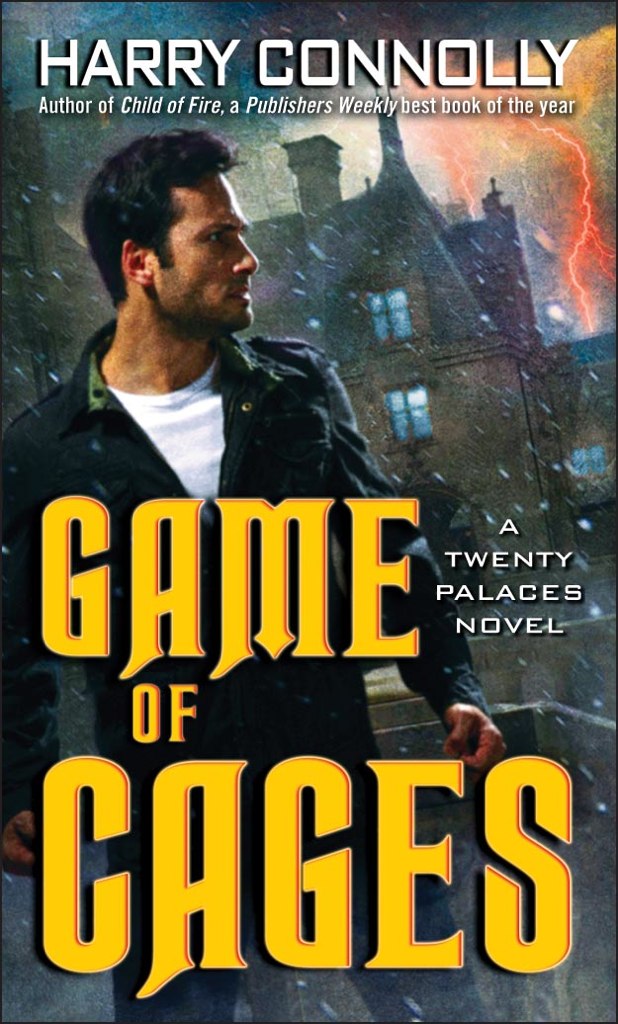
GoC Cover Art!

Standard

One of my LiveJournal commenters (thanks, geniusofevil!) mentioned that the cover art for Game of Cages is on the Amazon.com site, which I’m taking as explicit permission to post the art here:

Whoo-hoo!

Game of Cages

Mysterious house? Check. Red lightning? Check. Windbreaker and t-shirt in the dead of winter? Check. A facial expression that suggests someone needs some killin’? Check-check!

And, because this image is a little small, the text under my name says: “Author of Child of Fire, a Publishers Weekly best book of the year”

Thank you, generous PW peoples!

Side notes: the polish of Man Bites World continues–actually, it’s picking up pace as certain distracting domestic sleep issues have been resolving. Also, I received the contract for the Russian sale yesterday. I’ll read through them tonight and mail them back tomorrow. Then, more money!

I’ll call this a good day (so far).

UPDATE: I uploaded a larger image so it’s easier to see.

My editor writes a post

Standard

Betsy Mitchell, editor-in-chief at Del Rey, tallies up the reasons she rejected novels last year. It’s pretty interesting if you’re a writer-type. Be sure to read the comments, too; Betsy addresses several questions specifically.

Everyone Wants to Go to Heaven, But Nobody Wants to Die

Standard

Jim Hines talks about killing characters in books, especially beloved characters and protagonists. You can see the discussion on his main website or follow a much larger conversation (by a factor of ten or more) on his LiveJournal.

I posted a comment there (my LJ handle is burger_eater, for those not reading this post there) but wanted to expand a little: When it comes to killing characters in violent stories–and many fantasies rely on fighting for their conflict–there’s a wide spectrum between the slasher flicks at one end (where everyone dies) and the A-Team (where a whole armory-worth of bullets are fired but no one is ever hit).

Where readers fall on or within those extremes depends on the type of book they’re reading, their mood at the moment, or whether the wind is southerly. That’s natural. But I was astonished by the number of people who said they felt “betrayed” by the death of a major character.

Personal (and spoiler-free) story: When [Major Character] was killed in the first book of A Song Of Ice And Fire, I was startled and grateful. It was a real Joe Bob Briggs moment*, thank you muchly, and it showed me just how much danger these characters were in.

Contrast that with the end of that Tad Williams tree-killer epic, where ten or twelve characters rush into a headlong fight with Big Evil but only one minor character loses his life.

If the reader is ready for it–if they’re willing to go along–it’s powerful and fun. If the reader is not ready for it, either because a book has too much killing or not enough, they feel manipulated.

Of course, no one story will satisfy everyone, but I sure would like to work out the fat spot on the bell curve.

* Joe Bob Briggs number one rule for a great horror movie: “Anybody can die at any moment.”

Added to the list of things I don’t need

Standard

I don’t need my morning coffee to provide dietary fiber. Stupid broken filter.

Low/High Thrillers – Obligatory genre disclaimer here

Standard

We all know that genre definitions are inexact (to put it mildly). Stories defy easy categorization, and that’s what genre (and sub genre is all about). Still, humans like to sort things, and we like to think of things by their types. Which is why I’m typing all this out.

Most everyone reading this knows the meaning of the term “High Fantasy” (warning! that’s a tvtropes link!): Fictional-world stories about kings and armies, lots of magic, vast and powerful Evil, an epic scale, and the characters are people firmly within the halls of power.

In contrast, Low Fantasy seems to have been created to cover everything else. It doesn’t, not really, but low fantasy is often characterized as having little magic, small stakes and a less GvE morality. The characters are more likely to be common citizens–often they’re part of the criminal class–and the story centers on their personal problem rather than the fate of the world. And while High Fantasy is often noble in tone, Low Fantasy is frequently cynical or funny.

Now, yeah, we can all come up with examples of stories that straddle definitions–we don’t need to check off every item from the list for something to be one or the other. LOTR is certainly High Fantasy, even though it doesn’t have all that much magic in it, for instance, but Conan falls pretty solidly in the Low Fantasy tradition.

A while back, I decided I should apply these descriptors to thrillers. I’m talking about books here, not films, because in movies “thriller” means something different. My idea is that a High Thriller concerns people in power–not kings, obviously, since thrillers are set in our world, but Presidents, CIA officials, FBI investigators, DEA agents, etc. A High Thriller has gigantic stakes, good guys and bad ones, and a major part of the appeal is that it gives the reader a peek into the “halls of power” to lean heavily on a cliche.

Want to know how the president stays connected while on Airforce One? Want to know how a CIA Agent files secret reports? Curious to see how a White House Chief of Staff spends his day? A High Thriller makes an implicit promise to the reader that the writer has researched the book to the degree that, while the characters and the dangers are fictional, the depiction of how these powerful people and agencies act is bulletproof.* In fact, that research is part of the foundation of the genre’s appeal.

By contrast, a Low Thriller doesn’t portray powerful people. It generally portrays low level criminals or regular citizens who get caught up with low level criminals. An insurance salesman’s black sheep brother turns up after 15 years, with criminals on his trail. The criminals want the money the brother stole, and they’ll do anything they have to do to the salesman’s family to get it. Or a low-level mobster realizes he’s about to be betrayed by his bosses. Or some oddball criminal types try to pull off one last job, with comically disastrous results.

David Morrell and Elmore Leonard write these sorts of books, along with many many others. They might be noirish or comic. The characters are rarely wholly good or bad (although the villains are often crazed killers) and a tense confrontation is more likely to take place in a motel or boiler room than the Oval Office.

Which isn’t to suggest that Low Thrillers aren’t carefully researched, or that the research isn’t part of the appeal. But typically, the research isn’t there to give the reader a glimpse at the tools and methods of power.

Low Thriller is my favorite sort (and I’m still trying to work out how it differs from and overlaps with “Detective Fiction”) but I’ve been trying to figure out how this dialectic would map onto urban fantasy. High Fantasy and (my invented idea of) High Thriller both focus on people of authority and power, and there’s certainly a lot of that in UF. You have werewolf clans, vampire courts, wizard societies, etc., each with its own politics and area of authority. You also have outsiders, criminals and average citizens (well, not as many of those as I’d like). You have stories about the end of the world, and stories about small-scale threats.

It’s something I’m going to be thinking about.

* Police procedurals also rely on this sort of bulletproof research, but they are generally not thrillers and have a different sort of appeal.

Woo-hoo! Child of Fire Makes Another “Best of 2009” List!

Standard

This time the list is at PopSyndicate.com. Here’s the link.

The author added an “e” to my last name, but hell, everyone does that; at least she’s done it in an unusual way. Here’s a quote:

“This one has some delicious creep factor to it, and Lilly is a protagonist that you find fascinating.”

Did you hear that, universe? You find him fascinating!

Hee. I’ll write a grownup post sometime soon. :)

Randomness for 1/6

Standard

1) A cult I might join, and a manifesto that would do me good.

2) This is an article I’ve been waiting a few days for: What if the Christmas bomb had exploded? Did the Nigerian terrorist have enough explosive to bring down the plane? The answer seems to be “Maybe, but probably not.”

3) Lunch Lady Paper Dolls! Not your average lunch lady, either–it’s the crime fighting lunch lady from the popular comics.

4) Pride and Prejudice, told through emoticons. This is awesome.

5) The Venn Diagram of Cookie Status.

6) The difficult, difficult work of plotting AVATAR.

7) Screenwriters are trained to fail the Bechdel Test. “Ego and laziness – the intrepid supervillain team!” via Jim Hines.

Giftmas

Standard

This Christmas, my wife bought me a Wii Fit Plus and a huge (as in eight inch by five inch tin with a candy bar in it. At first, I was surprised by this. Wouldn’t the “Dark Chocolate Caramel & Sea Salt Bark” counteract the exercise games?

Apparently not, because I’m not the one who was supposed to be eating it. I had, in fact, been saving it, but when I opened it today, all but an inch-and-a-half was gone.

Now, I’ve certainly been guilty of giving people things I wanted. For years I gave books that I wanted to read to my friends, with a polite request to read it when I was done. Hey, I was poor.

But those were books. When you finish a book, you can hand it to a friend. Fancy candy, not so much. My wife, she’s a smart woman. Oh, and it’s really good candy.

I just got home

Standard

… and found the cover art for Game of Cages waiting in my inbox.

!!!

I don’t have permission to share it yet, so I will have to share my excitement instead.

:-D

It’s not “selling children”. It’s “selling parenting rights.”

Standard

The (supposed) moral implications of selling children according to libertarians.

Having said that much, I’m sure you know exactly what you’ll find at the other end of that link.