A Cool Opportunity for Anyone Interested in Film FX

Standard

Cinefex Magazine is going to digitize their backlist, and this Kickstarter gives you the opportunity to pick up, say, all of their stop-motion issues, or all of their Star Trek or Star Wars issues.

Anyway, FYI.

My last Clarion West writeathon post

Standard

It’s my last because I’m done. I wanted to add 40,000 words to my epic fantasy to reach 180,000, which I’d hoped would be the end. I’ve done that. If you pledged, thank you very much. If you haven’t, you still can here. Clarion West. It’s a good thing.

Unfortunately, I wanted to have this book wrapped up by now and I haven’t. That sucks. I have to say that, as the first fantasy writer to ever write long on an epic fantasy, my embarrassment is pretty huge.

Also huge is my desire to be done with this story and on to the next. I did 1600 words today and hope to double that tomorrow and Saturday. There’s a Kickstarter coming, and ebooks, and POD, and so on. Then it’ll be something new.

“I’m the best there is at what I do, which is lose fights.”

Standard

I’d heard THE WOLVERINE was okay but not great so I thought I’d give it a watch. Personally, I think “Okay but not great” is overstating things by a mile, but it can be instructive to watch and talk about movies that fail, so what the hell.

Spoilers.

The basic plot is this: Logan is freed from a WW2 POW camp just outside of Nagasaki just as The Bomb is being dropped, and he saves a prison camp guard’s life, mainly because he freed Allied prisoners as soon as the air raid sirens went off.

Actually, never mind the motivations. Motivations aren’t going to make much sense here.

Anyway, jump to the modern day. Logan is living in the wild like a depressed hobo, dreaming about Jean Grey, the woman he loved and killed in the third Xmen movie, when a fellow mutant (one of those plot-convenient precogs) whisks him off to Japan to meet that same prison guard it seems he’s now the super-wealthy head of a giant corporation and he’s dying. He’s also willing to take Logan’s healing factor off his hands, since he knows (somehow) Logan thinks of his eternal life as a curse.

There’s some handwaving about how Logan’s healing factor has to be “suppressed” before it can be transferred, and he spend most of the movie in some weird gray area limbo of minor powers where he can be slowed down and made to limp from gunshots or whatever, but he’s not unkillable anymore. Nevermind that his powers are supposed to be genetic.

Anyway, there’s a snake woman villain named Viper who spits poison acid at people and brags about being immune to poison (I’ll bet that comes up all the time) but who seems to have no motivation other than to get paid and therefore has no reason to stick around for the lethal battle at the end. There’s a beautiful woman who, being Asian, has a sad history; also, she must get kidnapped as soon as Logan fucks her. There are ninjas who declare themselves devoted to the old dying guy but who shoot arrows at anyone the plot requires. And there’s the Silver Samurai, which in the movie is a gigantic robot-looking thing (actually a suit of armor, and boy will you be unsurprised to discover who’s driving it).

And you know what? This is all stupid and careless and a little insulting, but it’s not like I’ve never enjoyed a movie that was careless for the sake of being fun.

However! THE WOLVERINE has an astonishing lack of fun. There’s a fight atop a bullet train that’s inventive and different, but all of the other confrontations are nothing new or interesting. There’s a running fight at a funeral and through the streets of Tokyo that looks like the same mook tussle over and over. There’s a red neck bar fight. There’s a samurai sword/claw fight right where you would expect to see it.

And the ninjas, man. That whole sequence sucked the life out of the movie. Logan has to get off his motorcycle for reasons, and he has to not fight the ninjas because if there’s one thing Wolverine fans hate, it’s seeing him slice up a bunch of ninjas.

Worse, he just runs down the center of the street so they can shoot arrows into him. Not even a little juke to the side here and there.

The weird thing is that, Movie-Wolverine never says “I’m the best there is at what I do,” because on the movie hero level, he’s a really shitty fighter. Because he has a healing factor, filmmakers stage fights where he’s shot in the gut from close range, stabbed, bashed on the head with a bat… It doesn’t matter! He can’t defeat a trained samurai without his healing powers because he has to let the other guy get five or six lethal blows in before he can score one himself.

The ninjas kick his ass with poison arrows. The Yakusa who kidnap Sad Asian Lady shoot him in the leg because he helpfully announces that he’s rushing to the rescue. The Silver Samurai beats the hell out of him until Sad Asian Lady intervenes.

I mean, nevermind that the climax shows the baddie stealing Logan’s (unsuppressed) healing powers by… drilling into the stumps of his wrecked claws? How does that even work? But nevermind. The whole movie is about a guy who really sucks at what he does.

If you’re going to make a Wolverine movie, you don’t show/use his healing factor in every fight. You save it for the true badasses. And you don’t line up a bunch of ninjas opposite him and have him run away, ffs.

Disappointed.

Added later: Cracked’s “The 9 Worst Things Comic Books Have Ever Done to Wolverine”

Randomness for 8/1

Standard

1) A male comic artist puts out webcomics under a female name and sees things from the other side.

2) Saddled with student loans in the U.S.? There are ways to get rid of them without paying.

3) The best places to build wind and solar power by the map, and it’s not where you think.

4) Best way to out a superhero’s secret identity: UV gun. Superhero tan lines.

5) The Machete Order: How to watch the original Star Wars films and the prequels in a way that doesn’t suck too much. h/t LJ user blackhanddpants

6) William Gibson on the visual and thematic virtues of PACIFIC RIM.

7) Vanishing literature: more evidence that our copyright terms are too long.

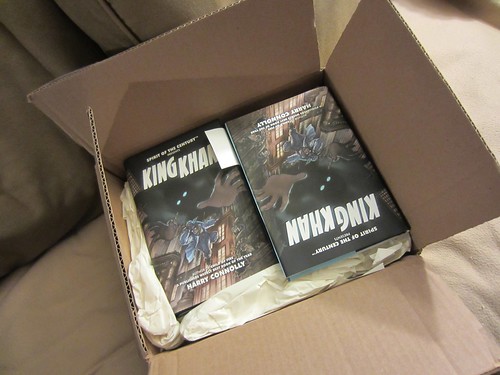
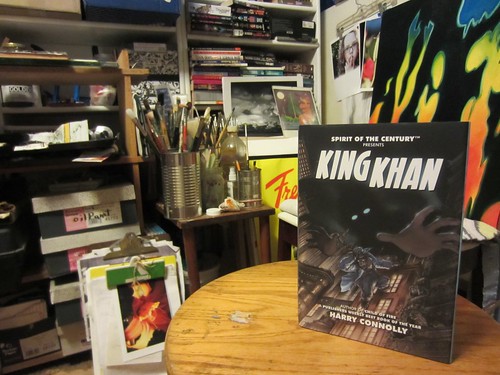
Look what arrived last night! My newest book!

Standard

THE BOX:


IMG_2065

THE BOOK:


IMG_2066

The insides are even prettier, but you’ll have to buy a copy to see those. You can pre-order it now from:

Amazon | Indiebound

Or, you can win one of the copies in that box. I’ll be holding a giveaway AFTER Stephen Blackmoore’s Khan novel comes out in August. (King Khan is a standalone sequel to his Khan of Mars.) Of course, you can order his book too: Amazon | Indiebound

In case you don’t know Stephen’s work, his debut urban fantasy novel City of Lost Things was one of Kirkus’s Best of 2012. Recommended!

Randomness for 7/25

Standard

1) Weird Ways To Burn 200 Calories. Video.

2) Excaliber, the world’s tallest (121 feet) free-standing climbing wall.

3) First of all, how do the astronauts was their hair in zero G? Awesome! Second of all, female astronaut. Awesome! Last, hair care tips from the woman on board? Hmph. I hope she gets to play guitar or something next time. Video. (Still, zero g hair-washing.)

4) The terrible and wonderful reasons I run long distances, by The Oatmeal.

5) Favorite movies laid out as vintage treasure maps.

6) Ryan Gosling Won’t Eat His Cereal. This is so simple and absurd. I love it.

7) This is what happens when you try to take video of police in Sweden. Video. (h/t to James Nicoll).

Congrats, English-type people

Standard

Congratulations to the British royal family on the birth of Tyrion Khaleesi Jeoffrey Cambridge. Don’t drink too much on your boar hunts, kid.

Sometimes people email me for writing advice

Standard

My first instinct is to tell them ask someone successful. For serious, it seems odd to ask for tips from Goofus when there are so many Gallants out there. But they write anyway, because they liked my books and they think I might have something useful to say. It’s extraordinarily flattering and I owe those people the respect of my best answer, whatever it’s worth.

So, with the permission of the person who emailed the questions below, I’m going to post the questions and do my best to answer them. Hopefully it’ll be informative to some of the ones of visitors my blog gets every day.

I have many ideas and have filled many notebooks about what I want to write. I am having difficulty, however, with the start up. How did you decide to do a first person versus a third person perspective? I know where I want my story to start, end, and what goes on in the middle, but still have problems constructing a full sequence. Did you create that first, or was it a flow of writing? If you created it, how did you go about that? I am also struggling with the time issue. As the father of 2 toddlers, my time gets drained fast. Do you have any tips for a writer that can only get 1-2 hours (usually 1) of dedicated writing time in a given day? If you have any advice to give to someone starting out, I would greatly appreciate it.

There’s a lot there so I’m going to break it up to address the questions with a little depth.

I have many ideas and have filled many notebooks about what I want to write. I am having difficulty, however, with the start up. How did you decide to do a first person versus a third person perspective?

Choosing between first and third (or second, or omni, or…) is a pretty big topic. The best way to address it quickly would be to cover a few basic points:

    What’s traditional for the genre? (Embedded in this question: What do readers expect?)

    What differing tools do each POV provide you?

    How close do you want the readers to get to the characters?

The first question is pretty straightforward: grab a bunch of books from your shelf like the ones you’re writing, and see how it’s done. Boom.

The second question is more complicated, but the simplest summation I could give is this: Third person lends itself to multiple viewpoints in a way that first doesn’t. Multiple first novels never seem to work all that well for me. First person lends itself to POV character as expert stories: the detective who knows his way around the local criminal element is the classic example. First lets you skip the audience stand-in character who has everything explained to them (for the audience’s benefit) because that POV lets the character talk directly to the reader.

That’s not an exhaustive list of the differences between them by any means, but it’s a start.

The last question is where my advice seems to contradict what others think: IMO, first person POV is not as “close” as third (limited), because the POV character is describing things in their own words. In third, you’re like one of the angels in WINGS OF DESIRE, the character’s invisible buddy. In first, you’re only getting what the character wants to share.

I know where I want my story to start, end, and what goes on in the middle, but still have problems constructing a full sequence. Did you create that first, or was it a flow of writing? If you created it, how did you go about that?

This isn’t something I can address specifically because it’s so general and I haven’t read any the specific work, however I would suggest that, if you have the beginning, middle, and end but can’t connect them, you don’t really have a middle and an end yet.

A lot of people think beginnings are the easiest part. Some people hate endings. Most of the world hates doing the middle (except me–middles are cool by me). However if they don’t work together there’s only one thing you can do: throw something out.

Sometimes you’ll have a story idea for a specific character and the plot events will be based on that character. Sometimes you have a specific plot and create a character to serve it. Sometimes the plot and character create each other in a way that feels (to me) like leapfrogging.

So if the parts of a story don’t fit each other, you either need to toss the character and introduce a new one or you need a new middle and end. As far as I’m concerned, neither choice is necessarily better than the other; it’s your art and it should serve your sensibilities. All that matters is the final result.

Personally, I tend to outline the beginning and middle of the book, then start writing. It’s an act of trust for me to believe that the story elements that emerge from the creation of the book will provide an ending. So, I’m both an outliner and a non-outliner.

That won’t work for everyone, obviously, and the only way to find your best method is to try different things. Just remember that, when you outline, you’re creating a first draft. It’s a very abbreviated first draft, but it follows the same logic as any other story: don’t put in what you want it to do, but what makes sense for the characters. It’s about what they want, what resources they can bring to bear on their problems, their moral/physical/emotional limitations, and who they interact with. That’s what directs the story.

One last consideration is that many readers buy the book for the characters’ emotional journeys. They want to see them change, and to see their screwed-up relationships change, too. When you’re putting together the sequence, as you call it, pay attention to that at least as much as you pay attention to the plot logic.

I am also struggling with the time issue. As the father of 2 toddlers, my time gets drained fast. Do you have any tips for a writer that can only get 1-2 hours (usually 1) of dedicated writing time in a given day? If you have any advice to give to someone starting out, I would greatly appreciate it.

I wrote CHILD OF FIRE an hour or two every day. It’s doable. In my post called Ten Things Writers Shouldn’t Do, I talked about coming to the page cold. Try not to. You’ll make the best use of your limited writing time if you already know what you’re supposed to be writing that day when you sit down to do it.

So, one to two hours a day isn’t bad, especially if you’re the sort of person who can really buckle down for that limited amount of time because it’s so limited, if you know what I mean.

However, I have to add this: toddlers steal your time. That’s their job. They are tiny unformed people who rely on their parents and other loving adults to form them, and these early years are incredibly important. If there’s any reason at all that could justify skipping a writing day, tiny kids are it. So, be flexible about your time, at least for the toddler years. Later it will be important for kids to see their parents take time for themselves, but right now sacrifices are the order of the day. If it gets too hard, tell yourself that it gets easier as the kids get older (which is true).

Remember also the advantage that men have over women in these situations. When a father takes time away from his kids to work, he’s making a regrettable sacrifice for his career. When a mother does it, she’s a bad person. The double-standard around being a writing parent is an ugly thing, and I’ve known a lot of people who went through a divorce (or came scarily close to one) during the toddler years. The main reason: Dads leaned too hard on moms to do all the parenting while they took care of everything else (including themselves and their own ambitions) and the moms go nuts because they spent all their time with tiny dumb irrational people.

So, while it’s important to protect your writing time from outsiders who want you to spend it on them, be sure to protect your family time from your writing ambitions, and make things as easy on your kids’ mom as you can.

One thing I’ll add that wasn’t addressed in a question: It’s important to develop a feel for narrative. Call it skill, call it taste, call it talent, but the most important ability you can develop is the trick to understanding the effect your written words will have.

That comes from developing a feel for things, and that comes from studying other people’s work, retyping it, and revising your own stuff with a fresh eye. Writers need to be able to feel (accurately) the effect their words will have, and that means honing those senses and paying close attention to them.

Good luck.

Movies that work without making any damn sense

Standard

PACIFIC RIM: the story of a talented but troubled pianist searching for love.

At least, that’s what I told my son it was about when I told him we were all going to see it. He’s old enough to to tell when I’m joking most of the time, but I kept telling him it was part of music appreciation and homeschooling, so he eventually just flat out admitted “I can’t tell if you’re being sarcastic or serious.”

Note to self: teach son meaning of “sarcastic.”

Anyway, once he saw the poster outside the theater, he knew there would be zero piano players. He bought his usual treat of a small popcorn with extra butter, but when the movie ended it was completely untouched. He’d been so engrossed in the film that he’d forgotten all about it.

A big question for me is: WHY? He wasn’t half a block away before he started picking nits. Why did the pilots have to be inside the robots? being the big one. My wife and are were also laughing about how ludicrous the whole thing was: Our Hero has a jaeger that is analog, not digital, because it’s nuclear powered? I guess that mind-meld technology runs on diskettes.

Anyway, the whole thing is deliberately absurd, but also powerfully affecting. When we got home, there was a Netflix disc in the mailbox. It was THE MATRIX, another movie that worked like gangbusters despite the fact that it made no damn sense at all.

So why do they work? It’s not the spectacle. There are plenty of dull movies full of spectacle. (We just watched 2012, so that’s fresh in my mind.)

The real secret is that the relationships between the characters, and the way the characters change, is what draws us in. Yeah, there’s a visceral thrill from the sight of claws, teeth, and roaring. Yeah, the music gooses your emotions.

But all of it falls flat if the emotions don’t work.

The funny thing is that I spent years trying to understand narrative structure, and so much of that time was spent on plot mechanics and exposition. It wasn’t until I began using the structure to focus the characters’ emotions and relationships that I began to have any success at all.

Stories are better if the plot makes sense, but if the characters don’t appeal no clockwork plot in the world will make it worth the audience’s time.

Five Things.

Standard

1) OMG, another terrorist attack in England! But maybe you haven’t heard of it because it was an attack against a mosque.

2) We only just started watching GLEE on Netflix (and I didn’t much like it) but we were all saddened to hear that one of the stars died of a drug overdose.

Media reports keep saying “He had just spent a month in rehab to break his addiction” as though it’s a shame that rehab failed him, but what few people say is that the risk of death by overdose is incredibly high after an addict has been clean for a while. Their tolerance drops, and when they fall off the wagon they go back to pre-rehab levels of drug use. That can be lethal with lowered tolerance.

I realize it could be undermining to say: “We don’t want you to fall off the wagon, but if you do…” but someone ought to warn people.

3) And of course there’s the Zimmerman verdict, which… Christ.

Not only are you well aware that many people are afraid of you—you can see them clutching their purses or stiffening in their subway seats when you sit across from them—you must also remain conscious of the fact that people expect you to be apologetic for their fear. It’s your job to be remorseful about the fact that your very nature makes them uncomfortable, like a pilot having to apologize to a fearful flyer for being in the sky.


It is painful to say this: Trayvon Martin is not a miscarriage of American justice, but American justice itself. This is not our system malfunctioning. It is our system working as intended. To expect our juries, our schools, our police to single-handedly correct for this, is to look at the final play in the final minute of the final quarter and wonder why we couldn’t come back from twenty-four down.

To paraphrase a great man: We are what our record says we are. How can we sensibly expect different?

4) There’s a growing movement for people to boycott the movie ENDER’S GAME because the author of the novel is a wackadoodle homophobe who done work for the NOM and has, in the past, advocated revolution if the same-sex marriage became legal. Lionsgate acknowledged the issue in their own official response, but I like this response better.

Personally, I doubt I’ll be seeing the movie myself but I was already meh on it before I heard about the boycott. Color me skeptical of stories about child soldiers. Besides, if I’ve already skipped the sequel to the rebooted Star Trek, Epic, Oblivion, and a bunch of other half-baked summer fare, I really can’t see myself stealing writing time for this film.

5) In much lighter news, JK Rowling published a book under a pen name, which was just outed last week.

I’ve talked about this a lot on Twitter and it’s hard to summarize everything for this space. Personally I think it was a smart thing for her to do; a pen name gives her the freedom to write without expectations. No one is comparing her books to the last Potter book, no one expects a huge event out of it. It’s just her doing what she wants.

Now that it’s out, of course, it’s like the blind wise sages describing an elephant: Some people think she tried to abandoned her fans, some think she proved that publishing is all (or mostly) about luck, some think it’s all about how a few bestselling authors dominate the market and make things incredibly difficult for new and midlist authors.

And then there’s this:

Which I think is hilarious.