Writing the last 20P along with birthday wisdom

Standard

June Blog Post

For once I’m going to start with news about the book I’m working on, then move on to other topics that maybe no one cares about. 

I typically write the Twenty Palaces books with short chapters, but for my own convenience, I’ll separate them into sections, and each section will have a semi-cryptic little title such as “Seizing Treasures” or “An Uneven Apocalypse”. Basically, it creates manageable sections for searches, revisions, whatever. 

Well, last week I created a section called “The Ending.”

Felt weird, guys. 

Writing the Twenty Palaces novels has always been difficult, but this last one is legitimately kicking my ass. I’ve already thrown out a few opening sections, and now I’m trying to wrap up the story in a satisfying way. It’s not simply more challenging than previous books in the series, it’s more intimidating. 

I’m at the point that I think I might have to set this draft aside once it’s finished and let it marinate for a few months before I start work on it again. Maybe, at the end of that time, I’ll have thought up a decent title, too. 

During that delay, I’ll do one more revision on the last pure fantasy novel I’ll ever write, then I can return to this current book, then I can write something new to hand to my agent. I have a novel idea waiting in the shadows, impatiently tapping its foot waiting for me to get to it. 

Moving on: tomorrow, the day after I send this out, will be July 1st. I’ve said many times in this space that July 1st is not my birthday, but it is the day I celebrate my birthday. And this past birthday was my sixtieth.

I think, having reached sixty years of age, I’m finally able to admit that I’ve failed at achieving the lifelong dream I had for my writing. 

I’m grateful for the successes I have had, and also for the readers who are still interested in my work. 

Honestly, I feel very lucky.

But my books doesn’t excite enough people to build the large group of readers I’d hoped for when I was younger, and no matter how hard I try, I’m not as prolific as I’d like to be. 

Which means I’m just me, a guy who revises and revises, then thinks again and revises again, until I finally release something I’m not entirely happy with. I’ll keep writing, of course, for however many more years my body gives me, but I’m giving up on hope. Hope is poison.

In other news, I recently picked up a book by a new-to-me author that was highly recommended, who gave a smart and charming interview on a podcast I enjoy, and the book has a genre mix that I find genuinely exciting. 

Then I opened it up to the first page and read a scene featuring Our Hero having a breakfast meeting with a fat person who is eating fatly. 

I understand that spectacle is an ordinary part of storytelling, but a fat person eating bacon is not spectacle, and I’m not looking for a book that expects me to feel revulsion, contempt, and pity for a person who is like me. It’s cheap, thoughtless contempt. 

I’m still reading it, though. It’s got good stuff in it. 

And finally, I’m watching Ironheart and it’s genuinely weird. It has great characters and a solid cast. The story is engaging, the lead is appropriately troubled, and everything feels fresh.

But not the superhero tech. All the superheroing stuff that used to be the real highlight of these shows now just feels samey. It’s the idea of spectacle again, I guess. The story is great but the superpower thrills are just not there. 

Which is not to say that I’ve become immune to or exhausted by the inherent fun of superpowers. A few weeks back, I watched Kraven (because I hate myself, apparently) and the one and only thing it had going for it was the fluid superhuman strength and agility of the main character. That one element was beautiful to watch, like an incredible dancer or martial artist. 

So the appeal remains, but Ironheart doesn’t know how to exploit it.

And that’s it. I’m going to go back to work on the book. I hope everyone is doing well.
An Update About Disappointing Things, and Things That Did Not Disappoint

Standard

Let’s talk about disappointment

First of all, the book I’m reading now is a bit of a disappointment. I’m not going to name it, but it’s a multi-author thing designed to showcase their talents, and I have been mostly bored so far. 

My son told me to quit it, which led to an uncharacteristically passionate tirade against “Sevens”. 

“No sevens!” he yelled. “Sevens are the worst! I am anti-seven!” 

By his reasoning, if a book, movie, game, whatever is an eight, nine, or a ten out of ten in quality and enjoyment, great! Keep going! If it’s a three or four out of ten, it’s easy to just put it aside. 

But a seven is something you mostly enjoy, then completely forget about. Pleasurable, but not pleasurable enough to be worth your time.

As a philosophy that seems pretty sound, except it’s coming from a guy who eats a whole lot of frozen pizzas. Anyway, it appears that having multiple authors is a lure that will keep me going, even though the book isn’t as promising as it seemed at first.

Second, one of the problems I mentioned in previous posts is that I’ve been struggling with a minor, nagging health issue that has an outsized effect on my life. 

Anyway, a few months ago I starting taking these injections of a drug that was supposed to put a stop to all that trouble. The allergist told me his wife had the same problem as I did but the injections cleared up her problem with no fuss. If I could get insurance approval, I could have the same benefits. I’d be able to exercise again and maybe take simple manual labor jobs. 

Well, I’m getting my third injection next week, and so far I’m not seeing much effect. Yeah, it should fade after each shot and each shot should increase the effect, but I’m wondering if the allergist is expecting a placebo effect to kick in here. 

There’s a certain manner doctors adopt when they try to placebo away a minor ailment along with an insistence on the efficacy of a particular drug. I feel wary when a doctor is telling me a drug is so powerful that we need to all sorts of precautions in place.

Sadly placebos have never really had a strong effect on me. If think if they did, I’d still love Star Wars.

Third, there’s New Fantasy Novel. 

Last week was the fifth anniversary of the date this (unnamed) book was sent to an initial round of publishers. Five years and one pandemic later, there are only two left who have it under consideration. 

If these last two pass, I’ll be releasing it myself as usual, and as usual paying Patreon supporters get the ebook free. 

Still, disappointing to get all those passes. 

Fourth, I mentioned before that I’ve been on a job hunt. It ain’t going all that well, in part because of the health stuff I mentioned above. In part because I’m not really good at much.

Fifth, we come to a topic that is not disappointing. There’s a show on Hulu/Disney Plus that I really loved called MOVING. It’s about two generations of ordinary citizens with superpowers and the way their governments try to exploit them. It has great reviews, and the negative ones all complain that it starts too slowly.

I’d disagree. I say it starts small. The show is a collection of small stories, starting with one kid whose power is more of a curse, then moving to this supporting character, then to that one. Sometimes it’s a love story. Sometimes it’s espionage. Sometimes it’s a wild, out of control murder spree. Often, it’s people fleeing from place to place, trying to live small enough lives that they can be incognito. Great stuff. 

Sixth, there’s the writing, which is also going well. I know I have to revamp the beginning again, but this time I pushed past all that and am working on the escalating tension part of the story. 

Even better, I feel like I’ve captured the feeling inside it. 

It’s still the most complex book I’ve ever tackled—even more complex than One Man. Revisions are going to be fun (in the “challenging” sense) but it feels fantastic to have momentum.

Finally, a question if you’ve bothered to read this far. 

Do you mind these updates with several topics all combined? 

John Scalzi does them one at a time, but I’m afraid if I did that it’d give away how many tv/movie recommendations I’d want to give. 

Also, I’m kind of dull. I don’t have pictures of beautiful places I visit or insights from fascinating people I meet. I don’t claim any expertise on political topics. We have no pets. 

Single topic posts might be more reader-friendly, but they might also be booooooring. Which would return us to disappointment again. 

Let me know in the comments on Patreon, or @ me on blusky, where I’m @byharryconnolly as per usual, if you think these should be shorter and more numerous. 

Stay safe. 

When A Show Is Renewed But The Storyline You Care About Most is Cancelled

Standard

Many—not all but many—movies have two genres. The first tells the story of the main plot line: the heist, the hunt for the spy, the fight to save the farm, the escape from the haunted house. Those are all the high-stress moments of the story, building tension to the finale. When the marketers cut a trailer, this is the genre they focus on.

The second genre tells a story in the down moments of the plot, when the tension of the main plot is allowed to ease and reset so it can be ramped up again. Traditionally, these would be romantic plots, but sometimes it’s a coming of age story.

TV does something similar. For example, Elementary was a mystery show that had, for its second, much smaller secondary plot, a little drama that played out within the main cast. Most focused on the growing friendship between Sherlock and Joan, but some were about Joan’s family, or Sherlock’s, or their circle of friends.

And since it’s an episodic show, the main-plot mysteries were one and done but the little dramas stacked one on top of the other, building over the long term to something wonderful.

Honestly, in TV it’s those tiny dramas, building one upon the other, that keep me coming back episode after episode. The Mystery of the Week keeps me entertained. The slowly changing relationships between the main characters makes me binge a whole season to Find Out What Happened.

Another example: for years, I was faithfully picking up Sue Grafton’s alphabet novels, one after another, because a) the private eye plots for each book were solid as hell, and b), the main character, Kinsey Milhone, discovered that she had a huge extended family that she knew nothing about, and the subplots of each book showed her inching closer to the family she never knew she had and wasn’t sure she wanted.

I really wanted to know what happened between Kinsey and her estranged family. I could find a solid mystery in any number of books, but the family drama is what kept me coming back.

Then the subplot suddenly shifted into a romantic plot featuring a good-looking homicide detective who used to be a hairdresser(!) which meant he could fix Kinsey’s famously terrible self-inflicted haircuts. I was so annoyed that I dropped the series immediately. I’d been coming back for the reconciliation with her family. The sexy hairdresser/homicide detective left me clammy.

One of the reasons I never watched House was that, while the main plots were interesting enough, I didn’t like watching the character dramas play out. It just felt so squicky. In fact, there are a lot of shows that I ditch after a few seasons because I feel absolutely done with the kind of subplot dramas the show puts its characters through.

Anyway, the reason all this has bubbled to the surface is the British show Miss Scarlet and the Duke. Brief description: Eliza Scarlet is a Victorian-era daughter of a police inspector and private investigator who is obsessed with being a private investigator herself, and of course she’s brilliant. “The Duke” is the nickname of a Chief Inspector of Scotland Yard, William Wellington. They’re childhood friends who love each other. The dynamic on the show is that he helps support her struggling business while she solves his most difficult cases.

Did I mention that they love each other? In season one they’re friends trying to accept their mutual attraction. Season two has them in a romantic relationship while Eliza’s dedication to her work keeps causing problems for William. Season three has them trying to be friends post-breakup, even though William begins dating Eliza’s childhood bully.

Then season four hit the library on disc and I was 100 percent ready for it. Three ended with the (now more adult and sensible bully) dumping William because he can’t admit that he’s still in love with Eliza. So four ought to be the season where they try again and actually make it work, right?

Well, no. Instead, William takes a posting in New York City. He tells Eliza that he loves her but that they need time apart.

And the next thing I discover is that season five will be called simply “Miss Scarlet” because Stuart Martin, the actor who played “the Duke”, is leaving the show.

Which I get. It can’t be fun to be the cop who scolds the main character for all the cool and fun ways they break the rules. Taraji P. Henson pulled the ripcord on Person of Interest because her role had changed and she’d become bored. I’m sure Martin believes there are better ways to spend the sexy leading man years of his life.

But I’m not sure I’m interested in a show without that subplot. The structure of each episode was such that each multi-season-long subplot was woven tightly into the execution of the mystery of the week. What, exactly, is supposed to fit into that space?

I have no idea, but it’s like imagining a Twenty Palace novel without Annalise. It just doesn’t make sense to me.

I mean, I’ll give season five a try, but I have to admit that I’m feeling a little cheated. If he’s leaving the show, I’m glad they didn’t kill off the character, because that would have sucked. I’m still disappointed in the unresolved ending of this four-year storyline, though.

(I should write shorter posts)

Terrific Fantasy Novels, Cheap

Standard

A few years back, I entered The Way into Chaos into SPFBO, the Self-Published Fantasy Blog Off, a reviewer-based competition for self-published novels only. My book made it into the finals but didn’t win, due mainly to readers liking the other entries more. Still, I was hoping that a respectable finish would provide a short-term boost in sales and bring in new readers long term.

It didn’t.

I think that last link is pretty interesting, if I do say so myself, and I recommend you check it out if you’re at all interested in book sales and promo.

Still, I don’t regret entering the contest. As I mentioned in the “It didn’t” linked post, some authors got real value from it, mainly by the social groups they formed.

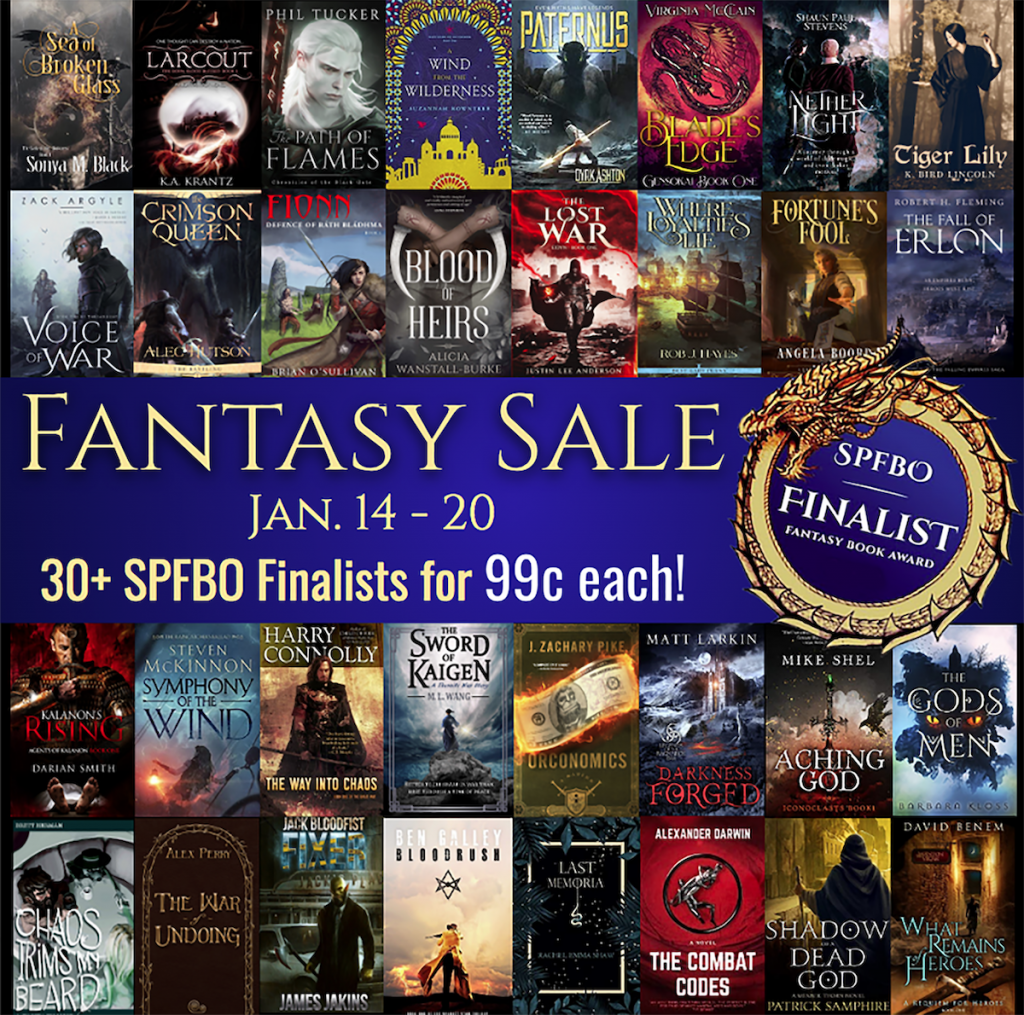
And, there’s an opportunity for cross promotion, like this:

SPFBO graphic

Only some of the books in the sale

Maybe I’m burying the lede here, but what the hell. All the 30+ books in this list are either winners for finalists for SPFBO, and all are only $0.99 for one week. They’re all fantasy, but subgenres include:

humor
military
dark
epic
YA
urban
historical
apocalyptic epic

And so many more. (Guess who that last one belongs to.)

We’ve got a pandemic. We’ve got civil unrest in the US. We’ve got economic turmoil and widespread unemployment. Isn’t now the time to find some fun, affordable fantasy novels for yourself. Even better, wouldn’t they make great gifts for your friends and loved ones? The answer is clearly YES.

Click through and check them out. You’re sure to find a few things you like.

The Pressure to Continue the Story After the Story

Standard

That video below? Worth watching, like Ellis’s other work.

(Actually, I’m sort of assuming the video shows up, since WordPress’s new “block” system doesn’t exactly fill me with confidence.)

If you’ve watched it (and let me say again, you should) you already know that it’s a discussion of some relatively recent critical schools of thought about literature, namely, does the author have any authority over the story and characters outside the published text? Or, to use the examples in the video, does the author get to tell us what happened to the characters after the last page? Do we have to take seriously the secret things they tell us about the characters that’s not in the text (such as, that Dumbledore is gay)?

Like John Green in the video, I’m of the opinion that readers get to choose for themselves, and at least should be able to extrapolate from the story.

As a personal example, a number of readers asked me what happened to Lar Italga after the end of The Great Way. Me, I thought it was so obvious that I didn’t even bother to write it. But that wasn’t good enough for some, and they seemed annoyed when I turned the question around and asked what they thought happened to him. They didn’t want to extrapolate. They wanted the authoritative word.

A number of people also wanted authoritative insight into how the names were pronounced, and “however you like” was apparently not an acceptable answer. I’ve read I-don’t-know-how-many fantasy novels with goofy pronunciation guides and I’ve learned to ignore them. In the privacy of my own head, I think of the characters’ names however I like, but a significant number of readers want the “correct” form.

The video takes JK Rowling to task for many of her pronouncements about the world of the books and the future of the characters. Is it especially laudable to make Dumbledore gay if you don’t include it in the actual book where it would have counted? Do we need an apology about who Hermione ended up with? Do we need to be told that, before indoor plumbing, wizard students crapped on the floor and them magic-ed the mess away?

Lots of people had a laugh at that last one, but it seems she knows what she’s talking about. Click the tweet below to see why I will never ever time travel back to the middle ages in Europe.

I’m lying here being sick while @seraph76 reads me bits of a history of French royal court poisonings and I think we need another terror— rahaf mohammed al-qanon (@AliceAvizandum) January 5, 2019

I know it starts off talking about poison, but it quickly moves to sewers (or the lack thereof) and no, please, authors, do not try for this level of realism. Just click the tweet to open and read. It’s hair-raising.

So, yeah, Rowling has a history of coming up with a bunch of extraneous stuff about the Harry Potter books–seemingly without giving it a lot of thought–and not to the benefit of her books or herself. To which I have to say: Can you blame her?

The Harry Potter books were such a gigantic hit that she has been deluged with questions, many from very young readers. Is she supposed to tell a ten-year-old Hermione fan that the character is a fictional construct with no life or existence outside the text? Yeah, that would go over well.

It’s entirely unsurprising that she launched an entire website (literally “More Potter”) which lists a bunch of character biographies and other bullshit that Rowling (or one of her interns/social media hires/whatever) threw together in an afternoon. That it draws in the hardcore fans (and tries to sell them stuff) is an entirely reasonable way to avoid all those earnest questions flooding the author’s social media.

And then, when a new Fantastic Beasts movie comes out, superfans get upset because the backstory in the movie doesn’t match the extraneous BS listed on Pottermore. Not that it matters. The Hogwarts Cinematic Universe is different from the books, obviously.

So yeah, I get why John Green and other authors (like myself) don’t want to add more story once the story is done. I also believe that Rowling’s circumstances are unique to her, and the pressure on her to drop these little bits of extraneous story must be incredible. I don’t always like what she says, but she has my sympathy.

Some Books I’ve Read Recently

Standard

These include Amazon Affiliate links, so don’t be shocked if a couple of pennies come my way if you decide any of these books are interesting.

Meddling Kids, by Edgar Cantero.

I was surprised to discover that this was a bestseller, since I had not heard of it before it turned up on a “What to read now that you’ve finished watching STRANGER THINGS” list. The author is from Spain and while English is his second language, he brings a beautiful fluidity and a welcome playfulness to the book. Well, mostly welcome. He experiments with the language, and not every experiment is a success, but I was still pleased by it.

Plot: Thirteen years before the events of the book, in 1979, four teenagers (plus one dog) were amateur detectives in their rural Oregon town, uncovering real estate swindles and smugglers in true Scooby-Doo style. Then, during their last mystery, they uncovered actual Lovecraftian evil (and the youngest teen read from the Necronomicon). They awakened something dangerous in their sleepy little mountain town, and at the same time utterly destroyed their own lives.

Now, as twenty-something screwups, they’re determined to return to the scene of their last mystery and solve it for real, in the hopes of putting the madness behind them.

This was fun, and light-hearted, but not as funny as I’d hoped. It quickly turns into a Lovecraftian thriller with a decidedly easy touch. Recommended.

The Hike, by Drew Magary.
This was a fun and funny contemporary fantasy that mixed fairy tale story structure, Stephen King(ish) frights, and some point-and-click video game plotting. That sounds like it shouldn’t work, but it really really does.

Plot: The protagonist, Ben, is a husband and father who has gone out of town on a business trip, but decides to spend the free hour before his meeting taking a brief hike through the woods near the hotel. Except that he gets lost, then he gets chased, and things begin to get really weird. He’s attacked by a giant cricket, captured by a friendly giant that wants to eat him, and finds support–moral and otherwise–from a talking crab.

What keeps the story from being meaningless fluff is that Ben himself is so engaging. A man who seems to be a short-tempered everyman at first quickly begins to show his flaws. Ben has a lot of damage, and he’s not managing it well in his real life. On this mythical hike, he starts to come apart and then puts himself back together again.

The book is funny, breezy, and at the same time, emotionally powerful. And I loved the ending.

The Outsider by Stephen King

What an odd book. For the first 200 pages, it’s a murder mystery. There’s a horrific crime, compelling evidence against an unlikely suspect who has an iron-clad alibi, and an investigation that circles around and around collecting conflicting evidence.

Has the suspect orchestrated the perfect crime? Will the cops crack his perfect alibi?

And just as I became convinced that King was going to give us a straight mystery this time, the story makes a u-turn toward the supernatural, when the characters realize they can’t pick apart either evidence or the alibi, and begin to recognize that Something Else must be going on. From there, it pivots to a King-ish members-of-the-community-come-together-to-fight-evil plot, and on those terms it works well. The ending was a little soft, but overall, a terrific book.

Also, it’s apparently a pseudo-sequel to a set of books I haven’t read, but while that’s obvious in the way the characters talk about their past experiences, it’s not a deal-breaker for the story here.

Edge of Dark Water by Joe R. Lansdale

This one is a thriller and coming of age story without a supernatural element, but it might be my favorite of the bunch. Lansdale seems to specialize in mid-twentieth century east Texas poor folk, when they’re caught up in crime or supernatural evil. (He also wrote some of the best episodes of Batman: The Animated Series)

Voice. Voice is an important part of any book, and Lansdale has the voice of his characters down. For all the time they spend solving mysteries and fleeing from those who want to rob and/or kill them, the real appeal here is the way the narrator draws you in.

A fantastic book. Highly recommended.


Looking these over again, I realize I’ve they were a string of white dude authors. That’s an old, bad habit, and when I finish the book I’m currently reading, I’ll find a way to mix things up a bit.

Win Free Books

Standard

Anyone following my blog knows that The Way into Chaos is a finalist in the SPFBO, the Self-Published Fantasy Blog Off. If you know what that is, you can skip the rest of this paragraph. If not, it’s a contest where 300 self-published fantasy novels are split among 10 review bloggers. Each picks one standout for the final round, then all ten reviewers read the finalists and rate them. The book with the highest score wins the blog off.

Well, the finalists have been chosen, and for a limited time, you can enter to win all ten. Just drop a comment, with some sort of contact info, here.

Hey, free books! And if you’ve meant to try some indie novels, this is your chance.

Rest in Peace, Ursula K. Le Guin

Standard

Writing in this space, I’ve been pretty clear about my own ambitions. It’s not just that I want to be read by millions of people, I also want to fundamentally change things. I hope to be one of those writers that people point to when they talk about how fantasy fiction has grown and evolved.

As ambitions go, it’s beyond me, really. I knew it was wildly unlikely when I started writing, and it seems more unlikely by the day. Still, it’s the goal that directs the work I want to do.

But a few years ago, I read Ursula K. Le Guin’s “Solitude” and I was humbled and intimidated. Most of the time, when I read an amazing story, I find it inspirational. I want to learn from it and do better. But with that one, I just felt small. Everything in that story just fell together in the right way, and it made me feel like a little boy trying to teach himself to write.

Ursula K. Le Guin passed away today. She was a writer who matched and surpassed all the foolish ambitions I have made for myself, and although all of us pass on, her work will be talked about for years to come. It’s time now to thank her for living the life she led, and for doing the work she did.

She was read by millions. She fundamentally changed things.

The Harry Potter Novels, by Robert Galbraith

Standard

[First, because just this morning I met someone who didn’t know: “Robert Galbraith” is the pen name JK Rowling uses for her private investigator novels.]

Hey, check out this tweet from more than a month ago, which is part of a longer thread that’s worth looking at. And by “longer” I mean it’s a handful of tweets that you can read in under a minute.

The real issue here is: “Backstories: are they interesting or fun?”

If you like private eye novels (and like Rowling, I do) the answer is obviously yes. They’re full of secrets and tragic pasts, and the denouement is dependent on uncovering every relevant truth. It’s a narrative about discovering a hidden narrative.

I mentioned before that I binged all the Harry Potter movies for my birthday; yesterday, I finished the last book.

Fantasy novels have long delved into the past to address the narrative present. How often do the characters in Lord of the Rings talk about Isildur, who died approximately 3,000 years before the events of the novels? (That’s a rhetorical question, by the way) The Others are returning to Westeros after eight thousand years, blah blah blah. Both books touch on recent history, but it’s political history, not the stories of ordinary folks.

But the Harry Potter novels, like great detective novels, are about personal history, which is why so many of the characters are given space to explicate their past. Harry even takes time in the lull of a battle to delve into Snape’s memories. He hated Snape through seven books, but when the time came he had to stop and uncover the man’s secrets, he did. And of course, in the scene in King’s Cross, Dumbledore spills his own family tragedy for Harry’s edification.

I can understand why readers wouldn’t like it. Years ago, when Veronica Mars was getting all the buzz, a science fiction writer of some prestige decided to give it a try. She was horrified by the way Veronica dug into everyone’s lives. We even got to read a “Don’t kids these days…” rant about privacy.

But that misses the point. Rowling clearly has a love for personal history and personal tragedy. Yeah, the books changed as the series progressed, becoming more mature along with the readers, but the latter books’ digressions into characters’ secrets was already there in the stories of James, Sirius, Remus, and Peter in book three and the flashbacks to Hagrid’s expulsion and Myrtle’s death in book two.

Which is a rather long-winded way of saying that some of us out here love it and wish we could see more.

As a further note, having finished the books, I have to say that it’s ridiculous to think that Harry should have fallen in love with Hermione over Ginny. People, please.

Harry Potter Turns 20

Standard

Today’s the 20th anniversary of the publication of Harry Potter and the Philosopher’s Stone, the first in a series that turned an awful lot of young people into readers. Of course, it came out with a different name in the U.S. the next year.

I didn’t encounter it until much later in the year, when NPR began to cover it. I grabbed a copy at the library, read the first book, and didn’t see what all the fuss was about.
Not for me.

A lot of books other people love are not for me, and it’s usually because I’m itching for something specific. There’s no point in picking up Fellowship of the Ring when I really want to read Conan. For example.

But the popularity of the books kept growing, and people talked about them more and more online. What’s more, writers were seeing Rowling’s popularity and thinking I want that, too. Lots of online writing talk shifted from “How to write fiction” to “How to write fiction for young adults.”

It was everywhere.

What really stuck with me, though, was the weird advice people were giving. Most common was that YA writers should not waste time at the beginning of a book because young readers don’t have patience to wade through a bunch of boring text. Get that plot moving! They want the story to be exciting!

And my first thought was: I’m not a young person but I hate boring text, too! Why are people talking about adult readers as though we’re okay with dull shit?

At some point, a bookstore across town went out of business, and bussed over there to see what they had on offer. What I found were hardbacks of the first four in the series at half-price. I was a little leery, but half-off! And by that time it was a cultural phenomenon, and I figured I’d try to work out why.

Besides, they keep the plot moving!

With the second attempt, I was feeling less fussy and enjoyed myself much more. I bought the books as they came out and mostly enjoyed them; with the last volume, I took an internet vacation to avoid the gleeful spoilers that people were throwing around for book 6.

Some time later, my son saw a theatrical trailer for one of the movies, and said: “I want to see that.”

“You haven’t read the books yet,” I answered, starting a tradition that kept up until Surly Teenagehood.

In fact, we read the books as part of family read-aloud time. The second time through, hearing them spoken, I was amazed by how funny they were. For the first four books, anyway. Some parts had my son and me rolling on the floor, literally. With book five, they turned more serious, but we enjoyed them just as much.

All seven hardbacks still sit on a shelf in the back hall. I don’t reread often, and I don’t collect books, but I like having all of them in hardback.

By some strange coincidence, Sunday will be my (not) birthday–my real birthday already passed, but I’ll celebrate on this convenient date–and many months ago I decided to make my usual B-day movie marathon a Harry Potter fest. The library dvds are sitting on the shelf beside me. And as flawed as the books may be, they have a charm that the movies lack.
Still, the films are pretty uneven in terms of quality, and therefore instructive.

They’re also, when you watch them end to end, 19 hours and forty minutes long. If you assume that each of the eight films has ten minutes of credits at the end, that 18 hours and 20 minutes. Factor in bathroom breaks, meal times, pizza ordering, 2 am coffee brewing, and a previously scheduled afternoon role-playing session, I just might be staying up 23 straight hours to wait for He-Who-Must-Not-Be-Named to get his ass kicked.

And I’m feeling sort of ambivalent about it.

I’m sure I will enjoy the films more than I remember, because I’m more forgiving when I re-watch. Plus: carb cheat day.

Anyway, today I salute J.K. Rowling for her accomplishment. Few writers will ever have as much impact on the culture as she has.

But I don’t know what house I’d be sorted into and I never will.