Three Shows I Watch on Netflix That I Won’t Be Recommending Ever

Standard

Somewhere in my list of incomplete blog posts I have a piece I’ve started months ago about forgiving the shows you enjoy. Everyone does it. Everyone has to. A terrific show has a weak episode, or a joke that’s in bad taste, or a special effect that looks fake as hell, and you shrug it off, because the rest is worthwhile.

Well, this post is going to be about TV shows I watch(ed) on Netflix that were in some ways wonderful, but which have flaws that are so egregious that I don’t recommend them to anyone. First up:

FINDER

Premise:
An Iraqi veteran receives a head injury that changes his personality and thought processes so that he can discern connections other people would never notice, making him a savant when it comes to finding lost items and people.

What Works:
Geoff Stultz is fantastic as Walter, the veteran who has been so completely changed that he cares about almost nothing except whatever he’s obsessed with finding at the moment. The late Michael Clarke Duncan is wonderful as the kind-hearted, staunchly ethical friend and business manager. Like a lot of shows, the relationship between the regular characters is what sells it. Walter is brilliant and erratic, but once he starts searching for something, he becomes obsessed and can’t stop. He has also lost much of the social skills he used to have, so the people around him are always trying to protect him, especially from himself.

And yeah, it’s a bit of a Sherlock Holmes thing, but with actual humor and some irrational processes. The lost items Walter is sent to find is usually a person, but not always. The walk-on roles for each episode have complexity to them, and the show benefits from not having the same old same old in every episode. Great idea for a premise, well executed.

Why I Don’t Recommend it:
That would be the vicious racism. Note for creative people of all types: “gypsy” is not synonymous with “gangster” or “career criminal”.

DEATH IN PARADISE

Premise:
A humorless, uptight detective from London finds himself transferred to an island paradise in the Caribbean, and he hates it.

What Works:
Most TV shows sink or sail based on the relationships between the main cast, and this fairly standard episodic whodunnit (complete with a “gather all the suspects to reveal the murderer” climax) leans heavily on the main cast. But it works. DI Richard Poole hates the heat, sun, sand, and relaxed lifestyle of the Caribbean–he even hates the run down (but beachfront! with gorgeous view!) house assigned to him. He insists on clinging to the symbols of his authority–especially the jacket and ties–because he just can’t adapt.

It’s a funny show. Not in a “hilarious belly-laugh” sort of way, but they’ve cast charismatic actors (including the guy who played Cat on Red Dwarf) and everything clicks. They even play fair with the clues. There’s some unfortunate stuff with the lead actress–TV is always trying to cram romantic story lines where they don’t belong–but it didn’t work and they recognized that and backed off.

Plus: gorgeous scenery.

Why I Don’t Recommend It:
The pilot episode starts with the current DI being murdered, and Poole is sent to investigate, then trapped in the assignment. However, as the third season started, the actor playing Poole wanted out (apparently for personal reasons: too much time shooting on the islands away from his family). So, to bring in a new DI, they did the same thing as in the pilot: they murdered the old one.

Some shows kill off characters all the time. Game of Thrones kills characters you love and hate every episode, it seems. But this? Not that kind of show. DI Poole is a comic figure, and we like him, and seeing him murdered, up close, with an ice pick… well, let’s just say the fun was spoiled.

Of course they had to bring in a replacement lead, and he had to not quite fit in without being identical to the previous character’s predicament. While it’s not the actor’s fault, the new character is ridiculous and the rhythm is ruined.

Maybe watch the first two seasons and pretend the rest doesn’t exist? Or not.

THE GOOD GUYS

Premise:
Fussy, rule-abiding Detective Jack Bailey is partnered with old-school rule-breaking Detective Dan Stark because the whole department hates them both, and no one can stand to have them around. They’re given the pettiest, most bullshit crimes to investigate which always leads to a major case.

What Works:
Jack thinks it’s a good idea to correct his superiors’ grammar, and Dan won’t stop talking about the time he and his old partner saved the governor’s son back in the 80’s (and that there was a TV movie of the week made about it). Together they’re an excellent double act (straight man and comic) and the show is pretty funny, even though it doesn’t have as many laughs as it probably should have.

The crimes the leads are given to investigate–smashed vending machine, stolen dry cleaning–are handed out like insults, but somehow the people involved always connect to a huge crime that no one else in the department knows about. The plots are structured like a farce, and each episode wraps up with an extended comic action scene like a shootout or car chase.

The villains are also great characters, from the vegan bank robber to the good old boys who think it’s their patriotic duty to steal cars from British criminals. Really, as fun as the plots can get, and as strong as the two leads are in their roles, it’s the attention to creating interesting, quirky villains in the Elmore Leonard mode that makes the show work.

Why I Don’t Recommend It:
The moment for a show like this has passed, hasn’t it?

It’s one thing to feature a comicly ridiculous rule-breaking cop to make fun of the trope of the renegade cop, but we’ve seen rule-breaking cops in real life, and the effect they have is anything but comic. So, it’s a fun show, but some people will take it with a heavy dose of ick.

I took 4 days off writing. Here’s why that’s okay.

Standard

A while ago, I tweeted this:

I joke a lot on Twitter, but that’s an actual thing I do to motivate me to get out of bed: I imagine the burning regret I will feel for every minute of my wasted life, because there have been a lot of them.

For me, a lot of the work I’ve done to make myself a better writer has been about increasing my productivity. When I first started out, I could barely get through a few hundred words a day. Finishing anything took forever, and everything I finished was mostly bullshit, and it was all so incredibly hard.

It took me a while to realize why I couldn’t get anything done: I’m easily distracted. Looking out the window, checking the internet, oooh that book looks interesting… all of it stole my time and attention away.

Then there’s the daydreaming, and I don’t mean about my characters or what they’re feeling. I’m talking about stupid shit like wondering if I could hit one of the rats running through the tree outside with an arrow, or what I would say to encourage JRR Tolkien if I could time travel back to the time he was struggling with Fellowship…. Really useless, stupid shit.

But I learned that working slowly was hurting me. Too many word echoes. Too many continuity errors. Poor pacing. I became a much better writer when I taught myself to speed up. I’m still not all that fast, but I’m better than I was.

The thing is, I suspect I’ve hit my personal upper limit.

Recently, I challenged myself to accomplish 10k words a week, with the added incentive that I could take days off, guilt-free, if I hit goal early. Why not? I’d certainly managed 2k or 2.5K on dedicated writing days. If I could manage five days of two thousand words each, I could take two whole days off and feel fine about it.

And it worked. For one week. Then I had to stop because I realized I was just typing out weirdly detailed extraneous bullshit about every minute detail of whatever behavior was happening in my mind’s eye. Everything was draggy and dull and bloated. So I stopped, tossed aside my dumb new plan, and took a couple of days to do nothing.

Check out Chuck Wendig’s post here about his productivity. Chuck writes quickly, finishing a few books a year. His stuff is popular (unless you love Mandalorians more than you probably should) and he gets critical raves, too. But, as he says in his post, this is what works for him. As much as I would like to be that prolific, it just ain’t gonna happen. And there’s nothing wrong with that.

(One place I would disagree with Chuck is this statement: “Fourth and finally, and I’m mighty sorry to report this, but a full-time writing career is not easily maintained by writing slowly.” I’d suggest a writing career isn’t easily maintained in general, and there are plenty of authors doing very well releasing books slowly. GRRM, Susanna Clarke, Pat Rothfuss, and Scott Lynch each have probably sold more copies of their latest than I will sell in a lifetime, but it has nothing to do with writing books quickly)

And this is why (to finally get around to the point of this post) I would warn people against gamifying your writing output. Yeah, I just spent a couple hundred words talking about increasing productivity and finding what works for you, but turning your process into a game, with points and levels, strikes me as leaning way too hard on productivity.

Because increasing productivity can be harmful to our work and our legacy, if we’re lucky enough to have one. It might be pleasant to award ourselves points for submitting stories, but if the stories don’t sell, then what good is it? Better to award points for actually selling work to a publisher, which supposedly writers can’t control, but if the work is solid and we’re putting them into the hands of buyers, we’ll eventually hit the mark.

And that’s why I cut off a productivity experiment. It was turning my fast-paced thriller into yet another bloated fantasy, and that sucks. Yeah, it would be great to write four books a year that were critical and popular darlings. It would be great to write a book every four years that readers turned into instant best-sellers. It would, in fact, be great to revive my moribund writing career so that I could maybe hit the midlist someday.

But then I read something like this and I’m reminded that I simply need to keep doing what I do, for the reasons I do it. I need to keep pushing myself toward better, more personal, more original stories, and productivity is secondary.

Don’t Turn Your Back arrives in the mail

Standard

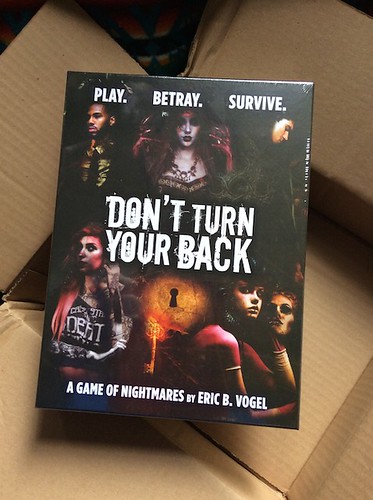
Look at what the friendly delivery-person-from-some-company-not-sure-which dropped off yesterday:

Don't Turn Your Back

It’s the board game version of the rpg Don’t Rest Your Head, a horror game about people trapped in a nightmarish dream world. Readers might remember that I (and a bunch of other terrific authors) contributed to an anthology based on the game, edited by Chuck Wendig, which you can buy directly from the publisher. In my story, I created a type of enemy that has been translated into the board game. You can see the card here.

As soon as I work up the heart to cut the wrapper off the game and open it up, I’ll get to see it in person. If you’re a fan of board games, check it out.

And check out this review for a discussion of game play and the game components themselves.

Locus Review of A Key, an Egg, an Unfortunate Remark

Standard

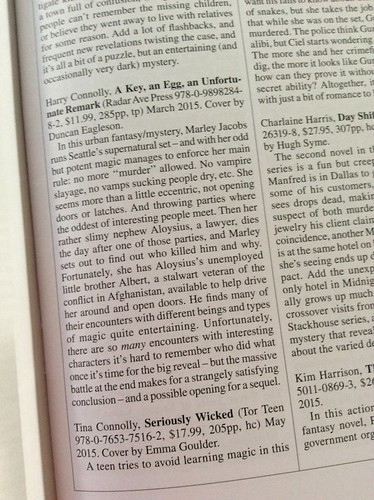
I’m pretty sure I posted about this before, but I picked up the hardcopy yesterday, and here’s a pic of the review itself:

Locus Review Key:Egg

“… strangely satisfying conclusion…” I’m cool with that.

Learn more about the book or read some sample chapters.

Help Refugees and Maybe Win Some Limited Editions of my Work.

Standard

Most everyone who’s following the news knows about the difficulties facing Syrian refugees. Author Kevin Hearne has decided he’s going to do something to help.

Basically, he’s giving away books to people who donate to UNHCR. All you have to do is donate, send him proof, and you’re entered to maybe win something.

And, to support his efforts, I’ve sent him four copies of the limited edition omnibus of The Great Way. Did you miss out on the Kickstarter? Would you like to get one of fewer than 200 copies of that omnibus edition, the one with nothing on the cover but the fantasy map?

If so, pop over to that link above and follow the directions, so you can get a chance to win. It will help people who need it, and maybe you’ll get some books, too. Admittedly, my books aren’t pictured (yet) but he should be receiving them today, so maybe there will be a picture later. Check out the update page with my (and several other authors’) books.

Time is short, though, so don’t wait.

This is amazing: the sounds of Jupiter.

Standard

Be sure to listen to the end, where you can hear the planet whispering “Trump, trump, trump.”

No, seriously, this is cool.

Randomness for 9/13

Standard

1) Why Salad Is Overrated.

2) Actually, salad is good.

3) Ice-T will has some startling information for you in these (fake) SVU screencaps.

4) Most Heinous Stories of Role-Playing Games Gone Wrong.

5) Picture Yourself as a Stereotypical Man. “Stereotype threat” and academic achievement, or how to erase any statistical difference between whites and blacks / men and women.

6) I love this book design.

7) Classic book covers turned into gifs.

The Lord of The Rings by J.R.R. Tolkien, book 15 in #15in2015

Standard

The Lord of the Rings The Lord of the Rings by J.R.R. Tolkien
My rating: 5 of 5 stars

Book 15 in #15in2015

In an era when so much fantasy–especially the really popular sellers–read like novelizations of movies that have never been made, this book (I read it in a single volume edition) was wonderful.

This isn’t my first time through. I read Lord of the Rings in high school and then again in the nineties when a pre-production interview with Peter Jackson got me all excited for the stories again. This time, though, for my third read, I promised myself that I wouldn’t skim.

Because, frankly, LOTR is pretty skimmable. Especially at the start, where Tolkien was obviously feeling his way through the story, trying to get a handle on what was happening.

But by the end of the story, the cumulative weight of what had gone before has a powerful effect. I’m not even sure when the change happened, but somewhere in The Two Towers I was hooked.

I’m not going to talk about these books too much, since so many others have done it before and better. However, I was really touched by the scenes in The Scouring of The Shire, in which Frodo, who’s been touched so deeply by evil, pleads with the others not to do violence of any kind.

Anyway, flawed, but its flaws are part of what makes it so wonderful.

Buy this book.

The Only Reason You Do [X] Is So People Will See You Doing [X]

Standard

So, there’s this annoying conversation that comes up in social media every few weeks that goes basically like this:

Person 1: “Writers who write in coffee shops are just hoping that someone will ask them what they’re writing.”

Person 2: “Yeah!”

Which is weird, right? You see people on their laptops at a cafe, and what you think is I can see them. That means they want to be seen.

Or maybe, and more insidiously: I can see them there. That means what they’re doing is a performance aimed at me.

In all seriousness, people talking shit about writers at Starbucks is a petty thing. It bugs me a little if I’m having a hard day because I’m one of those writers, but folks assuming that I’m there because I’m hoping to be interrupted?… well, I wonder if they’re really thinking clearly.

Also:

If you like big epic fantasy with lots of great female characters, check out Kate’s work.

Personally, I’ve been writing in coffee shops (mainly Starbucks, but not always) for 13 years. Thirteen also happens to be my son’s age. COINCIDENCE? Guess again.

When he was born, my wife’s family descended upon us. We had nine people in a two bedroom apartment–including a newborne, a teenager, and my wife’s elderly parents–that was already crowded with stuff. Writing at home became impossible, so I slipped out to the local Starbucks before everyone woke up and I did my work.

What I quickly discovered is that a) no, no one ever asks what you’re doing–In the 13 years I’ve been writing in cafes I’ve been asked about it three times[1]–and b) I got a lot more done than usual.

Home is where my distractions are. I’m a very distractible person, and the lure of the TBR pile, internet, TV, fridge, chores, whatever is powerful. Even more powerful are the voices of my wife and son; when they speak, my attention turns to them. I can’t help it. At the cafe, as long as I have my internet disabled (nowadays I use a program called Focus for that) my distractions are few[2].

As for hoping people will ask what I’m writing, let’s run that through a common sense check: Fantasy is about 6% of the market. Do I want to be interrupted in the middle of a thought by people who are 94% likely to be totally uninterested in what I do? And of the remaining 6%, how many are interested in my exact sort of fantasy? And those numbers look even worse when you acknowledge that they’re based on the assumption that everyone reads novels, which they don’t.

The answer is obvious. Starbucks is not a convention, where you get to meet admiring readers. It’s a place where you can ignore people and do some work.

Which is why a lot of people in different fields see cafes as a refuge where they can accomplish work. I have managed to sneak peeks at other people’s computers at those long Starbucks tables; what I mostly see is people writing code, not fiction. What’s more, if you click on Kate Elliot’s tweet up there, you’ll see more people talking about their reasons for slipping off to Starbucks to get stuff done.

But like I said: petty. In the specifics, anyway. In a more general sense, the twin notions that I can’t imagine a reason other than X, so X must be the reason and That person can be seen in this place doing X, so being seen must be the reason they’re doing it here are a genuine issue.

I’d like to think that most intelligent people recognize the problems with those sentences. I’d like to hope that most people understand, just to take an example, that just because (to take a not-so-random example) someone is wearing something sexy doesn’t mean they’re wearing it to please you.

And for those who have learned that specific lesson, they need to apply the principle more broadly.

[1] Two were asked dismissively, as in that other person had their laptop open to do REAL work. The third was when an old guy rapped me on top of my head with a folded up newspaper because he wanted to chat but I was wearing headphones. We didn’t chat.

[2] Not non-existent, but few. Very rarely someone with issues in their brain chemistry will distract me. Much more common are adorable tots. I don’t mind them at all. I like kids, and I’m happy to take a brief break to smile and wave at them, or to smile at their mortified parents when the kids act up.

oh god am i really going to write about the hugos again

Standard

Okay. I am. A little bit, but only to float an idea.

Eric Flint (possibly aiming for a fan writing Hugo himself) wrote a long post called The Divergence between Popularity and Awards in Fantasy and Science Fiction, in which he argues that the award-winners of Ye Dayes of Olde (before the mid 80’s, I guess) were also the best sellers in the genre, but for the last 25+ years, that hasn’t been true.

He comes at this argument through an odd, winding route, attempting to magically divine the top sellers by seeing how many feet of books are modeled[1] on the shelves, using pre-Amazon measurements he took at B&N and Borders. (Kids, Borders was once a big chain bookstore.)

Which… fine. Let’s just pretend that this is a good measure of sales. Assuming that the big sellers of today are no longer necessarily getting the awards, why not?

Let’s put aside the idea that there’s some sort of left-wing cabal handing them out to their friends, because that idea is dumb. Let’s also put aside the idea that the standards for the awards are especially literary. To quote Abigail Nussbaum:

The truth is—and this is something that we’ve all lost sight of this year—no matter how much the puppies like to pretend otherwise, the Hugo is not a progressive, literary, elitist award. It’s a sentimental, middle-of-the-road, populist one.[2]

I basically agree with her, although I don’t feel the urge to “walk away in disgust” and am in no way disappointed. The Hugos are what they are, and I think that’s fine for the people voting for them.

But here’s my suggestion, tentatively offered: what if the Hugo voters/nominators aren’t the one’s who’ve changed these last few decades? I mean, sure, some folks age out, new folks come in, so they aren’t the same individuals. But what if they’re the same sort of novelty-seeking reader, preferring clever, flattering books to pretty much everything else?

Because that would mean that the bulk of the readership now are the sorts of readers who don’t care about fandom or voting for Awards. Who have maybe sampled a few award-winners and found them not to their taste. They’re the people who came into the genre through Sword of Shannara, because it was the first fantasy to hit the NYTimes list, through STAR WARS and dozens of other action/adventure-with-ray-guns movies that sold millions of tickets, through D&D novels like Dragonlance, or through shoot-em-up video games.

Maybe the award hasn’t changed very much, but the readership now suddenly includes huge masses of people who are looking for Hollywood-style entertainment, with exaggerated movie characterization and a huge third act full of Big Confrontation.

Obviously, some Hugo voters enjoy that sort of thing, too. If they didn’t, GUARDIANS OF THE GALAXY wouldn’t have won this year. They may not think R.A. Salvatore’s work deserves an award, but they’ll read it and enjoy it. But the few thousand people involved in the Hugos are not enough to fill out the readership of someone like Jim Butcher or Robin Hobb. That’s a whole other group.

Flint’s post seems to suggest that the awards seem to have moved away from the influential big sellers, and he’s not sure why[3]. I would say that science fiction and fantasy have become large markets with a readership that’s less insular. It has more “casuals” to steal a gaming term. Those are the people who are blowing up the sales of the books at the “basic entertainment” end of the spectrum.

That’s a good thing.

It might seem funny at this point for me to say, once again, that I’m not all that interested in the Hugo Awards. I’m really not, although I’m very interested in selling large numbers of books [4]. The divergence between what sells in large numbers and what wins popular awards is an interesting data point.

[1] Modeling: When bookstores make a special effort to always have an author’s books on the shelf. A copy of The Two Towers sells, and a new one is ordered instantly. That’s a good place for an author to be.

[2] I found her writeup in this io9 summary of Hugo articles.

[3] Do the people who give out the Edgars worry that the books winning awards aren’t on the bestseller lists?

[4] Check out my books. I’ve got sample chapters for you and everything.