Guest Post: Free Possessed Chickens

Standard

Today we have a guest post, courtesy of my son. I told him a story of seeing a tiny chicken coop set out between the curb and the sidewalk like a discarded couch (Seattle is full of residential chicken coops) and he wanted to write a post for my blog, which turned out to be a pastiche of his current favorite book: Hyperbole and a Half. Interestingly, he wrote it from “my” point of view. Here it is:

The Box

Yesterday, while walking to my local Starbucks, I passed a Large-ish (is that a word?) Box out on that grassy strip of space between the road and Sidewalk.

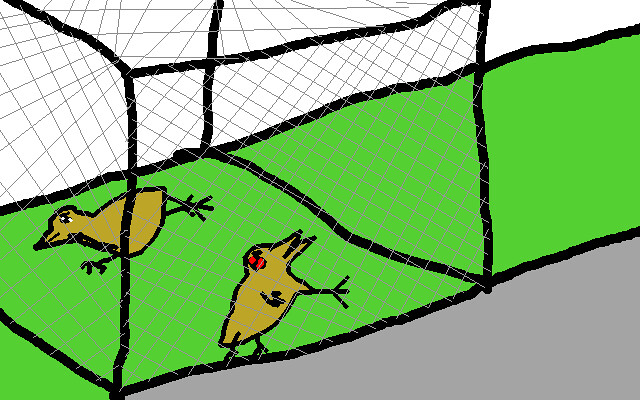
I stopped to take a closer look, as boxes sometimes have interesting contents. The Box was really a sort of Wooden frame, filled by chicken wire, and It contained chickens. One was kind of lying there, dragging itself across the cage back and forth, seemingly with no real goal. The other chicken, however, Looked like it was from a horror movie where aliens invade chicken’s brains before they realize chickens are kept in neat little cages.

Chickens

It repeatedly slammed itself at the walls of the cage.

The chicken didn’t seem to be attacking me in particular, but instead, the shape of the house. maybe this is why the chickens were abandoned out here in the savage sidewalk-roadlands.

I can almost imagine a sign that says “FREE POSSESSED CHICKENS!”

I may have to go back with some paper and a sharpie.

Women online receive threats of physical harm, part 2,000,342

Standard

How surprised would anyone be to learn that Shay Festa, the “Quid Pro Quo” book review blogger I wrote about over the weekend has not only been called a cunt and a bitch but has also received threats of physical harm?

Over a book review policy?

I really, really hope that no one who followed one of my links to her site was involved in that at all, because if my blog posts start inspiring threats against women online, I’m not going to write them. It’s not worth it at all.

In the meantime, I want to thank Michelle Sagara for pointing out this blog post: Reviews: A Service for Authors? by Chrysoula Tzavelas.

The gist of Tzavels’s post is that the Bookiemonster site is open to reviews by indie authors, who constantly struggle to get reviews of their work so they can stand out from the crowd. She suspects (and the request for more reviewers seems to confirm) that they’re inundated with books from people with little other opportunity to find critical attention and who are desperate to stand out from the pack. Self-published writers are likely to be a major portion of the Bookiemonster readership, too. You know, in the old days of the turn of the century, it was a truism that the main readership for self-published fiction was other self-publishers. They were all reading each other’s work. I thought that had finally changed with the release of ereaders, but maybe not for everyone. Maybe it’s only the bestselling self-pub and hybrid authors with a readership beyond other authors in the long tail. I’d be interested to know where that stands.

Anyway, it demonstrates the way subtle pressures can drive people to make decisions they wouldn’t ordinarily make. Like doctors who, with only their patients’ best interests in mind (as far as they’re concerned), schedule as much followup care as they need to make their monthly nut, so too does a site like Bookiemonster respond to subtle incentives. I had recommended that Ms. Festa turn to her readership for the SEO books she was seeking; readers are incredibly generous, especially if they’re grateful for the writing being offered. What hadn’t occurred to me was that the readers and the writers might be pretty much one and the same.

In any event, none of that matters now. Ms. Festa has posted a mea culpa followup post called Sometimes We Just Get It Wrong, in which she expresses gratitude for the non-vicious, non-threatening feedback people have given her and withdraws the whole idea of asking authors for likes, follows, and upvotes. I will say: far too many people would have looked at the most extreme criticisms she received–the name-calling and the threats–and used that to dismiss all criticism. That’s what Bill Keller did after his disgusting editorial about cancer patients and social media, and that dude writes for the NY Times. It’s to her credit that she sorted the rage-aholics from the fair responses, even ones that were extremely critical, like mine.

And that’s that.

Reviewer Expects SEO Payback From Authors She Reviews

Standard

You know how it is: you write things, you put them out into the world. Sometimes people like them, sometimes not. Worst of all, sometimes people just don’t seem to care.

But let’s imagine you’re a book reviewer who is becoming frustrated by the fact that you aren’t becoming as prominent as you used to be: What’s the next step? How do you give yourself the boost to prominence you’re hoping for?

If you answered: “Write better, more insightful book reviews and dare to be honestly controversial in a way that gets people talking,” you clearly need to be more entitled. Try this instead:

I operate on a Quid Pro Quo system. I will continue to promote authors that do the same for me. Not only that, but the more times promoted, the more buzz you will see. Tweet to your followers, post on Facebook, etc.

See, getting a review is a service provided to the author. If you mark her Amazon reviews as “helpful”, sign up for her newsletter, like her Facebook page, circle her on G+ and… oh christ time to start skimming this ridiculous list.

Anyway, “Bookiemonster” is frustrated that authors just aren’t meeting HER needs.

What I would (gently) suggest in response is that reviews are for the benefit of readers, not writers. Sure, it’s publicity, and yeah, it sells a few copies, but not many. Not many at all. I can see my own sales, and I know what the bump from a review looks like (spoiler: not large). Reviews are not for writers. In fact, a great many writers never ever look at their reviews. Not ever.

If you doubt that reviews are for readers, not writers, consider reviews in other fields: are film reviews just unpaid publicity? Nope, they exist to drive filmgoers to a newspaper (or whatever) so they can decide what to watch. Same for theater. What about critiques of art galleries? Nope. they’re an attempt to say something worthwhile about art, and to engage the aficionado on the subject.

It’s the same for books. Reviews are there to share an enthusiasm for the written word with other enthusiasts; in fact, a decent reviewer should excite readers with their expertise. This is about an exchange of ideas, not moving product.

You write reviews because you think there’s something worth saying to other readers. Maybe you think a book is wonderful. Maybe you think it’s toxic sludge. Maybe you think it’s emblematic of the sort of toxic sludge we see all too much of lately. Maybe it’s part of a movement that no one other than you has noticed. Maybe it reflects a certain kind of cultural change. Maybe you could talk about those things.

Or you could just write stuff like this:

The novel is witty, intense and keeps your interest from start to finish. It reads fast, I mean super fast and not that the book is short, it just reads that well. Nothing stumbled me. And that rarely happens. While some Zombie snobs may not like this book, I certainly did.

or

I also felt that prior to Mary becoming a prisoner in a walking dead corpse, her conflict with Azrael the Angel of Death was vague and undefined. More details on how Mary discovers Azrael’s scheme to take over the spirit realm would justify him sentencing her to an undead dungeon as well as her rage toward him.

or

Dead Boys was a welcome departure from what I find myself usually reading. Would I have picked it up had it not been submitted? Probably not. Why? Because short stories aren’t my normal thing. Simply because I enjoy investing the time to get to know the characters and follow a story through it’s arc. Penkas succeeded by giving me the appetizer, but I still wanted the main course. Thankfully, his concepts were intriguing and thought provoking enough to make the read satisfying.

(all sic)

You say your book review site is not as prominent as you’d like? Inexplicable.

I’m a writer. I put non-fiction on the blog and fiction in my books, and when they don’t sell or languish in obscurity, it’s not because someone didn’t hold up their end of the quid fucking pro quo. It’s because the thing I wrote didn’t earn it.

The same goes for reviewers. Your words will bring you the attention you deserve. If you feel you deserve better, do better. Be more thoughtful and original. Write with care and style (advice I could certainly bear to take myself). If some of your reviewers can’t manage that, let them go and put less (but better) content on your site.

But don’t come around with some quid pro quo, because ugh.

Kameron Hurley’s post on persistence

Standard

Last week, Kameron Hurley wrote a long guest blog on writers and persistence. If the descriptor ‘long’ makes you hesitate to click, be assured that she does that writer trick of being interesting the whole way through.

She makes a good point: Persistence is how it’s done. And by “it’s” I mean “become a professional writer”.

However, there are a few things I want to add, because I don’t think “You have to be persistent” is enough. I think it’s useful to talk about how, as well, and that sometimes persistence is bullshit because the goal is bullshit. So:

1. Persistence is just the pursuit of the goal via managed expectations and the certainty that writing professionally is a thing that can be learned. That’s it. If you can stop yourself from thinking “This book I’m writing is going to win an award/make me rich/get me laid/win the admiration of the right people” that’s half the battle. The other half is recognizing that, even if you fail this time, you can do better next time.

Okay, not everyone can improve. If you’re in a coma, no. If you’re so convinced you’re already a genius that you think every rejection Proves What Fools They Are, no. If you’re incapable of learning that text affects readers in ways that the writer might not intend, no. But for someone who can pick up a manuscript they “finished” last year and think “Look at this paragraph! I’m not still making this mistake, am I?” there’s no reason to expect they can’t make their goals.

Plus, it’s the big goals–that vile four-letter word: hope–that breaks the will to write. Like a weary traveler, writers think their destination is just over this next hill. And the hill is so steep and muddy and exhausting, they force themselves to push on, only to discover that the other side is just more road leading off into the distance.

If you fervently hope this is the book that will win an award or become a bestseller, and it doesn’t? That shit is disheartening as hell.

Plus:

2. Nothing bad happens to you if you give up.

Sure, you probably won’t finish that book, but if you get more time to spend with your friends, go hiking, maybe volunteer at a food bank? I can’t really see how that’s a bad thing.

The point has to be this: Do you want to write more than you want to do other things? Video games/TV shows/Other time wasters notwithstanding, if creating literature is not really what you want to do, you might as well be doing something else. You’ll be better off. Fuck persistence.

3. I know some people will bridle at the word “literature” but that’s what writers make, even if it’s Bigfoot pron. Maybe it’s not great literature, maybe it’s rote, or trite, or commercial or derivative. Maybe it’s a big steaming pile of goatshit. Who cares?

4. The point is, it’s really really hard to put aside those big expectations, but one of the best ways to do that is to drill your focus on the book. Whenever I start daydreaming about the reception my book might get (basically, whenever I get weird, starry-eyed high hopes) I stop, remind myself that those thoughts are poison, then refocus my attention on the characters, the voice, the plot. Whatever. Not only does this help throttle the strength out of Hope, that miserable enemy of all good things, but it helps keep my energy and effort where it belongs.

5. What’s more, the idea of a “successful writer” (earning enough to forsake all other employment) is a really strange thing. As Ursula Vernon says, pro writers are simultaneously “fetishized and devalued.” As soon as you start finding fans for your work, people encourage you to toss your day job. Then they complain to you in emails that they got a computer virus from a pirate copy of your book and where can they find one that’s safe and free?

The truth is, writing as a day job is completely awesome and completely nerve-wracking. Not everyone wants to spend harrowing hours wondering if they can pay their rent, or tightening their food budget yet again until that check turns up. Add to that the unhappy fact that a great many writers outlive their own careers and you have a pretty stupid career choice.

And, even if you keep the day job, Persisting can take up a helluva lot of your free time.

But let’s say you want to go for it anyway and stick with Persistence:

6. As I mentioned above: big daydreams are poison. If you can be zen about how well the book will do after you finish, that’s great. If you can’t, there are a few tricks that can help distract us from inflated expectations: first, pay attention to how much a mid-list author makes and how many copies they sell. That’s where realistic expectations should be set. Whatever genre you work in, someone out there is sharing their numbers. Check them out.

Second, a trick I use is that I don’t write for a large audience. I pick three people to write for. They become my primary readers. I choose new ones for each book and never tell them, but when it’s time to ask myself how a scene will play for the reader, I don’t have to picture a long line of people in line at B&N. I have specific people in mind: Will she feel cheated by this revelation? Will he like the way this character changes?

Even if I don’t know anything about them except what they post on their blogs (and yeah, some of the primary readers are pretty much strangers to me) I can do the important work of imagining the effect of the story without poisoning myself.

7. Not matter what anyone says about talent, inborn ability, natural aptitude, or whatever, people can teach themselves to write better. I mean, seriously, if there’s a placebo effect for sleep, there’s a way to improve writing, too. Obviously, that subject is too big for this post, but knowing it to be true is the important thing. You don’t have to give up after any one particular failure.

8. But what if you do all these things but still can’t make persistence work?

Hey, for a person struggling with depression, who’s caring for a sick loved one, who is utterly freaked over impending job loss, or who is generally overwhelmed by life, no worries. Writing is secondary to all sorts of other things, like health and family. Don’t be hard on yourself.

If you’d like to be writing but you seem to spend all your time hanging with friends, checking Twitter, watching TV, or shooting zombies on your Xbox, see about about nothing bad happening if you give up that dream of being a writer. It’s kind of a dumb dream and you clearly would rather be doing something else.

9. Oh, what’s that? You really would like to put aside the games and internet and do the persistence thing, but it never seems to happen?

First, put the distractions away. Alternately, take yourself away from your distractions. I write outside my home b/c my family is very disruptive. I also have an app that blocks my internet for a set period of time. Maybe that will work for you or maybe not, but give it a try.

Second, keep in mind that it is much easier to fail in the face of luxury than in adversity. For many of us, adversity spurs the spirit to strive, but luxury gives us excuses to seek pleasure right now. (I used to have a sign in my office cubicle that read “Hard work pays off in the future. Laziness pays off now.” My boss didn’t get it.) Take a hard look at the luxuries in your life–even if it’s something as simple as Bejeweled or Twitter on your phone–and limit them.

Last, friends of mine used to have this game they played every day called “Fresh Ten”. Every day they would write ten new words in the WIP, then post them online. After they did that, they could close the word processor and be done for the day, or they could write a little more.

Maybe even a little more than that. Just having to do ten new words a day gave them an excuse to sit down and start. Not every day was productive (and not every writer works every day) but it’s how we build our habits.

Well, that was longer than I would have liked, but I liked Hurley’s post and wanted to respond. I’ve struggled with persistence, too, and thought it might be helpful to offer a few mental tools that I’ve used to keep going.

Like Hurley, I hung a sign at my desk regarding persistence, but mine was a quote from Calvin Coolidge:

Nothing in the world can take the place of Persistence. Talent will not; nothing is more common than unsuccessful men with talent. Genius will not; unrewarded genius is almost a proverb. Education will not; the world is full of educated derelicts. Persistence and determination alone are omnipotent.

If you’ve been kind enough to read this far, you deserve a reward: Kameron Hurley’s book GOD’S WAR is available on Amazon and Indiebound

Randomness for 1/30

Standard

1) Artist paints murals, photographs them, then turns them into animated gifs.

2) Amazing fake signs in London Underground.

3) STAR TREK: INTO WHITENESS So, so funny. Screencaps for the win.

4) A great round of “Your novel is so” jokes.

5) Auteur Theory tries to take hold in the theater, leading to broken contracts and angry writers.

6) Star Wars as old-fashioned pulp covers.

7) Everyone Suffers From Imposter Syndrome Except You.

Time to ruin my blog again

Standard

I’m going to make my blog inaccessible for a while while I try to install a new theme, fuss with it for way too long, then give up and go back to how it is now. Again. The main page, www.harryjconnolly.com will still be available.

Added later: Yep! Changing themes is a pain in the ass and I can’t be bothered to waste time on it. Back to the same old boring look.

Click through no click through

Standard

Christ, I meant to watch a few minutes of THE MAN FROM NOWHERE and now it’s quarter to three in the morning and I’m supposed to be getting up to work in the morning.

Anyway, I hate writing short blog posts–esp if it’s just a link to something on another site–because it feels like such a cheat. WordPress automatically posts notice of the new entry on my Facebook, Twitter, and G+, and all people find when they click it is a link to another site. So, for example, if I want to let people know how to write for a game company like Evil Hat, it would make more sense if the tweeted link they’re clicking was the direct one. Just saying.

But the weird thing is that fewer than half the people who click a link to my blog actually bother to click the direct link. It’s like they click the one, see another link and just give up. They cared enough to click once, right?

I feel like Werner Herzog in JACK REACHER: “They always choose the bullet. I do not understand.”

Oh god I’m tired.

Photographer goes to Kiev to get the real story (translated to English)

Standard

It’s obvious the guy writing this is a photographer, but I’m not sure if he’s a journalist, activist, or curious citizen. In any event, his own words:

I came to Kiev. I came to see for myself what is happening here. Of course, an hour after arriving at Maidan, you begin to understand that everything what you’ve read in dozens of articles, saw in TV news reports is total crap. In the upcoming reports I will try to, as objectively as possible, to sort out this new wave of Kiev revolution.

via Sherwood Smith

Infographic Hell

Standard

Apparently there are companies you can hire to create infographics now? I mean, it makes sense, but I didn’t realize it was a thing. Anyway, people love stats about books and reading, so these guys have put together an infographic called “The DNA of a Successful Novel.”

It’s the usual bullshit. “Books priced at $3.99 earn the most revenue!” “Ninety nine cent books sell the most copies!” I also seriously doubt that science fiction earns more than romance, even if you combine it with fantasy.

And of course it doesn’t touch on the actual content of the books at all: voice, character, plot, none of that. It’s page counts, prices and genres.

Still, if you’re wondering if more people will finish a short book or a long one, they got that covered.

#sfwapro

Want to be a writer for rpg company Evil Hat?

Standard

Here’s the place to start.

If you’re new here, I wrote a book for Evil Hat, not to mention all my other work.