Randomness for 4/22

Standard

1) The annual Shorty Awards have chosen the Best Quora Answer of the Year: “What does the first day of a 5+ year prison sentence feel like?” The answers that made the list of finalists are at that link as well.

2) If Facebook made a Facebook house.

3) “Tie” Chi: knotting a Windsor as a martial arts kata.

4) Chemical-free “natural” swimming pools that are cleaned by plants. This looks a) awesome b) a lot of work and c) inappropriate for Florida. Still, it’s green and gorgeous.

5) From College Humor, Batman vs. The Penguin (played by Patton Oswalt). Video.

6) 27 Science Fictions That Became Science Facts In 2012

7) Seattle’s King Street Train Station has finally received its finishing touches and is ready for a Grand Opening. And it’s gorgeous. I’m tempted to take a train trip just so I have an excuse to go down there.

How to get hired as a Marvel Comic Writer and or Artist

Standard

C.B. Cebulski explains how a noob can get hired to work at Marvel as a writer or an artist.

In fact, if you’re published traditionally, they make it super-easy. Super-duper easy. If I had the money to keep current on the Marvel U, I’d mail one of my Twenty Palaces books in.

Check it out.

Update: A lot of new readers have been visiting this post in the year since I posted it. Hey, new readers, check out my books. You might like them.

What’s controversial about being someone else’s dandelion fluff?

Standard

Apparently there’s been a bit of controversy surrounding Neil Gaiman’s speech at the Digital Minds Conference at the 2013 London Book Fair. Instead of hearing about it second-hand, you can watch it here:

Actually, you can probably just listen while you do other things, since it’s Gaiman talking at a podium. There’s no RSAnimate stuff going on, and no flow charts.

There are a lot of interesting ideas in there but nothing revolutionary: Try new things, be generous, accept that sharing without payment is how people find new things they love, books are great, books might not last, maybe people won’t be able to make a living as a “novelist” in the near future.

However, the big thing I take away from it is his talk about about “dandelion seeds.” The idea is that you release your work into the world and some of it goes nowhere and some lands in a fertile place and leads to something great: Fans, more work, new opportunities to connect with people, and so on.

That’s all fine, but I should say that it works best once you already have the sort of much-deserved fame that Gaiman has. He can stick a drawing under a rock and fans will run for blocks to fetch it. I can publish a book in every store online and off and few people would ever know. So, his perspective is his, and it works for him, but I’m not sure if he understands how different things are for low-level mooks like me.

Why does it matter? Because it’s not just creators who are blowing dandelion fluff into a strong wind. It’s also publishing companies who do this. Some of those little seeds represents a year’s worth of work for authors trying to make a career for themselves, and damn, if it doesn’t give me a chill to know that my toil and hope is someone’s offhand experiment.

Troll proclaims his love for the site that he harassed for years.

Standard

Anyone who’s paid close attention to the way people laugh can tell you that most times people laugh, they are not laughing because something is funny. I mean, sure, we laugh because things are amusing or absurd, and sometimes we laugh to minimize things that scare us. But most of the time we laugh because we want to cement social connection to others.

So imagine my surprise when I read this interview with a troll. The guy admits that he’s sent insults to the guy writing the blog for years, that he’s claimed to have fucked the writer’s ex in incredibly degrading ways, and has even done things like claim that Native American genocide didn’t go far enough.

So what happens when the writer puts out a call for the troll to contact him for an interview, with the promise that his identity will never be outed?

The troll turns out to be a huge fan of the site, a fan of the writer himself, and a person who… actually, let me just put a little quote from the troll himself:

… but I felt like we had, you know, a sort of special communication going on.

He was just pinging the guy. He had an “immature sense of humor” and thought it was funny to say outrageous shit that made people angry. What’s more, he assumed no one else would ever be seriously bothered by what he did.

When asked why the troll agreed to the interview, he said:

I did it, I guess, in part because I feel like you and I have had this odd relationship over the last several years, so I guess I felt this would be sort of a good conclusion to that. But also, I kind of felt, I guess, that I owed you an explanation. Again, I never really thought you were offended by anything I wrote, but I would hate it if you told me that I had actually injured you in some way. And so I did feel the need to sort of explain myself to you.

PING! The guy wanted a human response, especially one he could control. He wanted to type awful things and make people angry while telling himself at the same time that he didn’t really mean to offend anyone.

In other words, he was lonely. He visited the site every day to keep up on the latest athletic uniform design news (which… really? Okay, I guess) but he had to treat it like shit for lulz, too.

And how broken is that?

Where webcomics go, so goes ebooks

Standard

In an embarrassment of riches, we have two different posts comparing the self-publishing ebook gold rush of today with the self-publishing webcomic gold rush of yesteryear. That first link is to Ursula Vernon, who is awesome, and the second is to KB Spangler, who I had not heard of before now.

Both make similar but not identical points and they’re both worth reading (the first post for the comments; the second post has some important links showing how little some incredibly talented comics creators earn). Important to note: people continue to point out the outlandish rare success stories and say “I want to be like that!” People continue to suggest “Hey, you could just do it for yourself” as though that route is equally attractive and equally beneficial (those aren’t the same things) to everyone. People still talk about it like it’s astrology: the success stories prove that it’s 100% viable while the failures are always failures of poorly applied process (wrong cover, not enough self-promotion, too much self-promotion, you should have bought ads on blah blah blah).

A big difference that neither poster touches on is the payment method. Webcomics are something people want to consume for free and creators have to make their money through merchandise, or selling collections of back issues, or ads. Personally, I read three or four different webcomics and I doubt I would pay for any of them. Maybe Order of the Stick, but even then I would watch for trade paperbacks and then put a purchase request through my library. That’s how I read corporate comics, too. I love comics, but comics are expensive.

People are used to paying for novels. In fact, there’s a general perception that free or $0.99 novels are not very good. When Del Rey set the ebook for Child of Fire at that price, I made a point of including the words “promotional” and “limited time.” I didn’t want people thinking they would get what they pay for.

As for the whole BUY MY BOOK thing… look, you can find out about my novels right on my front page. That one on the top is self-published, but do I want to push a “BUY MY BOOK” message? Nope. I want to push a “READ THE SAMPLE” message. Amazon/B&N/Apple/Etc all let you download the first 20-some percent so you can give it a taste test.

The difference being, you can’t get the whole book for free. If you like it, you have to pay to get the rest. If I like Saturday Morning Breakfast Cereal, I can just keep clicking the little arrow on the right until I run out of fun or accidentally click an Google ad and shove a couple of pennies at the creator.

The novel is something I can sell. A webcomic is something that draws in people who might someday click an ad, pledge in a Kickstarter, or buy a “Wookie Jesus” tshirt. The difference there is non-trivial and I realize how much that sucks. I am an ass who does not send money directly toward the people who make things I enjoy. Either I get it for free or I ask my library to pay. I have to do the same thing with books, mostly, so don’t hate me.

Anyway, if you’re curious where ebooks might end up, both links are worth reading. Check them out.

As news media announces an arrest in the Boston bombing…

Standard

Let me link to this article in the NY Times: Richard Jewell, 44, Hero of Atlanta Attack, Dies

When the name of the person arrested has been released, do not rush to Facebook to harass people with the same name. Do not start digging into the personal lives of complete strangers to see what dirt you can find or what political prejudices you can confirm. Jewel was harassed for months simply because a newspaper said the FBI was investigating him. Police asked him to sign a confession they had written up as a “training exercise.” In truth, his life was ruined.

And he’s not the only one.

The modern news media may be in a headlong rush to share every rumor or minor development, but we don’t have to follow. We’d be better off spending time with people we love or writing to our members of Congress about pending legislation. The last thing this country needs is to crowd-source our criminal justice system.

Finally got to play Race to Adventure last night

Standard

Now that season one of Veronica Mars is over, the family finally had a chance to play RACE TO ADVENTURE, which I backed as a Kickstarter.

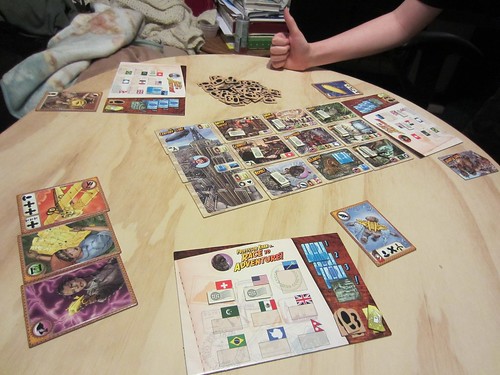
Here’s the layout near the start of the game. Of course I played Prof. Khan.

IMG_1880

You can see I’ve collected the passports for the USA and Switzerland, while to the right my son has collected USA and GB. However! I am about to collect Nepal in that very turn, while my son was hoarding clues at the Library of Congress.

Yeah, that’s my kid giving the thumbs up.

My wife… I’m not sure what she was doing. Let’s just say she had a busy day and wasn’t concentrating too well.

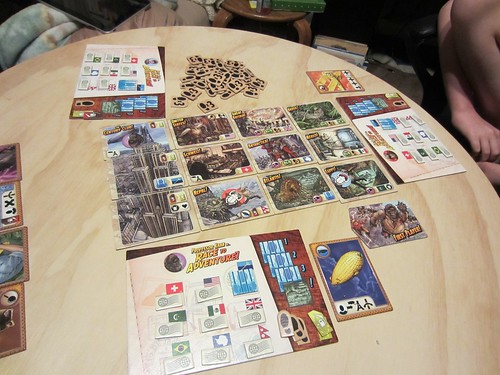
Here we are at the end of the game, when I had returned to the Century Club, said (house rule: no shouting) “I have returned!” and won the game.

IMG_1882

The others also collected all of their passports (and rescued the prisoner from Atlantis) but, having saved Egypt for last, they were still cursed. They were also way behind. Mwah-ah-ah-ah!

As for the game, it was terrific. I think I’d like to play it once or twice more on the tan side of the tiles before flipping them to the more advanced “shadow” game. We stumbled a little bit with the rules at first, like we do with every game, but by the end the turns were flying by. This might be the first game ever that says it takes 30 minutes to play and really means it.

The nice thing is that there’s no luck involved (no blowing your plans because of a lousy roll of the die) and the strategy elements were light but still effective. It’ll be a good fast game when we just want to play something fun without a ton of calculation.

On a day when the news was filled with blood, horror, and people coming together to help each other in dire need, it was good to sit with my family and play a game.

Best wishes to the people of Boston and to the marathon runners

Standard

No links here. I just want to send out good wishes to everyone affected by the double explosions at the end of the Boston Marathon.

Also, keep in mind that early news and social media reports are likely to be wildly inaccurate. It’s probably best to disconnect from things like Twitter at the moment and give first responders a chance to do a thorough investigation.

“Punching down” doesn’t always feel like punching down

Standard

I want to follow up on Friday’s Hugh Howey post without actually talking about Howey (much). I briefly mentioned the idea of “punching down” in that post but Tobias Buckell talked about it more extensively in his post on the subject.

It’s worth clicking through to read what he’s written, but for those that won’t: “Punching down” is attacking someone who is weaker, more vulnerable, or has less power than you. “Punching up” is attacking someone who is stronger, more powerful, and more influential than you. Mocking a rich guy who locked his keys in his Audi is punching up. Mocking a single mother who’s just been evicted because she was laid off is punching down.

Needless to say, punching down is what villains do and I’ve talked about it here on the blog more than once as a way to make sure the sympathetic characters are actually sympathetic. That’s the context of a fictional narrative, though. Most of the time, when people talk about punching up, they’re talking in terms of politics.

Leaving aside the question of whether the offending conversation Howey described actually happened (which I hadn’t considered at first, but Nick Mamatas brought it up and now the whole incident seems just too perfect), Howey is a best-selling author with a serious movie deal and six-figure print-only contracts. He’s doing well. The person he slams is, according to his story, a social climber trying to make herself seem important by offering to connect writers with agents. What’s more, he makes her sound desperate and a little delusional. Is his story, as he himself tells it, punching down?

Absolutely. And yet, I’d bet Howey himself would be surprised to see it this way. I imagine he still imagines himself as the upstart self-publisher, the guy who has to do it all himself, with no help from anyone. I’m sure he sees that scorn, whether it actually happened or not, as the “punching down” he endures every time he goes online or meets someone uninterested in his books.

I’m sure that, to him, this woman had aligned herself with the supposed gatekeepers of NY publishing, and he felt free to take a swing like any hard-pressed hero.

I can’t speak for Howey himself but in my experience putting out a book, either by yourself or through a publisher, feels nothing at all like becoming powerful. Just the opposite, really: We do a shitload of work and then, finally, this thing we made goes out into the world alone. All our hopes for success and praise are mixed with the expectation that everything could collapse, that people might be bored or dismissive or contemptuous. Worse, they might not even know we’re there.

And readers often treat writers as though we’re faceless corporations, like Bounty paper towels or something. They tweet insults directly at the author and act amazed that a real writer with a publishing deal would react angrily.

Readers need to have the freedom to say whatever they want about our books–they deserve it–and a book culture where everyone is nice all the time would be toxic. So when people are kind to my work I’m grateful. When they’re cruel to it, I shrug it off. I tell myself it’s not personal even when it’s clear from the review that it was meant to be. As Toby says in the blog post linked above, when people talk shit about your work, it stings.

So, writer as a position of power? It might be for some, I guess. Maybe if you’re Guest of Honor at a lot of conventions, or you teach writing to eager young folks, or getting a movie deal with a profile in the WSF, or something, that might feel like power.

But the publishing part of being a writer, when you send a book out into the world, whether it’s through a publisher or on your own? That feels like vulnerability.

The “Bitch from Worldcon” post and appealing to your base

Standard

It’s been more than a week since Hugh Howey posted his Bitch from Worldcon (now deleted) but I think it’s worth talking about anyway. Yes, it’s sexist rape culture bullshit for him to fantasize (even jokingly) about his big moment–which is apparently winning an award–standing in front of a crowd of people, and singling her out to say “Suck it, bitch” while grabbing his crotch.

Hello, small-minded fantasy of success. Hello, sexual threats to a woman he himself believes to be mentally ill. Hello, completely creepy behavior. I don’t care if he thinks it’s non-serious; it’s bullshit.

However, the real point of the post becomes clear right here:

Crazy girl asked who I was published with. “Self-published,” I said. No point in mentioning the Random House deal or the SFWA membership. Those weren’t what I was most proud of. The girl shook her head sadly and also knowingly. It was a complex bit of head shaking.

Bold added by me.

Who is Howey’s main audience? a) other self-publishers who have anointed him the next Amanda Hocking and b) readers who imagine themselves to be cutting-edge iconoclasts predicting the end of the old publishing paradigm. This is his “base,” and as much as he’d like to (and is) expanding beyond them, he’s still making the effort to hold them close.

On one hand, self-publishing is never going to have the legitimacy people want until they stop acting like they’re being assailed from all sides. I say this as a self-publisher myself. There is no revolution, only new opportunities. The people trying to get you to take one side or the other, whether that’s a “crazy girl” at a convention or a best-selling author featured in WSJ and Salon, are wasting your time and/or trying to sell you something.

What’s more, this post is a classic example of numbers #3 and #4 of my post about using social media to build a strong community of assholes. Howey isn’t sending his readers out to attack anyone–perhaps he understands that he shouldn’t punch that far down–but it’s still us-vs-them rah rah bullshit designed to instill loyalty more than inform.

It’s a shitty post. It’s not funny unless you’re looking to wave around pompoms with Howey’s name on one and Amazon’s on the other. It demonstrates that no amount of money or success will make you a better person. And it’s how a lot of authors create their brand.

Added later: Howey has apologized. Someone should explain that “I was just joking!” isn’t much of a defense.