Yeah, I’m watching season 1 of Veronica Mars again. The whole first season is only $12.50 on Amazon at the moment(!)
Damn this show is good.
Yeah, I’m watching season 1 of Veronica Mars again. The whole first season is only $12.50 on Amazon at the moment(!)
Damn this show is good.
I see a lot of people calling out coverage of the Steubenville rape trial for being ridiculously concerned about the effects of a rape conviction on rapists, and they’re right to be angry.
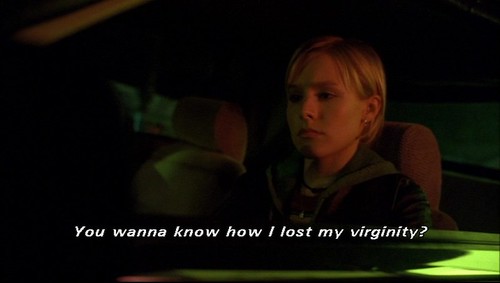
However, there’s one thing I don’t see people talking about:
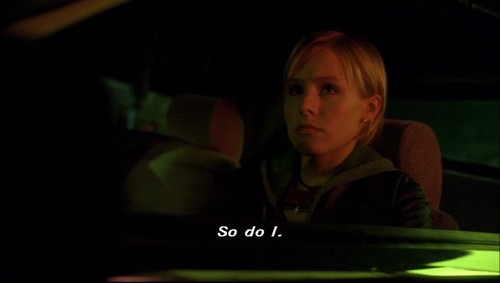
How incredibly common it is.
I know more than a few guys who lost their virginity by bringing a girl who was black-out drunk back to their room. It was a common enough thing in college.
To be clear, I never did this–I have never even found myself in that position–but a lot of guys have. When you see news people online talking about the awful consequences for those teenage boys, understand that they’re thinking That could be me/my husband/my brother/my best friend from college.
It’s hard for people to accept the idea that they or people they care about have done evil.
Ten years ago tomorrow was the start of the Invasion of Iraq. To my shame (not chagrin, not embarrassment. Shame.) I was an early supporter of the war.
I had long believed that war never be taken on as an adventure overseas, but I let myself be turned by the propaganda leading up to the attack. Did I believe the evidence supporting the presence of WMDs? No, actually, but I thought Hussein needed to allow inspections to continue. Did I believe Iraqi oil reserves were part of the reason we went to war? Yes, of course I did, but I thought there was good to be done anyway.
Which is completely ridiculous. Of course it is. How often are the tools of empire and destruction put of a positive use?
What’s more, I was a grown man who knew better. So what happened? I let myself get caught up in all the talk of chemical weapons used against Iraqi citizens and “rape rooms.” I let myself be convinced that the Iraqi people would be grateful.
At the time, there were anti-war marches in the streets. I remember looking out my window at them as they passed the office building where I worked: they were the usual far left hippie types with their giant puppets, long hair, and birkenstocks. They agreed with me that the war was about oil (a stance that was sneered at in the media at the time) but they were sure it was a huge mistake.
Of course they were right. Of course they were. At the time I thought their protests were ridiculous and self-marginalizing. They seemed more interested in confirming their cultural cred as outsiders than in winning people to their side. The civil rights marchers in the sixties wore coats and ties; these people were in tie dye and sandals that showed their dirty feet. These people don’t represent me.
And that’s utterly ridiculous. They weren’t trying to represent me. They were warning us that the nation was about to make a huge mistake, and they were 100% correct.
Shortly before the invasion, when talk of war was ever-present, I remember Hans Blix coming to the media to say that Hussein had knuckled under and agreed to allow inspections again. I spent half a day foolishly thinking that the invasion planning had done it’s job… until Bush administration officials declared that it was too little too late and the invasion was going to happen anyway. That’s when I realized what an immature asshole I’d been, although I still held out thin hope things would turn out all right.
It didn’t.
What I realize now is that I should have been out in the streets with those protesters. I should have held on to my beliefs and my mistrust and marched against the war. It’s not the responsibility of political protesters to make themselves palatable to me; it’s my job to recognize right from wrong and speak out about it.
No really, that’s what he said! Good thing he was joking.
If you’re one of those people who have been going around the internet posting comments, tweets, and status updates like “Who’s this Veronica Mars? Kickstart me some more SERENITY!” you should probably click that link up there. He’s not planning to Kickstart a new Serenity movie because he’s tied up for the next several years with commitments, not to mention the commitments the actors have. Plus yada yada budget etc. Give it a quick read.
After that, you should read this post by LEVERAGE co-creator John Rogers, cleverly titled Veronica Mars Kickstarter Thoughts. If you want analysis from someone who is inside the TV business, Rogers is the guy to turn to right now. Until it was cancelled, Leverage was the only independently-owned TV show in the U.S. market, and he has a lot of insight about the nature of non-studio funding, whether Warner is taking a risk by giving the go-ahead, and much more. That’s worth reading.
Remember yesterday when I talked about ALL THE SHIRTS (limited-edition!) the VM people would have to deal with? Kickstarter fulfillment companies.
And, naturally, everyone is jumping up to say what shows should be next on the Kickstarter auction block: Chuck. Pushing Up Daisies. Sarah Connor Chronicles. Terriers. Deadwood.
Personally, none of those shows appealed to me in a serious way, so I’ll be waiting for that THUNDARR reboot.
Okay. Unless something very interesting happens, I’m going to lay off the TV Kickstarter posts for a while. I’ve got to steal time for my books at some point, right?
Currently I’m over 100K words on THE WAY INTO MAGIC, which is the sequel to THE WAY INTO CHAOS. I’m writing it as one long story, which is probably dumb, but there you go.
My life is incredibly dull! Good thing the internet is full of fun stuff.
I wanted to do a little followup on the Veronica Mars Kickstarter. Yeah, they made goal. You can see the current numbers below.
Hey, you could even click on it to toss in a few bucks. I did.
But that isn’t to say that I think the setup is problem-free. I mean, there are issues and it does no one any good to gloss over them.
For example, at the time I’m writing this, Rob Thomas et al are going to have to make and ship over 40,000 “limited edition” T-shirts. That has to happen even if not one more person makes a pledge. They’re also looking at 4500 signed (by the cast) movie posters so far. You want to talk about signing your name seven thousand times (which is the limit for that reward)? I sure wouldn’t want to do it.
So… yeah. That sort of order fulfillment could be a huge drain on time and resources, even if you bring in a couple of out-of-work people (or actors, even) to handle it for you. He’s going to need his own clothing unit. And assuming they max out the poster reward (which looks pretty likely) and that it takes five seconds to sign one poster and move to the next, each actor is looking at over nine and a half hours to sign them all.
No writing hand was made to handle all of that. Just one hour would bring on cramps.
But that’s minor stuff. A great many people have been complaining that this project is just a way for a major corporation (in this case, Warner Brothers) to crowdsource production costs for their new movie. Is this the wave of the future? Will studios “hold their properties hostage” until the fans pony up?
It’s doubtful. The Veronica Mars Kickstarter is doing very well because it has a solid fan base. Also, it’s first. There’s a power in novelty when you’re asking people to give you money, and if it keeps happening again and again, there just won’t be much buzz around it.
Unless it’s THUNDARR THE BARBARIAN. Thundarr will always get buzz.
I can certainly see studios and production companies turning to crowdsourcing to decide if they want to re-up for another season, or bring the old gang back for a movie. Loved VR-5 and want to bring it back? Throw money at the Kickstater! and if it doesn’t happen the studio doesn’t have to be bad guy any more. They can just say: “The fan base wasn’t there. We only made 48% of goal.”
As for turning to fans for money that studios could put up themselves, the studios already do this in spades. They make foreign rights deals, they bring in outside investors, etc. It’s always been a part of doing business.
The big difference is that those investors get actual cash money once the film makes a profit. Fans, not so much.
Would I like to see that changed? Yeah, absolutely, but it’s not as simple as it sounds.
About ten years ago, my buddy and I were planning to make a movie. It was going to be a solid horror film–scary but not stupid–and we hoped it would open some doors for us. (Spoiler! It didn’t). As we were planning it, I did some research on how producers raise funds.
It turned out that there were all these restrictions on where the money could come from and who could donate. As I recall (a decade later) the budget would have to be split into X number of even pieces and each donor would be limited to that amount. There were more rules, too, and they were complicated and annoying. That’s when I realized I was a novelist.
(Digression: How it came out: The director sort of pushed me, the writer, out. He got the money from somewhere. The movie was seriously flawed and went nowhere. The script wasn’t my best but it is online: pdf or shitty html. It’s not my best work)
The point being, there are very strict rules around asking people to invest in your project for a cut of the profits.
However! The Jumpstart Our Business Startups Act (aka the JOBS Act) which was signed into law last year, contains provisions for crowdsourcing an investment in a company, not just in a particular project/product. You can read a description of the law here but just to touch on a few issues, investors are limited to 5% or 10% of their annual income, companies must use an established third party to run things, a great many disclosures are required, and the goal is $1million or less, so it’s not going to work for television anyway. While the law was passed last year, the crowdfunding part is not yet active because the SEC hasn’t finished drawing up a set of rules yet.
So, yes, a corporation is offloading a sizable part of their costs on this project to the fans, but they offload costs as a part of their every day business, and there’s no legal framework in place to allow the fans to invest directly. They only have the option to pledge for rewards, which is essentially preordering the end product, plus swag.
Will this become the model of the future? I doubt it, but even if it did it would be a terrific hedge against piracy and a fine reason to ditch DRM (not that there aren’t already many, many reasons to ditch DRM). Companies wouldn’t have to worry so much about their product being torrented if the true fans had already chipped in.
So! As I mentioned earlier today, I backed the Kickstarter for the Veronica Mars movie, although I probably shouldn’t have. Not because I think there’s something wrong with a WB property being crowdfunded, but because money is tight and KS is a luxury item. I may cancel sometime in the next month.
Which should not be taken as condemnation of the project itself, of which there has been plenty.
This article by Richard Lawson in the Atlantic Wire seems like a good representative sample of the bullshit people are saying about who ought to crowdfund and when it should be seen as unseemly. Have a quote.
But here in the bourgie, comfy confines of wealthy Western society, we’re talking about people like the indie musician Amanda Palmer, who raised $1.2 million on Kickstarter to make and distribute a folk album. That’s all. Amanda Palmer, who is married to successful author Neil Gaiman and has been a prominent musician for a decade or so. Handed $1.2 million because she asked for it. People are free to spend their money however they want, but there’s something so unseemly about the asking, isn’t there? Maybe that reaction is owed to some overly reserved New England quality in me that I should fight against, but I can’t help but feel that Kickstarter campaigns for stuff like this, that is stuff people are having no trouble selling elsewhere, are a bit gauche. Plus it’s too easy.
Of course he has to take a nasty sexist dig at Amanda Palmer. Of course he has to mention that she has married comfortably (The article is obstensively about Rob Thomas’s project, so where’s a mention of his wife? The article fails to mention if he even has one.) Supposedly, Palmer is so successful that she has 100K laying around to fund her studio time and if she doesn’t, well, isn’t she a big enough name to get that money from record companies?
That money comes with strings attached, you say? Awful, debilitating strings? Apparently, that’s a bonus; we wouldn’t want things to be “too easy.”
Let’s consider the Veronica Mars movie: Maybe it will suck or be vaguely disappointing. That first season was so great while the second and third were a bit of a let down.
But the article writer above barely touches on that. His point is that this movie is a Warner property. They own the rights and will distribute the movie once it’s made. Since that’s the case, isn’t it kinda gross to be asking fans to front the money?
I’m going to step up here and say “Not at all.” Here’s why:
Warner does have control of the Veronica Mars IP, and they have no plans to a) do anything with it or b) surrender it to the original creator, Rob Thomas. It’s just gathering dust. After there was no interest in the season four promo video, the show was dead.
That’s why this Kickstarter makes sense: Fan support can make this happen. What’s more, fans want to be a part of it.
Would I be happy to see gross points in the reward levels? Shit yeah. Is having Rob Thomas and Kristin Bell follow me on Twitter for a year for $400 kinda tacky. Sure, I guess. Do I think they’re doing something really cool with this project? Absolutely.
Lawson doesn’t like the idea of seeing money talked about publicly. He wants artists to raise their money from “proper backers and investors” behind the scenes so he doesn’t have to see art mixed with commerce in such a public way. There’s a laundry list of why this is stupid, beginning with the fact that “proper” investors have already shown their disinterest, continuing through the idea that fans are “improper” backers, and finally ending with art and commerce have always been mixed who the fuck are you kidding?
It won’t come as a surprise to anyone that making things is difficult, especially when they require a large capital outlay. I’m pleased to see a movie like this crowdfunded successfully (or it will be at this pace) and I hope to see more.
You don’t have to pledge much to get a copy of the script before they shoot, if you’re into that sort of thing.
First Amanda Palmer raises over a million bucks with her Kickstarter. Now she’s collected over a million views for the TEDtalk linked below. Apparently she likes to do things by the millions. (NB: I would be quite happy with a half as many book sales. Just saying.)
The reason it’s been so popular is that it’s pretty damn good and very interesting. Give it a watch, if you haven’t already.
In case that embed doesn’t work, here’s a direct link.
So many responses all over the intertubes! Tobias Buckell embeds the talk in a post about monetizing his blog; Buckell is a smart dude, but I’m going to call that missing the point.
Kat Howard sees the talk in terms of daring to see what she does as valuable and coming to terms with the idea that people would want to talk to her. While Palmer is talking about connecting with people, which includes struggling with the questions of both trusting them to say yes (without some sort of awful betrayal) and not asking for too much, but Howard is becoming accustomed to the idea that anyone would want to connect with her.
There’s also Chuck Wendig’s post about trusting his readers to pay if he gives away his work, about the internet age breaking the barriers between artist and audience, and about how happy that makes him.
But when he talks about making a connection to his readership, he says:
“If you’re going to be exposed, expose yourself.”
You know what I notice there? The audience is not even mentioned. He’s talking about baring himself through his work, but I don’t think that’s the same sort of thing Palmer is talking about at all.
You’ve watched the TEDtalk above already, right? Once again, it’s good and interesting and it takes the changes our culture is going through very seriously and half of what I’m about to say won’t make any damn sense if you haven’t.
I don’t want the flower. Palmer would have had to make the sad face as I walked away because I don’t want to lock eyes with a performer. I don’t want to share a moment. Palmer may be a performer and (almost certainly) an extrovert but I’m neither of those things.
So, yes. Me = introvert. But that doesn’t mean I’m shy. I’m not, particularly, although the odds are that, if we happen to sit at adjoining tables at a cafe or a party, I won’t talk to you. An introvert is someone who feels drained by human interaction. Taking the flower and meeting a stranger’s gaze for a minute? That shit is tiring. Thanks, it seems very interesting, but no thanks. I have too many demands on my time and energy as it is.
I assume things are different for Palmer. I would be willing to bet a whole nickel (maybe two!) that she’s an extrovert. When I recharge, I seek privacy. When an extrovert recharges, they seek face-to-face human connection. God forbid I should be in a band or do street theater; I can’t imagine anything more draining. I save my socializing-spoons for my wife and son, and sometimes for close friends. Making a connection with strangers? That’s fine in small doses, if I can prepare for it and have a way out when it gets to be too much.
That’s why I think Buckell, Howard, and Wendig are missing the point, even though Palmer herself tweeted a link to Chuck’s post with a big thumbs up. They’re talking mostly (not exclusively, but mostly) about online interaction. About mixing it up with people digitally, maybe through Twitter. Maybe through a PayPal Donate button. Maybe through a well-moderated comment section.
Palmer is talking about sleeping in the homes of strangers. She eats toast at their breakfast table and craps in their toilet. She is right there in their lives for a few hours, because if you’re a fan of hers you can offer crash space to her band. (Be sure to have lots of clean towels because drummers.) That is a very different thing than tweeting funny lolcats to each other, or even mingling in a store after a reading with your Game Face on. What Palmer does is riskier, less-controlled, and more visceral.
Also… Look, I don’t want to seem like I’m slamming any of these writers. I’m not. I’m just saying that there’s a huge difference between connecting with your audience through your art and connecting with them as a human being. She’s doing the latter.
I think that’s great. For her.
I don’t want to do that. This may sound silly, but my supernatural thrillers? The ones with “monsters and face-punching” as I used to describe them? Those were very personal. They are full of my obsessions, and I feel very much “exposed” when I see them in a bookstore or get a note from someone who liked them.
That’s how it’s supposed to be. That’s how I’ve always done it. If there’s nothing personal or painful in a story, whether it’s my issues around food or shame or self-loathing or the way we all tell stories to ourselves to rationalize our choices, that’s me in those books. That’s all my private bullshit. And I put it there for anyone to see, no matter what they might think, because that’s what writing is for. As Nick Mamatas said (rather dramatically) in his writing book Starve Better: “You have to stop caring whether you live or die.”
As Chuck said, I’m willing to be exposed (in a mental/emotional sense not physical, because ugh).
Like Howard, like Wendig, I want to connect with people through my work. Unlike them, maybe, that’s enough for me. Yeah, I’m among the audience because I’m a reader and a moviegoer and whatever else. I’ve always been in the audience.
But I’m not out there as an artist because I’m not looking for that personal connection. Palmer wants to be the artist who looks you in the eye. I want to be a twice-removed voice that whispers directly into your brain. Yes, I know that sounds creepy; guess what sort of stories I write. Don’t look at me. Here’s a book. That’s why I wrote it. Don’t open it up until I’ve gotten out of the room. That’s good enough for me.
Yeah, I spent an inordinate amount of time this morning putting Comixology on my wife’s iPad and downloading as many of the free Marvel comics as I could snag. I tried for all 700-some, but there were issues with server overload, obviously, so I’m going to try again later.
The free comics (first issues of new and old books) are only available for a short time, so snap them up if you want them.
I have to say that I enjoy reading comics on the iPad. For novels I think paper is better, but the electronic format works nicely with panels and art. I just wish I could afford them.
A quick post to share something I’ve been chatting about on Twitter: Here’s John Scalzi shooting down the idea that new writers don’t have the power to negotiate a deal or to demand decent treatment. It’s smart stuff, but I only want to add one thing:
Yeah, Scalzi makes the point that legitimate publishers acquire books because they believe the book has value. That means the writer is not a beggar hoping the publisher will cast a few alms into their bowl, and they’re not a lonely soul moping on the back stairs as the party winds down, still hoping for a pity fuck. They’re makers who have made something of value, and if people[1] aren’t yet treating a book as a thing with some value, then it’s time to write another book.
What’s more, a new writer has advantages over others who have already landed contracts with publishers. It’s easier to break in than to stay in, and that’s a fact. For some writers (me, of course, I’m talking about myself) new books come with a poor sales record attached to them. A writer gets more leverage by being a blank slate than by carrying a few scars. That’s why we sometimes have to start all over again under a new name.
So, if a publisher acts like it’s doing the writer a favor, or that it’s giving the writer to a chance to stick a thumb in the eye of those awful gatekeepers, or that the writer is being given a chance to create a whole new system, those are danger signs. The publisher a writer wants is the one who admires the book enough to treat the author like a business and artistic partner, and who thinks that together they can reach an awful lot of readers.
[1] In this case, “people” covers everyone from agents, editors, reviewers, and those voracious ebook buyers who buy and read a book a day.