Why does a reader pick one book over another?

Standard

Chuck Wendig hosts a discussion on what gets people to buy a book and (this is one of those times when you should read the comments) the results are interesting. A lot more people rely on blurbs than I would have expected, and several people say that glance at the first page or paragraph to decide yay or nay.

I reminded me of kicking back with my son to watch movies from the 80’s. When ESCAPE FROM NEW YORK starts, there’s nothing but a black screen, synth music and the credits, because it was made for a time when you bought the ticket and sat down in a theater. Nobody was holding a remote in their hand, thumb over the FF button.

When I pointed this out to my son, he asked to skip the credits but I wouldn’t. “This is the movie,” I told him.

Anyway, I understand the value people place on first pages, but sometimes they can be misleading. I really enjoyed THE NAME OF THE WIND but I only persevered past the “three kinds of silence” opening because people assured me the style would change.

For myself, I buy books mainly because of the author, the book is a classic of a genre, or a recent(ish) book is so widely lauded that it seems likely to become a classic. I read very slowly, so I can’t just be grabbing stuff willy-nilly.

Internet Fast Still Ongoing

Standard

In the meantime, check out this post from last weekend by Toby Buckell on the evolution of book blogging. He makes a good argument for the way our tastes and responses change as we read more and more.

Also, there’s a Kickstarter I’m involved with: the second volume of the WALK THE FIRE anthology. If it gets funded, I will be writing a story for them (and getting paid, which would be nice, too) but if it doesn’t, then no. It hasn’t been doing great in the way of pledges and I hope that changes.

Premise: there are certain people (Ferrymen) who can travel to anywhere in time and space. The far future on distant planets. The ancient past. Anywhere. What’s more, they can bring people with them.

The table of contents for the first anthology was all dudes, but I spoke to co-editor John Mierau about that and he said a number of authors begged off at the last minute, including the women they’d invited. Things would be different for volume 2, so I signed on. A quote:

The second Walk The Fire anthology will feature stories by two-time Campbell nominee Mur Lafferty, Hugo nominee Paul Levinson, Philippa Ballantine, Harry Connolly, JRD Skinner, Steve Umstead, Matt Iden, WJ Davies and more.

The interesting thing is that several of the authors in the first volume were Kindle bestsellers–basically, successful self-published writers. Me, I hadn’t heard of them before. It’s weird how many social groups can be like a parallel world.

Anyway, check out the Buckell post and consider a pledge, if you will. I’m writing this the day before the fast starts, so I can’t say how well it’s going. Hopefully, it’s so great that I can take a second week and really finish things up.

Randomness for 5/3

Standard

1) Miyazaki talks about why his films go beyond good and evil, in comics form.

2) What happens if you mix Silly Putty with a generous amount of iron oxide and put it next to a magnet? Slo-mo blob attack. Video.

3) Eleven of the world’s most unusual elevators.

4) Linguists excited about the introduction of a new conjunction to the English language (purists will gag, slash I think it’s cool).

5) Cartoonist does 100 self-portraits, each in the style of another cartoonist.

6) Thirteen creepy things a child has said to a parent. Number 3 would be a great start to a story.

7) Why Iron Man 3 Director Shane Black Was Once Hollywood’s Hottest Screenwriter. Word-smithing can be a little different over on the screenplay side of things.

Kickstarter anthology I’m in

Standard

More details right here:

If that doesn’t show up in your browser, here’s the direct link.

(Not So) Permanent Price Drop for Twenty Palaces

Standard

[Edited 1/30/2014: Dropping the price did very little for sales, so I’m returning it to $4.99.]

Folks who follow me on Twitter might have heard this already, but sales for TWENTY PALACES, the self-published prequel to CHILD OF FIRE, have dropped to the point that they are genuinely disappointing, so I’ve dropped the price to $2.99.

That price is already live at Amazon and B&N, but I’m still waiting on places like iBooks to update. I publish there (and to Kobo along with others) through Smashwords, and it can take a while for the prices to propagate.

The old $5 price point made sense when CHILD OF FIRE was still being offered at the promotional price of 99 cents, but that ended a while ago and I haven’t made the time to change it.

I also have short fiction for sale on those sites, but come June I’m planning to wrap them all up (along with a few new stories) in a single collection. You can buy those short stories and novelettes individually for now or get them all at once later. Your choice.

One other thing: the prequel has “lending” enabled and it makes a cheap three dollar gift. If you read and liked the books, would you mind sharing them, in some fashion, with others who might like them?

Thanks.

The #Womentoread hashtag on Twitter

Standard

In response to the Strange Horizons analysis of male/female review statistics (spoiler: books my men get more reviews than books by women) a number of folks on Twitter have been contributing to a #WomenToRead hashtag. It’s meant to be a way to get female authors’ names in front of readers who have a habit of only buying books written by dudes, but I’m not sure how effective it is.

Reading through, it seems more like an exercise in frustration than genuine recommendations. In the better tweets, someone will say, “If you like [male author x], try:” followed by a number of names, or else writers will be listed by genre.

Unfortunately, while it’s great to point out what sort of books these women have written, they don’t really tell readers why they would fall in love with any particular writer’s work. When I see a laundry list of authors’ names scroll past, my eyes glaze over very quickly, especially when so many of them are Twitter handles.

Still, I understand the frustration: I personally feel invisible within the genre; I continue to get very nice emails from people who love my books but only discovered them well after the series was cancelled. My sales were so shitty that I don’t deserve to call myself “midlist.” To most people, I’m barely a hanger-on.

And yet I still got reviews in a number of places, and nice critical attention, too. Imagine how it must feel to not even get that much. Imagine how it must feel to work like crazy on a book for a year knowing that no magazine anywhere is going to bother reading it, let alone devote column inches to it.

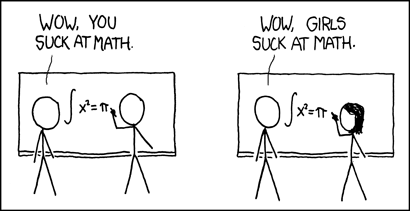
There’s also this (please imagine replacing the word “math” with “writing.”)

From this page: http://xkcd.com/385/

People (mostly guys) have this weird idea that fiction written by women are all one sort of thing, as if it can all be lumped in as one type. There’s also the idea that, if a subgenre has a lot of women writers and readers, it has a yellow “Caution” tape around it to warn guys away.

For instance, two years after it was posted I still get traffic from this Tor.com article: Urban Fantasy and the Elusive Male Protagonist (let us turn away from the issues around the blog post itself, which I tried to address in the comments) and the comment section can be instructive/cringe-inducing/hope-for-humanity-destroying. To quote (copy & paste, so sic):

its come to the point where i wont touch a book with a female on the cover unless its been recommended by some friends or an author i respect.

it seems as if its all about alpha werewolves and master vampires in a three way relationship with an independant ass kicking woman, the majority of it could also be classified as soft-core pron.

For a lot of people, men write books in a genre (or in a tradition) while women all write the same book over and over with a few proper nouns switched out. What’s more, That Same Book is usually considered Someone Else’s Thing.

Anyway, I’ve been pretty up-front in the past that I don’t think reviews have much of an effect on sales figures, but it’s not just sales we’re talking about here. We’re also talking about the critical conversation within the genre (such as it is): how it changes, what’s becoming old hat, what’s offensive or wrong-headed. When women are left out of that conversation, their contributions become ignored.

So, to wrap up I want to make two points: First, if you’re recommending female authors, a long list of names, even if you break them down to five or six in a genre, are just going to make people skim. Pick one or two, give a good reason why for each. Make a specific pitch. Yes, that means people you know will be left out, but this isn’t a one-time thing, right?

(To that end, I’ll recommend Sarah Monette’s The Bone Key. I bounced off Monette’s epic fantasy series, but this story collection blew my mind. Kyle Murchison Booth is nothing like Ray Lilly, but the setting and tone of these tales are a fantastic antidote to the tentacle monster stories that dominate so much of the dark fantasy genre. And this shows why I’m crap at giving recommendations, because I’m always reading years–or decades–behind, so I’m never up on the current stuff.)

Second, if you’re one of those readers who glances at their bookshelves, sees nothing but books by dudes, then shrugs it off, it’s time to break a bad habit. There’s a wide world of great books out there to be enjoyed and no reason to hide from it. If you like awards, start checking out books written by women that win or get nominated for them. If most of your reading is off the bestseller list, start trying some of the female writers there.

The truth is, your results will be mixed just as with anything. Some writers you’ll hate, some will be meh, some will be new gotta-read favorites. Of those books by “gotta-read” authors, some will also have “a female on the cover.” Take chances. Grab things from the library or try the sample chapters on your ereader. It may take a while before you start finding new favorites, but if you’re like me, the favorites you have now took a lifetime to collect. Don’t give up quickly. Keep stretching.

Added later: As pointed out on LJ by user martianmooncrab, RT has a review section for SF/F but their numbers are rarely included in these surveys.

Added later: The Revenge: The author who started the hashtag explains her reasons.

How I feel about the Hugo Awards (spoiler: meh)

Standard

The Hugos are fine. It’s a popularity contest with a small, self-selected sample, and frankly I ignore most everything everyone says about it (except for the juicy melodrama, naturally[1]). They’re not a bad thing at all; it’s nice that people win them and I’m glad they make people happy.

But they have an outsized profile, as argued here. Frankly, I think the guy argues his point too forcefully (“Twaddle”? Please.) but then I stopped trying to drive traffic to my blog a long time ago. He’s right about the awards having a greater significance than they can really support. They’re small groups of people getting together to vote for things they like, which is 100% legit, but should that really be the basis for the most well-known spec fic award in this part of the world? [2]

Anyway, it’s worth reading down to the comments, because one of the authors the OP criticizes, Larry Correia, pops up to justify his behavior (“The smof cabal is against me!” “It’s all just self-promotion!”) and I made the mistake of following a link back to his blog.

Because as disinterested as I am in the usual award stuff, bullshit like this quote below, about Saladin Ahmed, nominated for his debut novel, is toxic:

Saladin’s a nice guy, and beloved by SMOF (we were up for the Campbell at the same time), but I’m predicting he’ll come in last, becasue this is his only book and he’s not built up a huge SMOF backer faction yet, but just having nominated a guy with an ethnic name will make the SMOFers feel all warm and tingly inside and good about themselves, so that’ll be enough for them.

(Tyops in the original)

That’s grade-A horseshit right there. However small the nominating pool was, whatever value should be placed on the Hugo itself, they nominated the man’s book because they liked the man’s book. Attributing it to “an ethnic name” is racist bullshit.

Awards! They bring out the whacky in people. Now I’ll go back to my previous policy of not talking about them.

[1] An awful lot of people hesitate to say a book is awful unless it has won/been nominated for an award.

[2] It’s obligatory for Certain People to respond to any awards criticism by saying “Oh, so the stuff YOU like didn’t make the ballot and that’s why you think everything SUCKS!” It’s an easy response. It’s the knee-jerk response. It doesn’t fit me. To be honest, I don’t think I read a single new book or story last year. Actually, scratch that: I picked up the latest Dresden Files from the library, but I wouldn’t want to give it an award. I don’t really like reading short fiction on my computer, and most of the books I read are a few years old (or more than a few). I’m not what you’d call “up to date” and I don’t worry about it. [3]

So no, this isn’t a complaint about What I Thought Should Be On The Ballot, because I have no idea what should be on there and have higher priorities when I’m reading new stuff.

[3] Also: No, I didn’t release any new work in 2012 that could have been nominated, since that typically has to be said, too.

Readers hated Ray Lilly because of his sex life, oh wait, no, he’s a dude

Standard

In a post called, appropriately, Trigger Warning, about mostly-female reviewers unleashing a torrent of slut-shaming on sexually-active female lead characters. FYI: there’s a lot of pain in that blog post.

I came across that link through a public FB post by Mary Anne Mohanraj in which she tells of a book that was declined by Harper Collins because the editor believed a great many readers would not be sympathetic to a woman who has sex when she is not in love.

I immediately thought about Ray Lilly. He has sex in Child of Fire and Circle of Enemies, and he’s not in love with either of those women (he was once in love with Violet, but not anymore). What’s more, neither of those women are in love with him.

And not one reader has said boo about it.

Ray was written to be a likeable character (my first deliberate attempt at one, actually) and a thriller hero, so the narrative context of the sex is different. It turns readers’ attention away from the fact that these characters are living their lives and making these sorts of choices. For a social realist or coming of age novel, the whole thing is *about* those choices.

Plus, he’s a guy, and guys are welcome to get it on whenever they can without much risk of losing reader sympathy. It’s ridiculous bullshit, but it’s still there.

We’ve come a long way, but it’s not far enough.

I Would Not Have Taken The Flower: An Introvert’s Take on AFP’s “The Art of Asking.”

Standard

First Amanda Palmer raises over a million bucks with her Kickstarter. Now she’s collected over a million views for the TEDtalk linked below. Apparently she likes to do things by the millions. (NB: I would be quite happy with a half as many book sales. Just saying.)

The reason it’s been so popular is that it’s pretty damn good and very interesting. Give it a watch, if you haven’t already.

In case that embed doesn’t work, here’s a direct link.

So many responses all over the intertubes! Tobias Buckell embeds the talk in a post about monetizing his blog; Buckell is a smart dude, but I’m going to call that missing the point.

Kat Howard sees the talk in terms of daring to see what she does as valuable and coming to terms with the idea that people would want to talk to her. While Palmer is talking about connecting with people, which includes struggling with the questions of both trusting them to say yes (without some sort of awful betrayal) and not asking for too much, but Howard is becoming accustomed to the idea that anyone would want to connect with her.

There’s also Chuck Wendig’s post about trusting his readers to pay if he gives away his work, about the internet age breaking the barriers between artist and audience, and about how happy that makes him.

But when he talks about making a connection to his readership, he says:

“If you’re going to be exposed, expose yourself.”

You know what I notice there? The audience is not even mentioned. He’s talking about baring himself through his work, but I don’t think that’s the same sort of thing Palmer is talking about at all.

You’ve watched the TEDtalk above already, right? Once again, it’s good and interesting and it takes the changes our culture is going through very seriously and half of what I’m about to say won’t make any damn sense if you haven’t.

I don’t want the flower. Palmer would have had to make the sad face as I walked away because I don’t want to lock eyes with a performer. I don’t want to share a moment. Palmer may be a performer and (almost certainly) an extrovert but I’m neither of those things.

So, yes. Me = introvert. But that doesn’t mean I’m shy. I’m not, particularly, although the odds are that, if we happen to sit at adjoining tables at a cafe or a party, I won’t talk to you. An introvert is someone who feels drained by human interaction. Taking the flower and meeting a stranger’s gaze for a minute? That shit is tiring. Thanks, it seems very interesting, but no thanks. I have too many demands on my time and energy as it is.

I assume things are different for Palmer. I would be willing to bet a whole nickel (maybe two!) that she’s an extrovert. When I recharge, I seek privacy. When an extrovert recharges, they seek face-to-face human connection. God forbid I should be in a band or do street theater; I can’t imagine anything more draining. I save my socializing-spoons for my wife and son, and sometimes for close friends. Making a connection with strangers? That’s fine in small doses, if I can prepare for it and have a way out when it gets to be too much.

That’s why I think Buckell, Howard, and Wendig are missing the point, even though Palmer herself tweeted a link to Chuck’s post with a big thumbs up. They’re talking mostly (not exclusively, but mostly) about online interaction. About mixing it up with people digitally, maybe through Twitter. Maybe through a PayPal Donate button. Maybe through a well-moderated comment section.

Palmer is talking about sleeping in the homes of strangers. She eats toast at their breakfast table and craps in their toilet. She is right there in their lives for a few hours, because if you’re a fan of hers you can offer crash space to her band. (Be sure to have lots of clean towels because drummers.) That is a very different thing than tweeting funny lolcats to each other, or even mingling in a store after a reading with your Game Face on. What Palmer does is riskier, less-controlled, and more visceral.

Also… Look, I don’t want to seem like I’m slamming any of these writers. I’m not. I’m just saying that there’s a huge difference between connecting with your audience through your art and connecting with them as a human being. She’s doing the latter.

I think that’s great. For her.

I don’t want to do that. This may sound silly, but my supernatural thrillers? The ones with “monsters and face-punching” as I used to describe them? Those were very personal. They are full of my obsessions, and I feel very much “exposed” when I see them in a bookstore or get a note from someone who liked them.

That’s how it’s supposed to be. That’s how I’ve always done it. If there’s nothing personal or painful in a story, whether it’s my issues around food or shame or self-loathing or the way we all tell stories to ourselves to rationalize our choices, that’s me in those books. That’s all my private bullshit. And I put it there for anyone to see, no matter what they might think, because that’s what writing is for. As Nick Mamatas said (rather dramatically) in his writing book Starve Better: “You have to stop caring whether you live or die.

As Chuck said, I’m willing to be exposed (in a mental/emotional sense not physical, because ugh).

Like Howard, like Wendig, I want to connect with people through my work. Unlike them, maybe, that’s enough for me. Yeah, I’m among the audience because I’m a reader and a moviegoer and whatever else. I’ve always been in the audience.

But I’m not out there as an artist because I’m not looking for that personal connection. Palmer wants to be the artist who looks you in the eye. I want to be a twice-removed voice that whispers directly into your brain. Yes, I know that sounds creepy; guess what sort of stories I write. Don’t look at me. Here’s a book. That’s why I wrote it. Don’t open it up until I’ve gotten out of the room. That’s good enough for me.

Free Marvel Comics

Standard

Yeah, I spent an inordinate amount of time this morning putting Comixology on my wife’s iPad and downloading as many of the free Marvel comics as I could snag. I tried for all 700-some, but there were issues with server overload, obviously, so I’m going to try again later.

The free comics (first issues of new and old books) are only available for a short time, so snap them up if you want them.

I have to say that I enjoy reading comics on the iPad. For novels I think paper is better, but the electronic format works nicely with panels and art. I just wish I could afford them.