I have a lot to (not) catch up on, and some thoughts to post later when I’m out of the apartment.
In the meantime, Circle of Enemies is finally available at Barnes & Noble stores.
I have a lot to (not) catch up on, and some thoughts to post later when I’m out of the apartment.
In the meantime, Circle of Enemies is finally available at Barnes & Noble stores.
This is just a placeholder to remind people that I’m going to be on an internet fast starting today, Sept 10th and ending the Saturday following. When I come back, I’m going to mark everything read and hopefully have some insight into how I use the web and how it affects my life.
I’ll be checking email once a day.
In the meantime, if you’ve read and enjoyed my novels, you can read e-versions of several of my short stories and novellas. (Kindle | The Nook)
See you on the other side.
1) Owlcat Mountain thought Circle of Enemies was the best Twenty Palaces book yet: “The unique system of magic, the complex characters, and the fresh and vibrant plotline all combine to form one of the summer’s best fantasy novels.”
2) Dean Fetzer liked both Game of Cages and Child of Fire enough to use the word “genius”: “Okay, if you don’t like anything fantastical or supernatural, my advice would be to look away now. But you’ll be missing good reads. Your loss.”
3) Samantha Holloway at the NY Journal of Books liked Circle of Enemies quite a bit. “It’s noir made vital again with really strange monsters. It’s a thriller almost totally lacking the usual obsession with the technical details of the weapons, leaving more space for thrills. It’s one man against the dark with only a paper knife and woefully little education. And it’s addictively compelling.”
4) Beth at Library Chicken also liked Circle of Enemies: “It’s a gripping combination of characters and situation, and finishing the last book makes me want to start the series all over again.”
5) Michael B. Sullivan also also liked Circle of Enemies: “But if you’re looking for a dark, action-and-investigation oriented modern day fantasy series, nobody else is writing books quite like Harry Connolly, and you should check out Child of Fire.”
6) Charlaine Harris says nice things about my books: “I think Connolly’s books are startlingly original and suspenseful, and I recommend them all highly.” (Which is very nice! I expect I’ll have to update that link very soon, though)
7) K.C. Shaw at Skunk Cat Book Reviews thought Circle of Enemies was the best book yet: “Connolly’s monsters would freak the hell out of Lovecraft.“
So I’ve been doing the Livestrong calorie/fitness counter and it’s been fine so far. I get a little hungry but nothing that makes me want to yell at my kid or whatever.
But yesterday got a little nuts. We made a run to the Staples, the boy and I, for various supplies (note to my agent if you’re reading this: yes, we bought a new phone), walking a mile and a half to get there.
After lunch, my wife came home from work early and we went to the local park. We hiked to the beach, then hiked back, over an hour and a half, which is a long way considering our various problems with our legs. We hopped over to the bus stop, all sweaty and exhausted, to wait for our ride home.
Except the driver picked us up, took us one stop, and told us he was taking a 30-minute break. We could take another bus if we wanted at this next stop, but since we weren’t going downtown that was worth fuck-all to us. We had no choice but to wait until 9pm for the bus or walk all the way home.
Let’s just say that I arrived home and realized my calorie intake was a negative number for the day. Not just below my goal: below zero.
“Oh my god,” I said to my wife. “I can eat anything I want.”
Mmm, grilled cheese sandwich with mayo and hot peppers. (840 calories)
Anyway, today will be a recovery day.
In unrelated news to my physical health but closely related to my mental health, I’m going to start an internet fast on Sat the 10th of September.
That’s right. I’ll be logging off and staying off.
I will check my emails once a day. I won’t be blogging, or reading my LJ friends list, or posting earworms on Facebook, or goofing around on Twitter. I’ll check email and allow my dropbox files to do their thing, then I’ll turn off my modem.
It’ll be a useful way to re-examine my internet habits (the way I used to when I did actual food-type fasts) and hopefully up my productivity. It’d be nice to have a little extra family time, too.
Anyway, I’m going offline to run some errands. Don’t forget there’s a Twenty Palaces spoiler thread to check out.
This is a place, on my blog and LiveJournal only (pls don’t post spoiler comments or questions on Facebook or any other social media, because comments threads aren’t always hidden) for a full on spoileriffic discussion of the Twenty Palaces books.
Please note, some things are meant to be mysterious/ revealed later, as I won’t give away that stuff, but that shouldn’t stop others from talking about it. Also, if you point out something I screwed up, I will mea culpa.
After this posts, I’m going to address the question in this comment in a comment on the LiveJournal side of things.
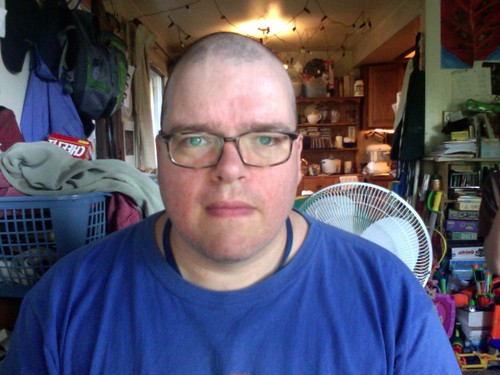
It turns out that my broken frames aren’t made any more, so I had to have my old lenses fit into whatever frames they had that would hold them.
I think I lucked out there.
1) A visual compendium of notable haircuts in popular music.
2) The origins of Superman’s villains, done in the style of Little Nemo In Slumberland>.
3) Amazing manhole covers in Japan.
4) Lord of the Rings in Lego (via Rose Fox)
5) The Silmarillion, bound and illustrated by hand.
6) The many difficult decisions around crossing a street in Los Angeles.
7) “There is widespread belief in a warm and comforting story which states the horse is a gentle herbivore.” From the description of Deadly Equines: The Shocking True Story of Meat-Eating and Murderous Horses by CuChullaine O’Reilly (seen via Ray Radlein)
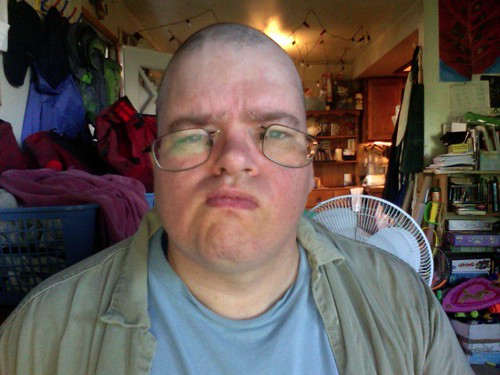
Yesterday I was making the rounds signing copies of my books and, as I was walking to my first B&N, I pushed up my slipping glasses and heard a tink!
And my glasses fell off my face in two pieces. The metal bridge finally succumbed to fatigue and snapped apart.
How can you tell I’m cool?
Hell yeah.
By the way, none of the B&Ns in town had copies of Circle of Enemies in stock. Hurricane Irene delayed them, I’m told. Can I tell you how happy I am that the biggest bookstore chain in the country won’t stock my books in a great many of their stores until at least a week after it’s come out?
This is how happy I am:
Anyway, my wife “fixed” them by wrapping a wire around the nose bridge and hot-melt gluing it in place. That’s better than tape, I guess? I think she’s mad at me.
1. I have promised a thread for spoilery discussions of the Twenty Palaces books. I have not forgotten this promise.
2. Today is the day I travel around Seattle (by bus!) signing book stock in stores. Fun! Okay, not. Actually, it’ll be a good time to do some reading and thinking about item 3.
3. My agent got back to me with some notes about A Key, An Egg, An Unfortunate Remark. They seem very straightforward but will require a bit of fixing to address. Must turn on brain.
4. My agent has also shamed me into replacing my phone. Let us not speak of this further.
5. The Livestrong calorie counter is making me rethink my devotion to kielbasa and peanut butter.
6. Booster Gold is a terrific character.
7. My email inbox has been exploding for weeks. I’m not sure what to do about it, but I have to do something.
8. Last night was date night for my wife and me. Unfortunately, our sitter never showed (don’t know why) so we ended up cooking some quick, sorta-crappy food and then rushing out to Elliott Bay Marina to see “Cirque du Sail” a couple who travel around the world on their sailboat, with their kids, and pay their way by doing acrobatic shows in the rigging for donations. Last night was the final Seattle show but they’ll be in San Francisco in a few days. They’re very good. Check it out if you can.
9. One the way to the Marina last night, my wife turned to me and said “Thanks for coming to see this thing with me.” I said: “Hey, it’s Date Night! We just had bad food and now we’re going to see some unlikely entertainment. The only difference is that we’re dragging the boy behind us in a little red wagon.” Date night, everybody.
10. Time to get out of here and start signing. Have a great holiday weekend, Holiday Weekend People.
So, I watched FRIGHT NIGHT in the first week of its release, and I’m a little stymied that it’s not doing so well. Maybe I shouldn’t be; it was dumped at the ass end of August when theaters are filled with crap and crowded with successful movies still pulling in ticket sales. There were literally two theaters where I could see it.
Thing is, it’s actually a good movie. Scary, kinda gory but not too bad (I can’t stand really gory gross movies) and filled with terrific performances. Farrell plays the vampire Jerry Dandridge as an odd, alarming guy with a number of weird tics. And why not? This is a dude who spends a whole, whole lot of time alone.
The other actors do a great job, too: David Tennant gets the flashy, wacky Peter Vincent sidekick role which almost overshadows the great performances from the two leads. The story loses something when it turns away from the fading TV show host, but at least it dropped the god-awful “true love reborn.” They should have held it until October when horror movies traditionally do well.
Anyway, it’s a terrific movie with some fantastic tension; I recommend it. One of the reasons I wanted to talk about it, though, is that I’ve seen a number of people talking about the vampire as a monster. Vampires should not, they assert, be emo love kittens, nor should they sparkle, nor should they be anything but skilled, violent killers.
That’s even made explicit in the film, which I suppose is necessary since sympathetic vampires have been so popular that they needed to draw a line between those other stories and this one. The vampire is compared to the shark in JAWS early on. It’s a predator.
None of which is new. Some of this is contempt for the feminine and things perceived to be meant for women (“Alpha male romantic lead? Cooties!”). Some of this is simply because people love vampire-as-monster and have no interest in other interpretations.
Me, I’m glad to see it. I think vampires are flexible enough to carry all sorts of different stories, and people’s willingness to portray them not as an invading evil (Stoker’s Dracula was portrayed as an ugly Slavic immigrant come to steal wholesome Victorian women) but in any number of ways: Lover, friend, oddball neighbor, steadfast ally… Kevin Hearne’s books have a vampire lawyer in them. It’s the process of turning outsiders and monsters in to fully-rounded individuals, of acknowledging they have real humanity.
I’m for it.
