Cop Show vs Spy Show (Agents of SHIELD)

Standard

No, I’m not going to put the periods into SHIELD, because that’s too annoying. Does the FBI put periods in? They do not.

So, AoS seems to be two different shows: one covering the first two-thirds of the season and another for the rest. The early one was kind of a chore… a friendly chore and one I didn’t resent too much, a lot of shows need time to find their feet.

The second show, the one they’re wrapping up the season with, is actually good. File that under “unexpected.”

Here’s the thing: with these shows you can lay the emphasis on the characters, or on the shit the characters deal with. Obviously, in a perfect world both would be extraordinary, but this isn’t a perfect world (because we had that show, it was called LIFE and it was cancelled). So you either focus on the relationships and have pretty interesting plots or the outside threat with a mostly-interesting cast. Everyone in the whole world loved HOMICIDE: LIFE IN THE STREETS except me, because I was so very uninterested in the drama between the cops. I didn’t care if those guys bought a bar together. I didn’t care about that one guy’s marriage or the other one’s health. All that stuff made me bored and irritable.

On the other side is THE X-FILES, in which the two leads were boring cyphers (luckily played by actors with extra helpings of charisma) but the weirdness they investigated was usually pretty fresh.

Anyway, AGENTS OF SHIELD started off as the latter: They tried to give us characters that delighted us instead of ones we could really invest in. Fitz/Simmons were excitable science-loving nerds, May and Ward were badasses with mysterious pasts, Coulson was still trading on the appeal he’d earned in the movies, and Skye was the pretty, idealistic audience stand-in with a lot to learn.

Which was fine, but the show set itself up as though they were a team of cops in a world with superheroes, then didn’t deliver. The pilot was fine, if a little rough, but they lost track: They were seeking a piece of alien tech with alien germs on it. They were hunting a rogue agent with a cyborg eye. They were trying to understand why people kept dying near an outcast safety inspector.

It’s not that they were bad ideas: there was a pyrokinetic in there, a wacky gravity machine, a wacky freezing machine, an Asgardian weapon, a couple of renegade Asgardians, and most interesting of all: an enemy mastermind who called themselves The Clairvoyant. It’s a cool idea; how would you defeat an enemy that could see the future?

But none of it had any zip. There were set-pieces they’d obviously spent money to pull off, like the revolving room in the gravity episode, but I wanted Coulson to be the mild-mannered badass of his Marvel One-Shot short film.

I wanted to be surprised by the characters’ solutions to the problems they faced. I wanted to see Coulson analyze the situation so well that he was ahead of everyone, including me. What I didn’t want was to be just as knowledgeable about the next step the team needed to take as the team was. I didn’t want to feel dragged along.

If they’re chasing a villain who can make men do whatever she wants, the team should not be surprised that the cops setting up a perimeter around the villain’s location have already been turned. I wasn’t. Why am I more suspicious than the trained government agents? There’s no excuse for it except not putting the effort in.

Instead, they should have played out the big reveal that the cops had already been turned, then show Coulson defeating them or defusing them immediately, because [CLUE] made him realize they were not on his side. Unfortunately, that never happened. Coulson was never ahead of me, and that’s a problem.

Then there was The Big Twist, the tie-in with The Winter Soldier, which revealed that one of team had been a double-agent after all. Suddenly, the show stopped focusing outward and began to focus on the team. Ward’s betrayal is still playing out, and last week’s episode showed that the whole team has realized that he’s Hydra. It’s playing hell on the camaraderie that has been kind of dull all season, and it’s making for complicated relationships.

It’s funny; they could have done something like this with Skye straight from the start. Her goal in the pilot is to uncover secrets, and there she is in the heard of a secret government agency. What Skye wanted to do what exactly what Captain America did to defeat Hydra and SHIELD both; she’s a good guy.

And she could/should have been a much larger source of conflict, not because she’s a villain but because she is most definitely not. Instead, her desire for openness is played as naivete and she sheds it quickly, buying into the group culture. It’s a lost opportunity.

Still, the best moment in the whole season so far was when Skye calls Ward a Nazi because a) it was absolutely the right thing for her to say and b) it surprised me. Ward’s response–and his conflict between his loyalty to Garrett and his love for Skye–has brought his character to life.

Shit’s become fun.

Alongside that, SHIELD as an organization is 100% gone. The team has lost its plane, its funding, its backup, its computer/intelligence resources, and its official sanction. In fact, they’re wanted fugitives. Whatever they do next, it had better be clever. If Nick Fury or whoever swoops in and fixes things for them, I’m going to be seriously disappointed.

Story beats they should hit before the end of the season:

1) In the pilot, Skye wanted radical openness. Now she has it. How does she feel about that? How do any of them feel? Not just the loss of their organization and their identity as SHIELD agents, but the loss of power that comes from keeping information secret.

2) CA2:TWS made it a point that SHIELD and Hydra were more alike than the good guys would care to admit. Coulson and his team keep discovering that their organization was involved in shady things–the most recent was that they intensified Mr. Darkforce’s powers instead of weakening them. But at no point does he take responsibility for this, nor does he seem capable of concluding that maybe SHIELD had lost sight of its mission and is better off gutted.
About Those “Big Name” Writers…

Standard

Last Friday, a funny conversation popped up on Twitter. It started with Kameron Hurley, when she tweeted this:

Click through to read the whole thing, but there was also this:

I think it’s worth saying that science fiction and fantasy is a small, disparate field, even on the internet. Those writers whose names you see on popular blog posts or online articles, or who have award nominations, or several thousand Twitter followers? You might be surprised by how much they struggle getting their books out there. Getting noticed, convincing readers to try their work instead of that other author’s, racking up enough sales to keep going and maybe, just maybe someday earning enough that all those hours of writing pay off at something like minimum wage.

Sometimes I think of the internet as a huge cave complex with innumerable caverns. Where I am standing, it may seem crowded with people, and many of the voices I can hear seem so big they echo off the walls, but people just one cavern over have never heard of any of us and don’t care a whit for the drama that sucks up all of our time. And beyond that cavern is another and another, all filled with people that we can’t reach.

The U.S. has a celebrity culture, which seems to be spreading beyond our borders, that encourages folks to assume that “well-known” somehow means “powerful” or “successful.” I’m just saying it’s not so, not with writers. A footprint that might seem large to an individual is probably smaller than you think in real terms.

Anyway, Kameron Hurley has a cool series you should check out, and so does Tobias Buckell. If you haven’t had a chance to check them out, you should. That’s how Big Name Authors are made.

New Kickstarter Update posted (with cover art)!

Standard

It’s the beginning of the month, so it’s time for an update on my Kickstarter.

This one includes the cover art for the first novel, The Way Into Chaos, by Chris McGrath!

Check it out.

No, seriously, check out that cover art! It’s gorgeous.

Randomness for 5/1

Standard

1) The LEVERAXE! which twists in your hand to split wood faster. It’s science!

2) Was the drop in crime caused by unleaded gasoline?

3) Orion, The Masked Man. The singer, not the comic book character.

4) How to make a “sick edit” with mountain bikes. I don’t even know much about mountain bike videos, but I learn a lot from parodies.

5) Is “mankind” the right word to use when you refer to all human beings? Scholars weigh in.

6) German man builds a “web shooter.” This is very similar to the “mini-railgun” ranged weapon my buddy gave to his Champions martial artist years ago.

7) Lip sync battle between Jimmy Fallon and Emma Stone. Video. This is just flat hilarious and amazing.

Do streetlights make traffic less safe?

Standard

Occasionally, I’ll see an article or post suggesting that traffic would move faster and be safer if we would only remove our street lights and stop signs. Let people self-regulate, the claim goes, and not only will they be more careful, they’ll get where they’re going sooner.

Well, here’s a time-lapse video of an intersection in the heart of Addis Ababa, Ethiopia. No traffic control, lots of scary moments.

Note, according to wikipedia, Ethiopia’s traffic fatalities per 100,000 people is slightly below the world average.

WTF. Doll in video that… I don’t… What?

Standard

YouTube embed deleted, because it’s a hoax. I mean, of course it’s a hoax. Of course.

Be sure to watch to the end, because how is this even a thing.

What the hell, people.

Little girl goes to My Little Pony Convention and…

Standard

It’s not just about the original story; it’s also about the way people responded to that story.

When my son first started going to Pokemon league, I always made sure to sit in the back of the room. The game store where it was held had a cafe attached (a pretty good one) where I could have relaxed with a beer and some fries, but I always hung at the very back and watched.

The main reason was that, for the first few weeks, an older guy decided to teach him out to play the game. The guy gave me the skeevies for a lot of reasons, not least that his shirts were always filthy in back between the shoulder blades, as though he was sleeping outside (now that sex offenders have to register and inform their neighbors of their criminal history, many have become homeless).

Did I know the guy was a pedophile? Nope, but there was no way I was going to take the chance, and I wasn’t going to leave my son’s safety in the hands of the store/event staff.

Now, this is different from a convention-type event. Pokemon League took place in a room about the size of the cafe I’m sitting in right now. In a convention, people range farther, it’s a bigger space, and there’s way more to see. In that situation, the organizers absolutely have to step up.

If the event is going to have little kids in attendance, pron and other sexual materials should be forbidden. If the whole point is pron and sexual material, the organizers should not allow anyone under 18 to attend.

More importantly, if the people attending have zero faith in the organizers’ ability to keep their attendees safe (especially 11yo girls) that’s a huge, huge problem.

Randomness for 4/19

Standard

1) Baby noises edited into beatboxing. Video.

2) Every live action Marvel movie from 1998 ranked. I’d quibble with some of the rankings, but who wouldn’t? Also, there was no excuse for Elektra being so terrible.

3) The Ten Most Deadly Rocks And Minerals. h/t Kat Richardson

4) The placebo effects of food labeling.

5) Metal Albums With Googly Eyes, a Tumblr.

6) Time is a flat Family Circus, a Tumblr.

7) The best resignation letter ever.

Two More Things To Say To Young Writers

Standard

Yesterday, Chuck Wendig wrote a post called Ten Things I’d Like To Say To Young Writers (the man likes his lists) and I think it’s good, solid advice. Me, I’d like to add two more things. Here goes:

Really study text that works.

Have a favorite short story? Retype it. A favorite novel? Type out that first chapter. There really is no substitute for retyping a whole mess of text–just reading it, even aloud, doesn’t bring the same focus. Then read it through with a yellow legal pad next to you and, every five pages, jot a line describing what happened.

How quickly does the book get to dialog? To the main characters? How quickly does the book describe what the main character is searching for, if it does at all? How much space on the page is given to description of people or places? How soon does the conflict start? Depending on the genre and the style of book, the answers can be quite different.

Best of all is to choose a successful book that is very like the one you hope to write. Study it. Try to get a feel for it, because:

Understanding how a piece of writing makes readers feel is the real prize

The universe is full of writers who crap on a keyboard and call it gold. Those people do not understand the way readers respond to their text; they know what’s in their head, they’re sure that’s what they put on the page, what’s wrong with readers/editors/agents/the world that they can’t see the awesome?

But, in fact, it can be very difficult to judge your own writing the way a reader will. We might hope the scene we just finished will be scary, or funny, or sad, but until we show it to complete strangers we’ll never really be sure.

What move people never say is that the ability to accurately understand the effect your own words will have on the reader is the first (and most difficult) step to becoming successful. So try to get a feel for your own books the way you do when you read the ones written by other people. Revisit stories you wrote the year before. Invite readers to tell you how they reacted to the story (but never what they think you should do.) Understanding those feelings are the way to mastery.

Captain America, Anti-Hero?

Standard

Now that CAPTAIN AMERICA 2: THE WINTER SOLDIER has had a gigantic opening weekend, people are starting to talk about how it ought to have been done.

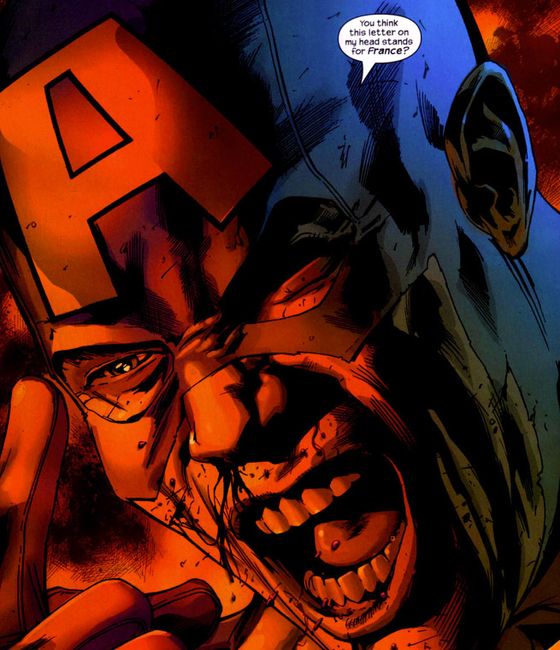
Take this post on Vulture, which says that Cap would be interesting if he was a prick. As supporting evidence, the author trots out Millar’s repugnant characterization of Steve Rogers in the first few Ultimates comics, adding this panel to his post:

Captain Freeper

Do we really think a guy who actually fought the Nazis would have the same opinion of France as some random member of the freeper cheetotariat? Yes, the Nazis attacked and occupied France in WW2. You know what we call people who mock victims of the Nazi war machine? Assholes.

So try to guess how impressed I am by the idea that Steve Rogers isn’t actually interesting unless he’s being some kind of jerk. (Not very.) There’s a weird mentality in comics that treats cynicism, misanthropy, and nihilism are somehow more mature than idealism; it’s a teenage boy’s idea of agency. It’s all about contempt: for people without power, for social rules and bonds, and for compassion. It’s a hero who “Does what has to be done,” which the narrative conveniently frames as acting like a ruthless thug.

But none of these stories are being created by teenage boys: it’s middle-aged adults, whether we’re talking about The Boys, or Wanted, or one of the New 52 storylines (like the much-discussed new Harley Quinn or Starfire, or the bit about the Joker’s face) that rub their hands together gleefully and sell ever-shrinking numbers of copies to their aging audiences. Clearly, the author of the Vulture article is deep into this mindset; why else discuss (and post a panel from) part of a story where Bucky is made out to be the killer that Captain America could never be, as though the American people couldn’t accept a WW2 soldier who kills Nazis? [1]

Nevermind that, based on where Cap was born and raised, he’s unlikely to be the France-mocking conservative reactionary the Vulture writer seems to expect. Nevermind that the big wave of anti-heroes seems to have passed and left us with very few lasting characters. [2]

More interesting is that Captain America has been around, and been successful, for decades. Comic book characters come and go and they always have. Some are superpopular and fade away. Some keep getting reinvented without really breaking out. Some fade into obscurity. How many times has Marvel tried to launch a Dr. Strange comic to middling sales and eventual cancellation? [3]

Most of these characters stick around. They’re ongoing IP, turning up in other characters’ stories, but they can’t sustain their own ongoing series.

Cap is one of those who can. Forget about the ridiculous costume (which they had fun mocking in THE FIRST AVENGER), he’s been popular for a long time, even with readers like me, who are not exactly overflowing with reflexive patriotism. He works in the comics (and has for decades). He works in the movies (as you can see by the box office and rave reviews). Where so many others have failed, he continues.

Instead of saying he needs to be roughed up to make him interesting, it would be worthwhile to figure out why he’s already successful. [4] I suspect it’s because the conflict is not inside him, it’s between his ideals and the distinctly non-ideal world around him. No anti-heroes necessary.

My spoiler-filled review of CA2: THE WINTER SOLDIER here.

[1] Yes, there were years when comics were ridiculous about the death toll that would come from superpowered combat in Manhattan. “Thank goodness the buildings the Hulk just collapsed were all condemned! Someone might have gotten hurt!” When comics became more realistic about the damage their fights could do, that was a welcome development. I just wish it hadn’t gone so far.

[2] Wither art thou, Darkhawk? What about you, Maggot? Shatterstar?

[3] Not that I have anything against Dr. Strange, who ought to be a wildly successful character, with the right writer.

[4] A trade collecting part of Mark Waid’s run is pretty much the only superhero comic my son has ever enjoyed.