Our Immortality Lies In The Effect We Have On Others: RIP David Bowie

Standard

I just recently wrote about fearing obscurity, but of course death is out there, too. Death is the end of all our contributions to the world. It’s the end of our opportunities to experience joy and delight, and to make an impact. It’s the end of us.

But we all get to have a kind of immortality, too. When any of us show kindness to someone else, we brighten their day. If we’re lucky, they feel happier than they did, and they get a chance to pass that kindness to someone else. In that way, a good deed can circle the world, just as long as recipients give away what they have received.

That’s our immortality, and it isn’t about us as individuals. The effects of our kindness can touch people who have never heard of us, and it can last long past the life span of those who knew our names or laughed at our jokes. It’s immortality as life force, the soul defined by the effect we have on others, and the way those effects ripple outward.

Maybe one particular good deed was prompted by a kindness someone else showed to us, which would mean that good deed sustains someone else’s immortality, mixing it with our own. Maybe the good deed is something we created ourselves, as an antidote for being mistreated. Either way, every kindness becomes part of the heaven that we ourselves create.

Because heaven isn’t a place we go at the end of things; it’s something we construct with our words and our deeds. It’s found inside generosity, joy, and connection like little pinpricks of light, and it’s something we make for other people, not for ourselves.

The way we raise our children, and the way we treat our neighbors and our friends over the long term… those things have an even larger impact on the world, for good or ill.

And then there’s the art we make.

David Bowie reached a great many people with his art. I’m not going to try to summarize his career; others will do that better than I ever could. But I don’t think it’s out of line to estimate that there are millions of people out there who feel that his music saved them in one way or another. That’s a powerful legacy–any artist would dream of having that kind of effect before their time on this world comes to an end, myself included.

He may not be with us any longer, but his impact remains. If David Bowie ever brought you joy or comfort, please try to pass that on to others. In that way, you help to make him immortal, and you become immortal with him.
Holiday time with my family, plus secular symbolism

Standard

I’m not a Christian, but like many Americans I’ll be celebrating the holiday today. We have our niece visiting from out of town, and the tree has lots of gifts under it, four stockings hang over the fireplace, the fridge is stuffed with the traditional foods, and the shelves are full of board games waiting to be played.

Twenty years ago I would spend the holidays alone, making ravioli and writing. Personally, I prefer this. If you find yourself spending the day in a way that makes you feel awful, please reach out. There are folks out there who want to hear from you; you don’t have to be alone.

Whether you celebrate or not, I hope you have a wonderful day. If you like, you can check out my post from two years ago about secular symbolism over the holidays.

Best wishes to you.

Portugal, Day Twelve: No Pix

Standard

Today was Sunday.

By this point, my legs were aching to a degree that I can’t readily dismiss as simple soreness. Shit was painful. I did my best to take time off, but it wasn’t enough. It’s never enough.

No pix today, obviously.

Portugal, Day Eleven: Sintra

Standard

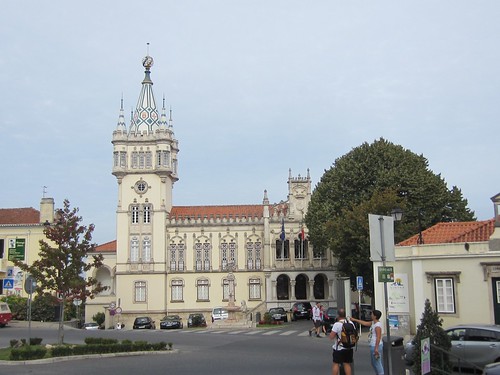
On this day we went to Sintra—which is just a short distance north of Lisboa, and very near the coast—to see the Moorish castle there. It’s what my sister-in-law referred to often as the “storybook castle” because it looks like something out of a fairy tale.

That was a deliberate choice, as it turns out. King Ferdinand II decided to have the castle restored in keeping with the Portuguese version of Victorian aesthetics. Gardens, moss, and crooked trees were all mixed with the beautifully ruined walls and buildings.

Storybook. Unfortunately, it was more elaborate art installation than useful reference material, so I didn’t take a whole lot of pictures (to my wife’s annoyance). Also, it sat atop a tall mountain, so not only did I have my usual twinges of anxiety from the height of a wall, there was the long, long cliff faces on the other side. Yeah, the view was panoramic, when I could pry my clutching fingers from the stonework and lift my head to take a look.

It didn’t help that I was primed for anxiety by the ride up the mountainside. We rode—standing room only—on a full-sized bus that swung through switchback after switchback. Fast, too: the driver knew the route well and he was rushing up paying tourists up and down the slopes.

Which meant I had to hold on for deal life while looking down through the windows at the slopes we were zooming past.

I didn’t get too many pictures, and everyone was a little too burned out to make the trip to the other hill and see the Palace, so home we went for quiet time and a chance to catch up with old friends.

Portugal, Day 11

Portugal, Day Ten

Standard

When I dragged my kid to the castle in Tomar, I said: When are we going to get another chance to see a castle?

Well, derr on me, there’s a castle right within Lisboa city limits. Of course there is. My wife’s Italian friends are historians, so we thought it would be educational to see a castle with them.

But first! A church. Churches and castles, man. That’s what Europe’s all about.

The church was actually the Lisboa Cathedral, and it was cooler than the castle, but only once you paid to see the treasury and the cloisters. The paid parts contained an archaeological dig that revealed Roman roads and sewers, Moorish homes, and a bunch of Christian sepulchers. Have some pics below.

The castle was pretty crowded, as you’d expect, and it was full of money-making opportunities for the city. There was a fee to enter and lots of opportunities to buy souvenirs and espresso. It was still pretty cool, but a little Disney-fied.

By then my feet were hurting like whoa, because the public transportation to those sites is packed. We stopped for lunch at a little restaurant, where the waiter talked us out of the meal we wanted to order into the house special. It turned out to be, once again, meat w/ two carbs, no veg. I’m pretty much over Portuguese food.

Portugal, Day Ten

Portugal, Day Nine: Turkey Day

Standard

Today was Thanksgiving in Portugal (almost two months early) for my wife’s American friends who have been living in Italy.

There’s not much to tell, so I won’t. I cooked a lot. It went over well. I met one of my sister-in-law’s Portuguese friends and my wife’s friend’s partner from Italy. Both tried to greet me with kisses on the cheek, but I out-awkwarded them. I did not go on vacation to kiss people I don’t know, and if that’s a requirement I should have been warned ahead of time.

So, instead of talking about the nice time we had, I’m going to talk about a few other things. Just a quick summing up of some of the fun things that have been going on:

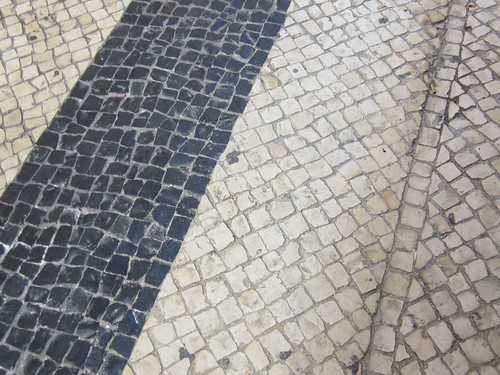
1. Portuguese sidewalks are made of calçada[1] which is really just a whole lot of similar, mostly square, stones laid out in a grid. Many of the websites that talk about it address the art/mosaic qualities it sometimes has: In downtown Lisboa, the sidewalks have all sorts of designs. In Tomar, they were Templar crosses. But those are in the historic districts, not the regular neighborhoods. In the rest of the country, it’s just plain yellow stones. Here’s a pic.

Calçada

Yeah, it’s not flat. I’m sure it’s super-sturdy and resilient, but man is it unfriendly to feet and bicycle tires.

2. Here’s how you order coffee in Lisboa:
Bom dia. Queria um cafe, fazh favor.
Pronounced: “Bohn DEEya. Keh-REE-ya oon caff-ay, fazh fav-or”
Translated: Good day. I would like one coffee, please.

If you want two coffees, you say “doysh” cafe. For three, “traysh” cafe. “Doysh” has become my new favorite word.

The “cafe” you get is a straight espresso shot in a tiny cup, with a packet of sugar on the side. To get other kinds of coffee, check this out: http://americaninportugaltours.com/how-to-order-savor-coffee-in-portugal/

3. If it’s after noon, you can switch out “cafe” for “imperial” (imp-ear-ee-AHL), which is a schooner of beer. The house beer is generally a light bock. If you want a full pint, you order something else, which I don’t remember because I’ve never ordered one.

But that’s only in the southern part of the country. In the north, it’s something else.

4. It seems to me that Portuguese sounds like a mix of Spanish and Russian.

5. Lisboa has pushed my tolerance for funny waiters who do intrusive comedy routines into the red zone. Let’s consider this an opportunity for my personal growth.

6. Portugal, Brazil, and several other Portuguese-speaking countries recently enacted an agreement that would bring their different versions of the language into one. A number of changes and simplifications have been made with regards to the way people spell certain vowel sounds, and with the elimination of silent letters in words. However, the weirdest thing is that Portuguese now includes letters it didn’t have before: K, W, and Y.

Looking around at all the Portuguese signs on stores and on book covers, I have never seen those letters used, ever. The only place I’ve seen them is in English language text and in graffiti. Google tells me that “GWK”, which is all over the place here, stands for “Graffiti Word Krew.”

7. Portugal has a lot of graffiti.

[1] pronounced “cal-SAH-da” I believe. In Portuguese, the “C” always makes a “K” sound when the vowel that follows it is an “A”, “O”, or “U”. If the vowels that follow it are an “E” or “I”, it makes an “S” sound.

But what if you want an “S” sound in the middle of a word with a following “A”, “O”, or “U”? Then, you change the “C” to an “Ç”. That’s a “cedilla” https://en.wikipedia.org/wiki/Ç

“Business! Mankind was my business” Annual repost.

Standard

This is my annual repost of my favorite version of A Christmas Carol, animated for TV.

If the embedding doesn’t work, the link is here.

It’s only 25 minutes long, but it’s full of amazing creative choices: Scrooge’s candle on the dark stair, Ignorance and Want, the transitions that Scrooge takes with the Ghost of Christmas Past, the hands, the waves and clouds, and so many other things.

Really beautiful. If you haven’t seen it before, treat yourself.

Portugal, Day Eight

Standard

It’s always challenging to cook in someone else’s kitchen, right? Well, I impressed myself with today’s pepperoni frittata. Let’s pretend you tasted it and were impressed, too.

Today was a prep day. My wife and her sister have a friend flying in from Italy—a friend they haven’t seen in years and years, but have kept in touch with—and they’ve decided to surprise him with a traditional American Thanksgiving meal: roast turkey, sausage stuffing, cranberries, mashed potatoes, apple pie, the whole deal.

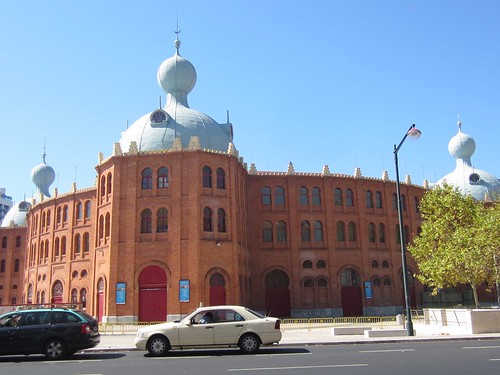
But first, supplies: I was excited to go to the old bull-fighting ring with my son. There was a food court where he and I could sit with our laptops and while away a few hours, and there was shopping to be done.

Unfortunately, the bull-fighting ring was mostly a shopping mall, and the food court was cramped and noisy as hell. To me, it was just an indistinguishable clamor, but it really bothered my son. We tried to slip away to a quieter place, but their internet wasn’t working. In the end, we just went back to the apartment and did a little work. Too bad. I would have liked to have pretended part of my new book was written in a bull-fighting ring, even if no one knew the truth.

Oh, and there was a bookstore but nothing I could read, of course.

Lots of quiet and lots of cooking today.

Portugal, Day Eight

Portugal, Day Seven (and on the seventh day…)

Standard

You know what’s nice? Taking it easy. I’m not a kid anymore and we’re in Portugal for a full month. I don’t need to rush every day. In fact, a little downtime to get some writing done is just the thing.

I spent the morning working quietly in the lobby of the Residencial Uniao, our “guest house.” The chairs were very comfortable, and for once I didn’t just nod off in one of them. Then we caught a train back to Lisboa, carried all our stuff into my sister-in-law’s apartment, and I fell over into a deep sleep for several hours.

That eventing we had leftovers from the fridge: chili, octopus and rice, good bread…

Actually, have I talked about the bread in Portugal? The local word is pão.

It’s incredible. As troublesome as we sometimes find the food here, the bread is always first-rate.

Anyway, we played another game of iota, then had quiet time. A day off. It was nice.

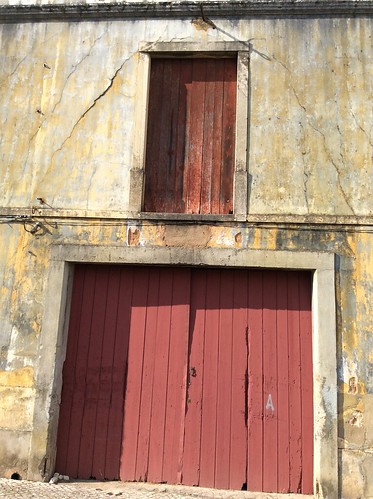
Here’s a picture of an old building. If you like decayed places, Portugal is the place for you.

Old things

Honey-glazed onions: a Turkey Day tradition

Standard

My wife loves this recipe. I make it every year as part of our Turkey Day celebration, and every year it wins the award for Least Likely To Become Leftovers. It’s also the only part of my dinner that’s sweet. We don’t do the yams with marshmallow thing, and the pies we eat for dessert always come hours later.

While in Portugal, I made this for my sister-in-law when she organized a Thanksgiving dinner for an American friend who’d been living in Italy for many years. I promised to give her the recipe, but I forgot. Here it is, converted to European measurements.

.5 kg small boiling onions
75 grams butter
40 grams honey
salt

Bring a big pot of water to a boil, add the onions, and boil for 5 minutes if they’re really small, 8-10 if they’re big.

Drain and cool, then peel them. The easiest way to peel them is to cut the root base almost all the way through, then pull off a strip of the outer layer, then peel off the outer skin. (I do this part the day before, usually).

On the day of, melt the butter in a skillet large enough to hold the onions in a single layer. Medium heat. When the butter stops fizzing, add the onions and then the honey. Stir until everything is well combined.

The original recipe said they were done when slightly browned, but I cook them way past that point. I cook them until the glaze is dark, dark brown and incredibly thick, and the onions are basically falling apart.